

Manipulation of elliptically polarized terahertz emission and second-harmonic generation in chiral metamaterial
-
摘要:
基于超材料的非线性光学效应研究,对新型光电子器件的开发具有重要意义。超材料因其可设计性在非线性光学领域展现出独特优势,但在单一结构中同时实现椭圆偏振太赫兹波辐射与二次谐波产生仍面临挑战。本文设计了一种具有3阶旋转对称性(C3)的超材料,分别研究在线偏振光与圆偏振光泵浦条件下,该超材料及其镜像结构太赫兹波与二次谐波辐射特性。结果表明,所设计的超材料可同时实现椭圆偏振太赫兹波辐射和二次谐波产生,其旋转方向和椭圆偏振程度可通过椭偏率进行量化表征。仿真结果显示:在右旋圆偏振光泵浦下,右旋手性构型(R构型)超材料具有最高的太赫兹辐射椭偏率,达到−0.167,对应左旋椭圆偏振太赫兹波;在垂直方向线偏振光泵浦下,R构型超材料二次谐波辐射椭偏率最大,最高可达0.845,对应右旋椭圆偏振二次谐波。2种构型超材料二次谐波产生的转化效率均高于太赫兹辐射,这取决于超材料共振响应对二阶非线性电流的影响。该研究为片上集成式非线性椭圆偏振光产生器件的设计提供了新思路。
Abstract:Nonlinear optical effects based on metamaterials are of great significance for the development of optoelectronic devices. Metamaterials offer significant advantages in nonlinear optics due to their designable properties, it remains challenging to design structures capable of generating elliptically polarized terahertz emission and second-harmonic generation within a single structure. This study designs a metamaterial with 3-fold rotational symmetry (C3) and investigates the characteristics of terahertz emission and second-harmonic generation under linearly and circularly polarized light pumping for both the metamaterial and its mirrored symmetric structure. The results show that the metamaterial can simultaneously achieve elliptically polarized terahertz waves and second-harmonic generation, where the rotation direction and ellipticity of elliptically polarized light can be quantitatively characterized by ellipticity. The simulation results show that under right-circularly polarized pumping, the right-handed chiral structure (R-structure) metamaterial exhibits the highest terahertz radiation ellipticity of −0.167, corresponding to left-handed elliptically polarized terahertz waves. Under vertically polarized light pumping, the second-harmonic radiation ellipticity of R-structure is the highest, reaching up to 0.845, corresponding to right-handed elliptically polarized second-harmonic. The conversion efficiency of second-harmonic generation in both metamaterials is higher than that of terahertz radiation, which is attributed to the resonant response of the metamaterial influenced the second-order nonlinear current. This study provides new ideas for the design of on-chip integrated nonlinear ellipsoidal polarization generating devices.
-
0. 引言
超材料,又称超构材料,是一种人工设计的亚波长微纳结构阵列,具有天然材料不具备的特殊物理性质[1]。其概念最初源于负折射率与负磁导率的理论构想,早期常被称作“左手材料”或“负折射率超材料”。在线性光学领域,超材料可突破传统材料的固有性能限制,实现完美吸收、负折射率、隐身及手性效应等独特物理现象[2-4]。在非线性光学领域,超材料同样具有重要的应用价值,可通过非线性差频过程产生太赫兹(terahertz,THz)辐射[5],也可利用光学倍频效应实现二次谐波产生(second-harmonic generation,SHG)[1]等。此外,超材料结构具有高度灵活的可设计性,在非线性光振幅、相位与偏振调控方面具有重要的研究价值。实验方面,Luo等[5]研究了纳米级开口谐振环在不同电磁模式的THz辐射特性,并在此基础上进一步探究了开口环的宽带THz辐射特性;Ellenbogen团队围绕超材料THz辐射产生[6-7]、动态调控[8-9]以及功能器件研制[10-13]等方向开展了系统性研究;Li团队研究了多种一重、二重、三重等不同旋转对称性的金属超材料,显示其在不同偏振状态泵浦下的飞秒脉冲光具有优异的二次[1,14-15]及三次谐波[16-17]非线性响应,并基于其对左、右旋光及线偏振光的特异性响应,归纳提出超材料选择定则[18],进而实现对谐波信号的偏振及相位调控[19-20]。在仿真研究中,Fang等[21-22]采用电子流体动力学模型,将金属自由电子气模型、电子连续性方程与麦克斯韦方程组相结合,计算了金开口谐振环的宽带THz辐射。然而,目前针对超材料二阶非线性光学响应的研究大多仅聚焦于THz辐射或SHG单一效应,鲜有工作同时研究超材料THz辐射与SHG。同时,超材料激发椭圆偏振太赫兹辐射的内在机制与调控特性,目前仍有待深入探究。
针对上述问题,本文设计了一种基于纳米级3阶旋转对称性(C3)超原子和SiO2基底构成的超材料结构,该结构包含2种手性构型,单元结构为右旋手性的超材料命名为R构型,单元结构为左旋手性的超材料命名为L构型。首先研究了2种构型在900~1 300 nm的线性透射、反射及吸收特性,结果表明,R构型在1 000 nm附近出现明显共振吸收峰,其值达到39.3%,L构型在同一波长处的共振吸收峰值为37.0%。在此基础上,系统研究了在1 000 nm飞秒脉冲光激发下2种构型的椭圆偏振THz辐射和椭圆偏振SHG特性:THz辐射方面,R构型在水平方向(沿x方向)线偏振光泵浦下可产生右旋椭圆偏振THz辐射,L构型在右旋圆偏振光(right-circularly polarized,RCP)泵浦下同样产生右旋椭圆偏振THz辐射;SHG方面,任意光激发R构型均能产生右旋椭圆偏振光,其中在RCP泵浦下R构型的倍频响应最强,且在垂直方向(沿y方向)偏振光泵浦下,R构型出射SHG的椭偏率达到0.845,已接近圆偏SHG。研究表明,出射SHG的椭偏率普遍大于THz辐射的椭偏率,这是由于超材料中SHG的转换效率更高,使其产生的椭圆偏振二次谐波具有更大的椭偏率。该研究结果可为片上椭圆偏振THz辐射源及SHG源的设计提供有效方法与理论参考。
1. 超材料结构设计及理论模型
本文设计了一种具有C3旋转对称性的超材料及其镜像结构,该结构不具有空间反演对称性,适用于研究其在飞秒脉冲光正入射下的二阶非线性响应。图 1(a)为2种构型在飞秒脉冲光激发下产生的THz辐射与SHG信号,图 1(b)为右旋手性结构,记为R构型,图 1(c)为左旋手性结构,记为L构型。该超材料周期单元沿六边形的形式排布,六边形周期长度w=300 nm,超材料各边长a=40 nm,b=100 nm,c=120 nm,d=80 nm,e=60 nm,超材料厚度为50 nm,基底厚度为250 nm。值得注意的是,虽然R和L构型均具有C3旋转对称性,但受开口环特定朝向的影响,二者互为镜像且无法通过平面内旋转实现重合,因而满足严格意义上的手性特征。
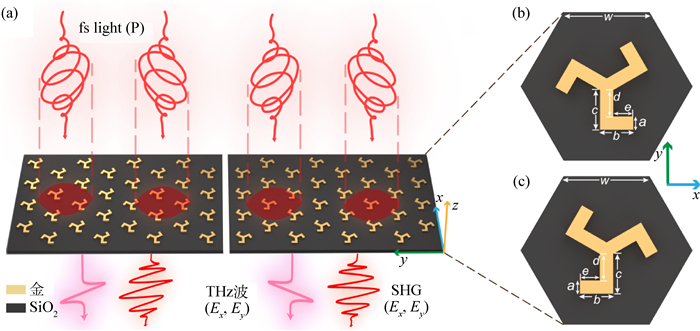 图 1 不同构型超材料在飞秒脉冲激发下产生的THz波辐射和SHG及单元构型注:fs light(P)为入射P偏振飞秒脉冲;SHG为二次谐波产生;E为电场沿x方向分量;E为电场沿y方向分量;w、a、b、c、d和e为超材料各边长。
(a)THz与SHG产生示意;(b)R构型周期单元;(c)L构型周期单元Fig. 1 terahertz wave radiation and SHG from different structures excited by femtosecond pulses and unit structure(a) schematic of THz and SHG generation; (b) periodic unit of R-structure; (c) periodic unit of L-structure 下载:
全尺寸图片
在线性仿真中,通过在z方向设置散射边界条件与完美匹配层,以避免入射光被边界反射影响计算结果,同时在超材料周边采用周期性边界条件,以模拟xy平面内无限大超材料周期性阵列。在高频波段下,金的振荡模式可通过Drude模型[23]进行表征
$$ \varepsilon_ {\omega} = \varepsilon_ {\infty}-\frac {\omega_ {\mathrm{p}} ^ {2}}{\omega^ {2} + j \gamma \omega}, $$ (1) 式中:高频介电常数ε∞ = 9;等离子振荡频率$ \omega_{\mathrm{p}}=\sqrt{n_0 e^2 /\left(\varepsilon_0 m_e\right)}=1.37 \times 10^{16} $ rad/s;金的本征电子密度n0= 5.92×1028 m-3;等离子体阻尼频率γ=1.068×10¹⁴ rad/s[24]。SiO2基底的介电常数ε = 2.25。
为描述外界光场作用下超材料非线性光学响应,采用基于麦克斯韦-流体动力学模型的自洽方程组[22,25-27]。在电磁场作用下,超材料中被激发的自由电子运动可描述为:
$$ \frac{\partial \boldsymbol{v}}{\partial t}+(\boldsymbol{v} \cdot \nabla) \boldsymbol{v}=-\frac{e}{m_e}(\boldsymbol{E}+\boldsymbol{v} \times \boldsymbol{B})-\gamma \boldsymbol{v}-\frac{\nabla p}{m_e n}, $$ (2) $$ \partial_t n+\nabla \cdot(n \boldsymbol{v})=0,$$ (3) 式中:E为泵浦电场振幅;n为金的电子密度;ev × B是洛伦兹项;v和me分别是电子速度和电子有效质量;γ是电子衰减频率;∇p是量子压力项,其中p = (3π2)2/3·(ℏ2/5me)·n5/3,可由托马斯-费米理论计算得到[28]。由于超材料具有较弱的磁响应,洛伦兹项和量子压力项对二阶非线性效应的影响可以被忽略[29-30]。(v·∇)v是对流加速项,这一项对金属超材料的二阶非线性响应起主要作用[31]。超材料中非线性极化率(P)与极化电流(J)的关系满足
$$ \frac {\partial P}{\partial t} = J =-e n \boldsymbol{v} 。 $$ (4) 在仿真中,通过沿z轴正入射的飞秒脉冲光激发超材料样品面,并在基底面探测THz与SHG信号。高斯飞秒脉冲光的电场设置为$ \boldsymbol{E}=\boldsymbol{E}_0 \exp \left[-2 \ln 2\left(\left(t-t_0\right) / \tau\right)^2\right] \cdot \cos (\omega t)$,其中设置脉宽τ=100 fs,延迟时间t0=500 fs;入射激光的峰值振幅E0=2×10⁸ V/m,角频率(ω)与入射波长有关,之后在远场设置边界探针,用于探测超材料产生的THz波与SHG信号。
2. 结果与讨论
2.1 C3对称性超材料的线性响应
为得到R和L构型的线性光学响应,首先计算2种构型在900~1 300 nm光谱范围内的吸收率、反射率及透射率曲线。如图 2(a)所示,沿平行方向泵浦时,R构型于1 000 nm处达到最高吸收率39.3%,表明该波长激发下R构型具有较强的电磁共振响应。图 2(c)为R构型在1 000 nm光泵浦下的电场分布,结果表明电场主要分布在超材料的A1、A2两臂,且在A1臂处出现明显的强电场局域。图 2(c)展示了L构型在1 000 nm处的吸收率为37.0%,电场主要局域在A1、A3两臂。结合图 2(c)中L构型电场分布特征分析可知,与R构型相比,L构型在1 000 nm处两臂局域的电场强度较小,这使得L构型的光子共振效应弱于R构型,从而导致吸收率低于R构型。
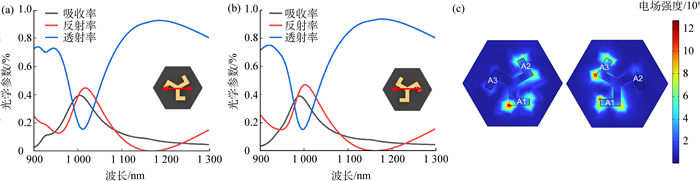 图 2 R和L构型的反射、吸收和透射光谱及电场分布注:图(a、b)中内嵌红色双向箭头代表泵浦光偏振方向;A1、A2和A3分别表示3个臂。
(a)R构型反射率、吸收率及透射率;(b)L构型反射率、吸收率及透射率;(c)R、L构型在1 000 nm光泵浦时电场分布Fig. 2 reflectance, absorptance and transmittance spectra and electric field distribution of R- and L-structure metamaterials(a) reflectance, absorptance and transmittance of the R-structure; (b) reflectance, absorptance and transmittance of the L-structure; (c) electric field distribution of R- and L-structure under 1 000 nm fs excitation下载:
全尺寸图片
2.2 C3对称性超材料THz波辐射特性
基于2.1节对超材料线性光学响应的分析,该超材料在1 000 nm处存在线性吸收峰,表明此波长处存在电磁共振响应,因此选择该波长作为泵浦光,以激发超材料产生二阶非线性响应。图 3为1 000 nm(R构型共振吸收峰)线偏振和圆偏振飞秒脉冲光正入射R构型和L构型的THz辐射时域谱,内嵌图为THz辐射$ E _ { x } ^ { \mathrm { T H z } } $与$ E _ { y } ^ { \mathrm { T H z } } $分量的偏振椭圆合成。RCP光垂直分量(y分量)的相位通常比水平分量(x分量)滞后π/2,而左旋圆偏振(left-circularly polarized,LCP)光垂直分量(y分量)相位通常比水平分量(x分量)超前π/2。因此,圆偏振光飞秒脉冲光在时域仿真中可由电场定义为ERCP/LCP = (E1,E2 ±,0),E1和E2±表达式分别为:
$$ E _ {1} = E _ {0} \exp \left[-2 \ln 2 \left(\left(t-t _ {0}\right)/\tau\right) ^ {2} \right] \cdot \cos (\omega t), $$ (5) $$ E _ {2} \pm = E _ {0} \exp \left[-2 \ln 2 \left(\left(t-t _ {0}\right)/\tau\right) ^ {2} \right] \cdot \cos \left(\omega t \mp \frac {{\rm{ \mathsf{ π} }}}{2}\right), $$ (6) 式中:E1和E2±分别为入射电场的x和y分量,可以构成圆偏振及椭圆偏振飞秒脉冲;E0为电场峰值振幅;ω为电场角频率;t0为脉冲延迟时间,τ为脉宽,整个仿真时间为1 ps,时间步长为0.2 fs。通过计算RCP和LCP飞秒泵浦光在空气层中的传输特性,确保入射泵浦光为严格的圆偏振光,仿真中泵浦光的振幅和相位误差可忽略。
图 3(a)为沿x方向线偏振光激发R构型的THz辐射。沿x方向出射的THz辐射时域波形呈现谷-峰特征,其振幅$ E _ { x } ^ { \mathrm { T H z } } $分量取负值为−6.0 V/m;沿y方向$ E _ { y } ^ { \mathrm { T H z } } $分量振幅为−12.3 V/m。为评估超材料产生椭圆偏振THz辐射能力,计算了椭圆THz辐射椭偏率(φ),在光学中其表达式为
$$ \varphi = \frac {E _ {\mathrm{b}}}{E _ {\mathrm{a}}}, $$ (7) 式中:Eb为偏振椭圆的短轴长度;Ea为偏振椭圆的长轴长度。当φ > 0时,产生的椭圆偏振THz辐射为右旋,反之则产生左旋偏振的THz辐射。图 3(a)中内嵌图表明,在x方向线偏振光泵浦下,R构型可产生右旋椭圆偏振THz辐射,经拟合φ=0.042。表 1为各偏振光泵浦下R和L构型的THz辐射ExTHz和$ E _ { \nu } ^ { \mathrm { T H z } } $分量的振幅和φ拟合结果。值得注意的是,在线偏振光激发条件下,2种构型超材料在沿x和y方向线偏振光泵浦时,ETHz分量会发生极化反转现象,如图 3(a、b)与图 3(e、f)中$ E _ { x } ^ { \mathrm { T H z } } $分量所示,而$ E _ { y } ^ { \mathrm { T H z } } $分量只有大小会发生变化,但不会发生极化反转,如图 3(a、b)与图 3(e、f)中$ E _ { y } ^ { \mathrm { T H z } } $分量所示,这与线偏振光泵浦的方向有关。由于THz波辐射分量的差异,R和L构型在沿x方向线偏振光泵浦下产生的椭圆偏振THz辐射旋转方向相反,如图 3(a、e)内嵌图所示;在沿y方向线偏振光泵浦下产生左旋椭圆偏振THz辐射,如图 3(b、f)所示。在圆偏振光激发条件下,实验结果表明:RCP光泵浦时,2种手性构型均产生椭圆偏振THz辐射,如图 3(c、g)所示;LCP光泵浦时,R与L构型分别获得最大THz辐射$ E _ { y } ^ { \mathrm { T H z } } $分量,如图 3(d、h)所示,峰值分别达到−30.5与−17.5 V/m。在LCP光泵浦下,R与L构型几乎不产生椭圆偏振THz辐射,尤其是L构型,其φ在所有泵浦条件下均为最低,仅为−0.003。此外,R构型在圆偏振光激发下产生左旋椭圆偏振THz辐射,同理RCP泵浦L构型仅产生右旋椭圆偏振THz辐射,这与C3超原子A1、A2和A3臂开口朝向有关。
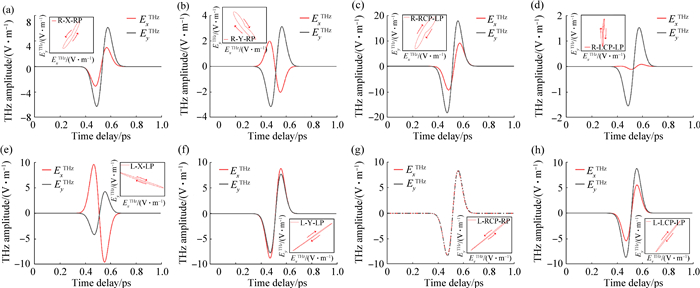 图 3 R和L构型超材料经飞秒脉冲激发后THz辐射特性及偏振合成椭圆注:插图为ExTHz和EyTHz分量的偏振合成椭圆;箭头代表THz波的偏振旋转方向;R(L)-X(Y、LCP、RCP)-RP(LP)表示R(L)构型在x(y、LCP、RCP)方向线偏振光泵浦下产生右旋(左旋)THz辐射。
(a、b)R构型在x和y方向线偏振光;(c、d)R构型在RCP和LCP飞秒脉冲泵浦下THz辐射$ E _ { x } ^ { \mathrm { T H z } } $和$ E _ { y } ^ { \mathrm { T H z } } $分量;(e、f)L构型在x和y方向线偏振光;(g、h)L构型在RCP和LCP飞秒脉冲泵浦下THz辐射$ E _ { x } ^ { \mathrm { T H z } } $和$ E _ { y } ^ { \mathrm { T H z } } $分量Fig. 3 THz radiation characteristics and polarization-synthesized elliptical states of R- and L-structure excited by femtosecond pulses(a、b) linearly polarized light in x and y directions for R-structure; (c、d) THz radiation $ E _ { x } ^ { \mathrm { T H z } } \ \mathrm { a n d }\ E _ { y } ^ { \mathrm { T H z } } $ component of Rstructure under RCP and LCP femtosecond pulse pumping; (e、f) linearly polarized light in x and y directions for L-structure; (g、h) THz radiation ExTHz and EyTHz component of L-structure under RCP and LCP femtosecond pulse pumping下载:
全尺寸图片
表 1 C3对称性R和L构型超材料THz辐射分量振幅与椭偏率Table 1 amplitude of THz radiation components and THz radiation ellipticity of C3 sy mmetric R- and L-structure metamaterials构型 泵浦光 $ E_{x}^{\text{THz}} $振幅/(V·m-1) $ E_{y}^{\text{THz}} $振幅/(V·m-1) 椭偏率 R x方向偏振 -6.0 -12.3 0.042 y方向偏振 4.0 -6.3 -0.097 RCP -3.6 -7.1 -0.167 LCP -1.7 -30.5 -0.032 L x方向偏振 3.8 -1.7 -0.045 y方向偏振 -17.7 -15.5 -0.012 RCP -16.7 -16.7 0.016 LCP -11.2 -17.5 -0.003 注:C3表示3阶旋转对称性;RCP为右旋圆偏振光;LCP为左旋圆偏振光; $ E _ { x } ^ { \mathrm { T Fz } } $和$ E _ { y } ^ { \mathrm { T H z } } $分别为超材料经飞秒偏振光激发后沿x和y方向的THz辐射电场振幅分量。 2.3 C3对称性超材料SHG特性
与THz辐射类似,SHG也是二阶非线性光学响应[32],二者区别在于,超材料中THz辐射由二阶非线性差频效应产生,而二次谐波则由倍频效应产生。因为C3超原子不具有空间反演对称性,在飞秒脉冲光正入射条件下可产生二次谐波。图 4(a)为x方向线偏振光泵浦下,R和L构型所产生的椭圆偏振SHG信号,其出射SHG在x方向分量$ \ \left|E_x^{\mathrm{SHG}}\right| $ = 4 647.7 V/m,在y方向分量$ \left|E_y^{\mathrm{SHG}}\right| $ = 2 245.3 V/m,并且出射二次谐波具有右旋椭圆偏振辐射特性,经拟合得到φ=0.384。表 2为沿x和y方向线偏振光和圆偏振光泵浦下R和L构型SHG各分量振幅和φ。在线偏振光激发下,如图 4(a、b)所示,R和L构型出射的椭圆偏振SHG具有相反符号的φ,表明二者的偏振旋转方向相反,这是由于R和L构型开口环开口方向相反导致。此外,在y方向偏振光泵浦下,R构型产生的右旋椭圆偏振SHG的φ达到0.845(图 4(b)),表明其具有产生近圆偏SHG的优异潜力。在圆偏振光激发下,如图 4(c、d)所示,R和L构型均辐射出右旋椭圆偏振二次谐波,并且RCP泵浦R构型具有最强$ \left|E_x^{\mathrm{SHG}}\right| $振幅,达到7 328.0 V/m,对应SHG的φ可达0.425(图 4(c))。当LCP光泵浦R构型时(图 4(d)),与RCP泵浦下的椭圆偏振SHG对比,其SHG各分量振幅与φ均出现显著下降,$ \left|E_x^{\mathrm{SHG}}\right| $和$ \left|E_y^{\mathrm{SHG}}\right| $降幅分别接近56%和18%,φ由0.425变为0.045,这与超材料构型对圆偏光的选择性响应有关[17]。总体而言,在任意线偏振光与圆偏振光激发下,R构型均会产生右旋椭圆偏振二次谐波,且其SHG响应强度显著优于L构型,这与2种构型在1 000 nm波长处的吸收率相关。相比于椭圆偏振THz辐射,椭圆偏振SHG的φ明显更高,且在相同泵浦光激发下,THz电场振幅分量均低于SHG电场振幅分量。因此,SHG具有更高的转换效率,其产生的椭圆偏振二次谐波的φ也显著高于THz辐射。
 图 4 R和L构型超材料在不同偏振光激发下SHG特性注:R(L)-X(Y、LCP、RCP)-RP(LP)表示R(L)构型在x(y、LCP、RCP)方向线偏振光泵浦下产生右旋(左旋)SHG
(a、b)x和y方向线偏振光;(c、d)RCP和LCP飞秒光泵浦下$ \left|E_x^{\mathrm{SHG}}\right|$与$ \left|E_y^{\mathrm{SHG}}\right|$分量合成的二次谐波偏振椭圆Fig. 4 SHG characteristics of R- and L-structure metamaterials under excitation with different polarization states(a、b) linearly polarized light in x and y directions; (c、d) SHG polarization ellipses reconstructed from the $ \left|E_x^{\mathrm{SHG}}\right| \text { and } \left|E_y^{\mathrm{SHG}}\right| $ components under RCP and LCP femtosecond pulse pumping下载:
全尺寸图片
表 2 C3对称性R和L构型超材料SHG分量振幅与椭偏率Table 2 SHG component amplitudes and ellipticity of C3 symmetric R- and L-structure metamaterials构型 泵浦光 $ |E_x^{\text{SHG}}| $振幅/(V·m-1) $ |E_y^{\text{SHG}}| $振幅/(V·m-1) 椭偏率 R x方向偏振 4 647.7 2 245.3 0.384 y方向偏振 1 596.1 1 806.2 0.845 RCP 7 328.0 3 914.8 0.425 LCP 3 265.9 3 214.9 0.045 L x方向偏振 643.0 201.7 -0.242 y方向偏振 846.3 2 031.9 -0.088 RCP 1 430.0 1 897.4 0.267 LCP 840.5 2 076.5 0.193 注:$ \left|E_x^{\mathrm{SHG}}\right|\text{和}\left|E_y^{\mathrm{SHG}}\right| $为超材料经飞秒偏振光激发后沿x和y方向SHG辐射电场振幅分量的绝对值。 3. 结束语
本文设计了一种由纳米级C3旋转对称性超原子和SiO2基底构成的超材料及其镜像结构,根据其开口方向分别命名为R构型和L构型。基于线性光学和非线性光学仿真,系统研究了2种构型在900~1 300 nm波段的透射、反射及吸收特性。结果表明,2种构型在1 000 nm附近具有共振吸收峰,分别达到39.3%和37.0%(R/L构型)。进一步探究了1 000 nm线偏振和圆偏振飞秒脉冲光激发下,2种构型的椭圆偏振THz辐射和椭圆偏振SHG响应特性。在THz辐射方面,R构型在沿x方向线偏振泵浦下可产生右旋椭圆偏振THz,L构型在RCP泵浦下同样产生右旋椭圆偏振THz,在其他偏振光激发下2种构型均可产生右旋椭圆偏振THz。在SHG方面,x、y方向线偏振光激发时,2种构型SHG椭圆极化方向相反,且任意偏振光激发下,R构型均产生右旋椭圆偏振光。当R构型沿y方向偏振光泵浦时,其SHG的φ达到0.845,这在所有仿真结果中,最接近圆偏SHG辐射的情况,而产生二次谐波φ大于THz辐射的原因在于二次谐波的高转换效率。同时,出射SHG的φ普遍大于THz辐射,这与差频和倍频的二阶非线性响应过程相关。该超材料结构有望设计成为集成化椭圆偏振THz光源和非线性偏振调控器件,在手性物质检测与识别、THz椭圆偏振光谱成像以及非线性偏振光谱等领域具有重要的应用潜力。
© The editorial department of Journal of Capital Normal University (Natural Science Edition) 2026.This is an open access article under the CC BY-NC-ND 4.0 license (https://creativecommons.org/licenses/by-nc-nd/4.0/). -
图 1 不同构型超材料在飞秒脉冲激发下产生的THz波辐射和SHG及单元构型
注:fs light(P)为入射P偏振飞秒脉冲;SHG为二次谐波产生;E为电场沿x方向分量;E为电场沿y方向分量;w、a、b、c、d和e为超材料各边长。
(a)THz与SHG产生示意;(b)R构型周期单元;(c)L构型周期单元Fig. 1 terahertz wave radiation and SHG from different structures excited by femtosecond pulses and unit structure
(a) schematic of THz and SHG generation; (b) periodic unit of R-structure; (c) periodic unit of L-structure
下载:
全尺寸图片
图 2 R和L构型的反射、吸收和透射光谱及电场分布
注:图(a、b)中内嵌红色双向箭头代表泵浦光偏振方向;A1、A2和A3分别表示3个臂。
(a)R构型反射率、吸收率及透射率;(b)L构型反射率、吸收率及透射率;(c)R、L构型在1 000 nm光泵浦时电场分布Fig. 2 reflectance, absorptance and transmittance spectra and electric field distribution of R- and L-structure metamaterials
(a) reflectance, absorptance and transmittance of the R-structure; (b) reflectance, absorptance and transmittance of the L-structure; (c) electric field distribution of R- and L-structure under 1 000 nm fs excitation
下载:
全尺寸图片
图 3 R和L构型超材料经飞秒脉冲激发后THz辐射特性及偏振合成椭圆
注:插图为ExTHz和EyTHz分量的偏振合成椭圆;箭头代表THz波的偏振旋转方向;R(L)-X(Y、LCP、RCP)-RP(LP)表示R(L)构型在x(y、LCP、RCP)方向线偏振光泵浦下产生右旋(左旋)THz辐射。
(a、b)R构型在x和y方向线偏振光;(c、d)R构型在RCP和LCP飞秒脉冲泵浦下THz辐射$ E _ { x } ^ { \mathrm { T H z } } $和$ E _ { y } ^ { \mathrm { T H z } } $分量;(e、f)L构型在x和y方向线偏振光;(g、h)L构型在RCP和LCP飞秒脉冲泵浦下THz辐射$ E _ { x } ^ { \mathrm { T H z } } $和$ E _ { y } ^ { \mathrm { T H z } } $分量Fig. 3 THz radiation characteristics and polarization-synthesized elliptical states of R- and L-structure excited by femtosecond pulses
(a、b) linearly polarized light in x and y directions for R-structure; (c、d) THz radiation $ E _ { x } ^ { \mathrm { T H z } } \ \mathrm { a n d }\ E _ { y } ^ { \mathrm { T H z } } $ component of Rstructure under RCP and LCP femtosecond pulse pumping; (e、f) linearly polarized light in x and y directions for L-structure; (g、h) THz radiation ExTHz and EyTHz component of L-structure under RCP and LCP femtosecond pulse pumping
下载:
全尺寸图片
图 4 R和L构型超材料在不同偏振光激发下SHG特性
注:R(L)-X(Y、LCP、RCP)-RP(LP)表示R(L)构型在x(y、LCP、RCP)方向线偏振光泵浦下产生右旋(左旋)SHG
(a、b)x和y方向线偏振光;(c、d)RCP和LCP飞秒光泵浦下$ \left|E_x^{\mathrm{SHG}}\right|$与$ \left|E_y^{\mathrm{SHG}}\right|$分量合成的二次谐波偏振椭圆Fig. 4 SHG characteristics of R- and L-structure metamaterials under excitation with different polarization states
(a、b) linearly polarized light in x and y directions; (c、d) SHG polarization ellipses reconstructed from the $ \left|E_x^{\mathrm{SHG}}\right| \text { and } \left|E_y^{\mathrm{SHG}}\right| $ components under RCP and LCP femtosecond pulse pumping
下载:
全尺寸图片
表 1 C3对称性R和L构型超材料THz辐射分量振幅与椭偏率
Table 1 amplitude of THz radiation components and THz radiation ellipticity of C3 sy mmetric R- and L-structure metamaterials
构型 泵浦光 $ E_{x}^{\text{THz}} $振幅/(V·m-1) $ E_{y}^{\text{THz}} $振幅/(V·m-1) 椭偏率 R x方向偏振 -6.0 -12.3 0.042 y方向偏振 4.0 -6.3 -0.097 RCP -3.6 -7.1 -0.167 LCP -1.7 -30.5 -0.032 L x方向偏振 3.8 -1.7 -0.045 y方向偏振 -17.7 -15.5 -0.012 RCP -16.7 -16.7 0.016 LCP -11.2 -17.5 -0.003 注:C3表示3阶旋转对称性;RCP为右旋圆偏振光;LCP为左旋圆偏振光; $ E _ { x } ^ { \mathrm { T Fz } } $和$ E _ { y } ^ { \mathrm { T H z } } $分别为超材料经飞秒偏振光激发后沿x和y方向的THz辐射电场振幅分量。 表 2 C3对称性R和L构型超材料SHG分量振幅与椭偏率
Table 2 SHG component amplitudes and ellipticity of C3 symmetric R- and L-structure metamaterials
构型 泵浦光 $ |E_x^{\text{SHG}}| $振幅/(V·m-1) $ |E_y^{\text{SHG}}| $振幅/(V·m-1) 椭偏率 R x方向偏振 4 647.7 2 245.3 0.384 y方向偏振 1 596.1 1 806.2 0.845 RCP 7 328.0 3 914.8 0.425 LCP 3 265.9 3 214.9 0.045 L x方向偏振 643.0 201.7 -0.242 y方向偏振 846.3 2 031.9 -0.088 RCP 1 430.0 1 897.4 0.267 LCP 840.5 2 076.5 0.193 注:$ \left|E_x^{\mathrm{SHG}}\right|\text{和}\left|E_y^{\mathrm{SHG}}\right| $为超材料经飞秒偏振光激发后沿x和y方向SHG辐射电场振幅分量的绝对值。 -
[1] Klein M W, Enkrich C, Wegener M, et al. Second-harmonic generation from magnetic metamaterials[J]. Science, 2006, 313(5786): 502-504. DOI: 10.1126/science.1129198. [2] Wang C H, Kuang D F, Chang S J, et al. A metamaterial terahertz modulator based on complementary planar double-split-ring resonator [J]. Optoelectronics Letters, 2013, 9(4): 266-269. DOI: 10.1007/s11801-013-3041-3. [3] Huang Y W, Kaj K, Chen C X, et al. Broadband terahertz silicon membrane metasurface absorber [J]. ACS Photonics, 2022, 9(4): 1150-1156. DOI: 10.1021/acsphotonics.2c00166. [4] Dong X X, Luo X Q, Zhou Y X, et al. Switchable broadband and wide-angular terahertz asymmetric transmission based on a hybrid metal-VO2 metasurface[J]. Optics Express, 2020, 28(21): 30675. DOI: 10.1364/oe.405173. [5] Luo L, Chatzakis I, Wang J G, et al. Broadband terahertz generation from metamaterials[J]. Nature Communications, 2014, 5: 3055. DOI: 10.1038/ncomms4055. [6] Keren-Zur S, Tal M, Fleischer S, et al. Generation of spatiotemporally tailored terahertz wavepackets by nonlinear metasurfaces[J]. Nature Communications, 2019, 10: 1778. DOI: 10.1038/s41467-019-09811-9. [7] Minerbi E, Sideris S, Khurgin J B, et al. The role of epsilon near zero and hot electrons in enhanced dynamic THz emission from nonlinear metasurfaces[J]. Nano Letters, 2022, 22(15): 6194-6199. DOI: 10.1021/acs.nanolett.2c01400. [8] Minerbi E, Keren-Zur S, Ellenbogen T. Nonlinear metasurface Fresnel zone plates for terahertz generation and manipulation[J]. Nano Letters, 2019, 19(9): 6072-6077. DOI: 10.1021/acs.nanolett.9b01970. [9] McDonnell C, Deng J H, Sideris S, et al. Functional THz emitters based on Pancharatnam-Berry phase nonlinear metasurfaces[J]. Nature Communications, 2021, 12: 30. DOI: 10.1038/s41467-020-20283-0. [10] Sideris S, Minerbi E, McDonnell C, et al. THz radiation efficiency enhancement from metal-ITO nonlinear metasurfaces[J]. ACS Photonics, 2022, 9(12): 3981-3986. DOI: 10.1021/acsphotonics.2c01447. [11] Minerbi E, Sideris S, University T A, et al. Enhancing THz emission from nonlinear metasurfaces by a Bragg perfect absorber [J]. Optics Letters, 2023, 48(11): 2853. DOI: 10.1364/ol.489887. [12] Tal M, Keren-Zur S, Ellenbogen T. Nonlinear plasmonic metasurface terahertz emitters for compact terahertz spectroscopy systems[J]. ACS Photonics, 2020, 7(12): 3286-3290. DOI: 10.1021/acsphotonics.0c01012. [13] Elias E, Sideris S, McDonnell C, et al. Generating angular-varying time delays of THz pulses via direct space-to-time mapping of metasurface structures[J]. ACS Applied Optical Materials, 2023, 1(11): 1783-1790. DOI: 10.1021/acsaom.3c00240. [14] Chen S M, Li G X, Cheah K W, et al. Controlling the phase of optical nonlinearity with plasmonic metasurfaces[J]. Nanophotonics, 2018, 7(6): 1013-1024. DOI: 10.1515/nanoph-2018-0011. [15] Chen S M, Reineke B, Li G X, et al. Strong nonlinear optical activity induced by lattice surface modes on plasmonic metasurface[J]. Nano Letters, 2019, 19(9): 6278-6283. DOI: 10.1021/acs.nanolett.9b02417. [16] Li Y, Zhang G Q, Tang Y T, et al. Third harmonic generation from the gold/amorphous silicon hybrid metasurface[J]. Nanophotonics, 2022, 11(10): 2245-2251. DOI: 10.1515/nanoph-2021-0712. [17] Chen S M, Zeuner F, Weismann M, et al. Giant nonlinear optical activity of achiral origin in planar metasurfaces with quadratic and cubic nonlinearities[J]. Advanced Materials, 2016, 28(15): 2992-2999. DOI: 10.1002/adma.201505640. [18] Chen S M, Li G X, Zeuner F, et al. Symmetry-selective third-harmonic generation from plasmonic metacrystals[J]. Physical Review Letters, 2014, 113(3): 033901. DOI: 10.1103/physrevlett.113.033901. [19] Tang Y T, Deng J H, Li K F, et al. Quasicrystal photonic metasurfaces for radiation controlling of second harmonic generation[J]. Advanced Materials, 2019, 31(23): 1901188. DOI: 10.1002/adma.201901188. [20] McDonnell C, Deng J H, Sideris S, et al. Terahertz metagrating emitters with beam steering and full linear polarization control [J]. Nano Letters, 2022, 22(7): 2603-2610. DOI: 10.1021/acs.nanolett.1c04135. [21] Fang M, Feng J, Xie G D, et al. Nondepleted time-domain method for simulating difference frequency generation from metallic metasurfaces[J]. IEEE Transactions on Microwave Theory and Techniques, 2023, 71(8): 3379-3391. DOI: 10.1109/tmtt.2023.3276448. [22] Fang M, Niu K K, Huang Z, et al. Investigation of broadband terahertz generation from metasurface[J]. Optics Express, 2018, 26(11): 14241. DOI: 10.1364/oe.26.014241. [23] Yang Y, Liu C J, Huang Y Y, et al. Elliptically polarized second-harmonic generation by local magnetic field in terahertz chiral metamaterials[J]. Optics Communications, 2022, 508: 127668. DOI: 10.1016/j.optcom.2021.127668. [24] Liu N, Kaiser S, Giessen H. Magnetoinductive and electroinductive coupling in plasmonic metamaterial molecules[J]. Advanced Materials, 2008, 20(23): 4521-4525. DOI: 10.1002/adma.200801917. [25] McIver J W, Hsieh D, Drapcho S G, et al. Theoretical and experimental study of second harmonic generation from the surface of the topological insulator Bi2Se3 [J]. Physical Review B, 2012, 86(3): 035327. DOI: 10.1103/physrevb.86.035327. [26] Bistritzer R, MacDonald A H. Hydrodynamic theory of transport in doped graphene[J]. Physical Review B, 2009, 80(8): 085109. DOI: 10.1103/physrevb.80.085109. [27] Krasavin A V, Ginzburg P, Wurtz G A, et al. Nonlocality-driven supercontinuum white light generation in plasmonic nanostructures[J]. Nature Communications, 2016, 7: 11497. DOI: 10.1038/ncomms11497. [28] Ginzburg P, Krasavin A V, Wurtz G A, et al. Nonperturbative hydrodynamic model for multiple harmonics generation in metallic nanostructures[J]. ACS Photonics, 2015, 2(1): 8-13. DOI: 10.1021/ph500362y. [29] Wen Y Z, Zhou J. Artificial nonlinearity generated from electromagnetic coupling metamolecule[J]. Physical Review Letters, 2017, 118(16): 167401. DOI: 10.1103/physrevlett.118.167401. [30] Yang G H, Li Z X, Kang Q L, et al. Enhanced magnetic Lorentz force second harmonic generation originating from a double-resonances plasmonic metasurface[J]. Journal of Physics D: Applied Physics, 2021, 54(17): 175110. DOI: 10.1088/1361-6463/abde69. [31] Shi M J, Lei Z, Xi Y Y, et al. Manipulating nonlinear photocurrent from interlayer coupling in bilayer metamaterials for polarized terahertz generation[J]. Annalen der Physik, 2023, 535(12): 2300314. DOI: 10.1002/andp.202300314. [32] Garmire E, Kost A. Nonlinear optics in semiconductors Ⅱ [M]. New York: Academic Press, 1999: 97.
