

Research on solution adsorption theory based on statistical thermodynamics
-
摘要:
溶液吸附理论作为表面化学的核心教学内容,是连接基础化学与工业分离、环境治理、材料制备等应用领域的关键纽带,其教学品质对化学、化工、环境等专业的人才培养至关重要。然而,当前教学与研究中存在显著矛盾,如传统气-固吸附理论(Langmuir分子层吸附理论、Brunauer-Emmett-Teller(BET)多分子吸附理论等)直接套用至溶液体系时,因忽略溶剂效应、顶替效应等溶液特殊性而存在逻辑矛盾,且理论推导复杂、缺乏对非均匀吸附剂及多元溶液等实际体系的覆盖,导致理论与实践脱节。为了填补当前教学资源的空白,本文以统计热力学为核心理论基础,构建了系统完善的溶液吸附理论教学体系。教学中,首先明确3个核心假设:(1)溶液吸附本质为溶质在界面的单分子层吸附,平衡时溶质化学势相等;(2)分子间作用能由范德华力与氢键构成,配位数与组分体积分数成正比;(3)非均匀吸附剂表面为多类活性中心集合,总吸附量为各中心吸附量的线性叠加。基于均一位势模型(液相)与理想势阱模型(吸附态),简化了二元溶液单分子层吸附方程的推导过程,使该方程的物理意义更明确,低浓度时符合亨利定律,高浓度时趋近饱和吸附量,适合单分子层吸附的本质特征。在此基础上,进一步拓展理论边界教学内容,建立了非均匀吸附剂吸附方程与多元溶液吸附方程,为验证理论有效性,同时开展了多维度实验验证。涵盖了苯胺、苯酚和环己醇等7种吸附质与6种不同类型炭材料吸附剂的吸附实验,并结合大量色谱实验、温度效应研究及有机酸、醇类、碱金属离子吸附等体系验证。结果表明理论计算值与实验值高度吻合,证实溶液吸附为单分子层吸附而非传统认知的多分子层吸附。此外,通过骨炭吸附醋酸、硅胶吸附碱金属离子、血炭吸附正丁醇等进一步验证了理论在不同吸附体系中的普适性,明确了温度、分子结构、吸附剂活性中心等因素对吸附行为的影响机制。本文构建的溶液吸附理论体系,不仅为高校相关专业提供了简洁系统的教学工具,帮助学生快速掌握核心原理;同时为实际应用提供了科学指导,在液相色谱保留值预测、吸附分离工艺优化等领域展现出重要应用价值。
Abstract:Solution adsorption theory, as the core teaching content of surface chemistry, serves as a crucial link between fundamental chemistry and application fields such as industrial separation, environmental governance, and material preparation. The quality of its teaching is of vital importance to the cultivation of talents in chemistry, chemical engineering, environmental science, and other related fields. However, there are significant contradictions in current teaching and research. For instance, when traditional gas-solid adsorption theories (such as Langmuir's molecular layer adsorption theory and Brunauer-Emmett-Teller (BET) multi-molecule adsorption theory, etc.) are directly applied to solution systems, logical contradictions arise due to the neglect of the solvent effect, substitution effect and other special properties of solutions. Moreover, the theoretical derivation is complex and lacks coverage of practical systems such as non-uniform adsorbents and multi-component solutions, resulting in a disconnection between theory and practice. To fill the current gap in teaching resources, this paper takes statistical thermodynamics as the core theoretical basis and constructs a systematic and complete teaching system for solution adsorption theory. In teaching, it is essential to first clarify the three core assumptions. (1) The essence of solution adsorption is the monolayer adsorption of solutes at the interface, and the chemical potential of solutes is equal at equilibrium. (2) The intermolecular interaction energy is composed of van der Waals forces and hydrogen bonds, and the coordination number is directly proportional to the volume fraction of the components. (3) The surface of the non-uniform adsorbent is a collection of multiple types of active centers, and the total adsorption capacity is the linear superposition of the adsorption capacities of each center. Based on the uniform potential model (liquid phase) and the ideal potential well model (adsorption state), the derivation process of the monolayer adsorption equation for binary solutions is simplified, making the physical meaning of the equation clearer. At low concentrations, it conforms to Henry's law, and at high concentrations, it approaches the saturated adsorption capacity, which is in line with the essential characteristics of monolayer adsorption. On this basis, the teaching content of the theoretical boundary was further expanded. The adsorption equation of non-uniform adsorbents and the adsorption equation of multi-component solutions were established. To verify the validity of the theory, multi-dimensional experimental verification was carried out simultaneously. The adsorption experiments covered 7 types of adsorbates, including aniline, phenol and cyclohexanol, and 6 types of carbon material adsorbents, and combined a large number of chromatographic experiments, temperature effect studies and system verifications of adsorption of organic acids, alcohols and alkali metal ions. The results show that the theoretical calculated values are highly consistent with the experimental values, confirming that the solution adsorption is monolayer adsorption rather than the multi-molecular adsorption as traditionally understood. In addition, the universality of the theory in different adsorption systems was further verified through the adsorption of acetic acid by bone charcoal, the adsorption of alkali metal ions by silica gel, and the adsorption of n-butanol by blood charcoal, and the influence mechanisms of factors such as temperature, molecular structure, and the active center of the adsorbent on the adsorption behavior were clarified. The theoretical system of solution adsorption constructed in this paper not only provides a concise and systematic teaching tool for related majors in colleges and universities, but also helps students quickly master the core principles. At the same time, it provides scientific guidance for practical applications and demonstrates significant application value in fields such as liquid chromatography retention value prediction and adsorption separation process optimization.
-
0. 引言
溶液吸附作为表面化学的核心内容,是连接基础化学与工业分离、环境治理和材料制备等应用领域的关键桥梁,其理论教学是高等院校化学、化工、环境等专业的重要环节。学习这一理论,不仅能帮助学生理解吸附现象的本质,还能为其在多个科学和工程领域的研究与实践打下坚实的基础。然而,实际教学中存在:一方面,吸附理论中包含了诸多抽象的概念,例如吸附等温线、吸附动力学、表面张力和表面活性剂效应等,这些概念不易被直观感受,学生需要通过理论学习和想象来构建这些概念,从而增加了理解的难度;另一方面,吸附理论往往伴随着复杂的数学模型,如朗缪尔(Langmuir)吸附等温式、Brunauer-Emmett-Teller(BET)方程等,这些模型涉及微积分、概率统计等高级数学知识,要求学生具备扎实的数理基础,否则难以理解模型的推导和应用[1-3]。
国内外教学研究现状调研显示,现有教学资源吸附理论或模型,存在:传统气-固吸附理论与溶液体系的适配性不足,直接套用易出现逻辑矛盾;溶液吸附相关公式推导涉及复杂的统计热力学知识,教学呈现方式不太符合学生认知规律;多元溶液、非均匀吸附剂等实际体系的理论讲解缺失,理论与实践脱节。这些问题导致学生理论基础薄弱,同时也制约了溶液吸附基础理论研究的后续发展。鉴于此,本文以统计热力学为基础,提出了简化单分子层吸附方程推导过程,拓展非均匀吸附剂与多元溶液吸附模型。
1. 溶液吸附理论的发展历程
吸附理论的发展始于气-固吸附体系:1909年,Freundlich提出经验吸附等温式;1916—1918年,Langmuir建立了气体单分子层吸附理论;1938年,Brunauer、Emmett和Teller等在Langmuir理论基础上提出BET多分子层吸附理论,这些理论奠定了气体吸附化学的基础;1944—1950年,鉴于溶液的吸附等温线与气体多层吸附等温线相似现象,傅鹰将BET公式从气相拓展至溶液体系,提出溶液多层吸附理论,构建了气相与溶液吸附的统一框架,但是未能从溶液的本性出发研究溶液吸附的问题;20世纪80年代后期,基于传统气-固吸附公式应用于溶液体系的缺陷,戴朝政遵照卢佩章先生的指示[4-7],从溶液本性出发,采用统计热力学推导二元溶液吸附方程,得到大量实验数据的支持。本文从二元溶液吸附方程出发拓展至非均匀吸附剂及多元溶液体系,建立了更为完善的溶液吸附理论体系。
2. 溶液吸附理论体系的研究
2.1 核心假设与理论基础
溶液吸附理论的构建基于三大核心假设:(1)溶液吸附本质是溶质在溶液与吸附剂界面的单分子层吸附,吸附平衡时溶质在两相中的化学势相等;(2)分子间作用能由van der Waals力与氢键作用构成,分子周围配位数与溶液中组分的体积分数成正比;(3)非均匀吸附剂的表面可视为多种活性中心的集合,总吸附量为各活性中心吸附量的线性叠加。
理论基础源于统计热力学原理,通过建立溶液体系的均一位势模型与吸附态的理想势阱模型,推导两相中溶质的化学势,利用平衡条件建立吸附方程,最终形成涵盖不同体系的统一理论框架。
2.2 溶液吸附方程的推导方法
针对教学中的基础环节,简化推导过程,本文在此仅给出了二元溶液的核心吸附方程,可以了解一下采用统计热力学推导溶液吸附方程的方法。考虑一个只是包含有吸附剂和溶液的系统。溶液含A、B成分,当溶液中的物质与吸附剂表面被吸附的吸附质达到平衡时,物质在两相中的化学势相等。因此,推求吸附方程必须知道物质在体系中其溶液态与被吸附态的化学势。
根据热力学原理,化学势是物质在体系中偏摩尔自由能。为了求出偏摩尔自由能,需知道体系中物质的恒温、恒压Gibbs函数或恒温、恒容Helmholtz函数。
根据统计力学原理,物质的Helmholtz函数与统计力学的配分函数(Z)有关。而Helmholtz函数F为
$$ F =-R T \ln Z, $$ 式中:R为气体普适常数;T为绝对温度。
配分函数是统计力学中描述系统微观状态分布的核心物理量,本质是对系统所有可及微观状态的权重求和,定量反映了微观粒子运动状态的丰富程度。
为了求得体系的配分函数,必须对真实物理体系的微观特征进行简化抽象,构建可量化分析框架,即所谓的模型。模型的本质是保留核心相互作用、忽略次要细节,用明确的微观规则(如粒子状态、运动模式、相互作用形式)描述系统,最终通过配分函数等工具连接宏观热力学性质。
以上讨论采用统计力学推导溶液吸附方程的步骤是:
① 建立溶液体系吸附剂表面的模型,其是体系描述是否正确的关键;
② 根据统计力学原理,写出2个体系相应的配分函数;
③ 根据统计力学原理,从上述配分函数求出相应的Helmholtz函数;
④ 根据热力学原理,从Helmholtz函数求出吸附质在两相中的化学势;
⑤ 根据热力学原理,物质在体系中达到平衡时,根据化学势相等原理求出吸附质在两相中分布的关系;
⑥ 考虑分子间van der Waals作用能和(或)其他作用能的关系,最终得到溶液吸附方程。
以上6个步骤,②~⑤都有经典的统计力学与热力学理论支持,其正确性毋容置疑,是必须遵守步骤,能改变的只能是①与⑥。①是建立模型。统计力学的研究已有100多年,但是至今并无完善的溶液模型和吸附模型理论。因此,虽然从道理上说可以由此创造新的溶液和吸附模型而发展出新的吸附理论。但是实际上短时期内恐怕是很难做到。而⑥是描绘溶液系统和吸附剂表面特征的关键。蛋白质、核酸、生物大分子、环境pH和离子强度等,特殊物质或金属有机骨架化合物(metal organic framework,MOF)、共价有机骨架材料(co-valent organic frameworks,COF)凡吸附剂特殊情况,都可以试图在此去解决。关键是要知道分子间作用能与作用方式。要有分子间作用能的方程式。而⑥是今后溶液吸附理论进一步拓展的重要方向。
2.3 二元溶液吸附方程的推导
采用统计力学方法构建单分子层吸附模型,推导溶液吸附方程。设定包含组分A、B的溶液与吸附剂构成的封闭系统,该系统在热力学过程中不与外界发生物质交换。依据统计热力学基本原理,液相体系的总配分函数可表示为
$$ Z = \left[ \left(\frac {2 {\rm{ \mathsf{ π} }} m _ {\mathrm{A}} k T}{h ^ {2}}\right) ^ {3/2} j _ {\mathrm{A}} ^ {1} \right] ^ {N _ {\mathrm{A}} ^ {1}} \times \left[ \left(\frac {2 {\rm{ \mathsf{ π} }} m _ {\mathrm{B}} k T}{h ^ {2}}\right) ^ {3/2} j _ {\mathrm{B}} ^ {1} \right] ^ {N _ {\mathrm{B}} ^ {1}} \times \varOmega , $$ (1) 其中
$$ \begin{array}{c} \varOmega = \frac {1}{N _ {\mathrm{A}} ^ {1} ! \times N _ {\mathrm{B}} ^ {1} !} \times \left[ \iiint \exp \left(-\frac {\chi_ {\mathrm{A}} ^ {1}}{k T}\right) \mathrm{d} x \mathrm{d} y \mathrm{d} z \right] ^ {N _ {\mathrm{A}} ^ {1}} \times \\ \left[ \iiint \exp \left(-\frac {\chi_ {\mathrm{B}} ^ {1}}{k T}\right) \mathrm{d} x \mathrm{d} y \mathrm{d} z \right] ^ {N _ {\mathrm{B}} ^ {1}}, \end{array} $$ (2) 式中:mA、mB分别为A、B的相对分子质量;k为玻尔兹曼常数;T为热力学绝对温度;h为普朗克常数;jA1、jB1分别为液相中A、B分子内配分函数;1表示液态$ \smash { \vdots N _ { \mathrm { A } } ^ { 1 } 、 N _ { \mathrm { B } } ^ { 1 } } $分别为液相中A、B的分子个数;Ω为体系构型积分;χA1、χB1分别为液相中A、B分子在溶液中的势能。液相体系的总分子数(N)为
$$ N = N _ {\mathrm{A}} ^ {1} + N _ {\mathrm{B}} ^ {1} 。$$ 本模型中,溶液分子被近似视为质点,同时将溶液体系等效为高度压缩的气体,采用均一位势模型把分子在溶液中的势能χ视为与位置无关的常数对构型积分进行简化处理,得到构型积分为
$$ \varOmega = \frac {V _ {0} ^ {\left(N _ {\mathrm{A}} ^ {1} + N _ {\mathrm{B}} ^ {1}\right)}}{N _ {\mathrm{A}} ^ {1} ! \times N _ {\mathrm{B}} ^ {1} !} \exp \left(-\left(\chi_ {\mathrm{A}} ^ {1} N _ {\mathrm{A}} ^ {1} + \chi_ {\mathrm{B}} ^ {1} N _ {\mathrm{B}} ^ {1}\right)\right), $$ (3) 溶液的总体积(V0)为$ N _ { \mathrm { A } } ^ { 1 } V _ { \mathrm { A } } + N _ { \mathrm { B } } ^ { 1 } V _ { \mathrm { B } } $。式中VA、VB分别为单个组分A、B分子在液相环境中占有体积。由此可推导出液相体系的Helmholtz自由能为
$$ \begin{array}{c} F =-R T \left\{-\ln \left(N _ {\mathrm{A}} ^ {1}!\right)-\ln \left(N _ {\mathrm{B}} ^ {1}!\right)-\frac {N _ {\mathrm{A}} ^ {1} \chi_ {\mathrm{A}} ^ {1} + N _ {\mathrm{B}} ^ {1} \chi_ {\mathrm{B}} ^ {1}}{k T} + \left(N _ {\mathrm{A}} ^ {1} + \right. \right. \\ \left. \left. N _ {\mathrm{B}} ^ {1}\right) \ln V _ {0} + N _ {\mathrm{A}} ^ {1} \ln \left[ \left(\frac {2 {\rm{ \mathsf{ π} }} m _ {\mathrm{A}} k T}{h ^ {2}}\right) ^ {3/2} j _ {\mathrm{A}} ^ {1} \right] + \right. \\ \left. N _ {\mathrm{B}} ^ {1} \ln \left[ \left(\frac {2 {\rm{ \mathsf{ π} }} m _ {\mathrm{B}} k T}{h ^ {2}}\right) ^ {3/2} j _ {\mathrm{B}} ^ {1} \right] \right\}, \end{array} $$ (4) 基于化学位的定义,在恒温恒容情况下对式(4)求$ N _ { \mathrm { A } } ^ { 1 } $偏导,得到组分A在液相中的化学位表达式为
$$ \begin{array}{c} \mu_ {\mathrm{A}} ^ {1} = \left(\frac {\partial F}{\partial N _ {\mathrm{A}} ^ {1}}\right) | _ {T, V} = \\-R T \left\{-\ln N _ {\mathrm{A}} ^ {1}-\frac {\partial N _ {\mathrm{B}} ^ {1}}{\partial N _ {\mathrm{A}} ^ {1}} \ln N _ {\mathrm{B}} ^ {1}-\frac {1}{k T} \left(\chi_ {\mathrm{A}} ^ {1} + \frac {\partial N _ {\mathrm{B}} ^ {1}}{\partial N _ {\mathrm{A}} ^ {1}} \chi_ {\mathrm{B}} ^ {1}\right) + \right. \\ \left(1 + \frac {\partial N _ {\mathrm{B}} ^ {1}}{\partial N _ {\mathrm{A}} ^ {1}}\right) \ln V _ {0} + \ln \left[ \left(\frac {2 {\rm{ \mathsf{ π} }} m _ {\mathrm{A}} k T}{h ^ {2}}\right) ^ {3/2} j _ {\mathrm{A}} ^ {1} \right] + \\\left. \frac {\partial N _ {\mathrm{B}} ^ {1}}{\partial N _ {\mathrm{A}} ^ {1}} \ln \left[ \left(\frac {2 {\rm{ \mathsf{ π} }} m _ {\mathrm{B}} k T}{h ^ {2}}\right) ^ {3/2} j _ {\mathrm{B}} ^ {1} \right] \right\}。\end{array} $$ (5) 根据理想势阱模型,吸附剂表面的总配分函数Z可表示为
$$ \begin{array}{l} Z = \frac {N _ {\mathrm{S}} !}{N _ {\mathrm{A}} ^ {\mathrm{a}} ! \times N _ {\mathrm{B}} ^ {\mathrm{a}} !} \left(j _ {\mathrm{A}} ^ {\mathrm{a}}\right) ^ {N _ {\mathrm{A}} ^ {\mathrm{a}}} \left(j _ {\mathrm{B}} ^ {\mathrm{a}}\right) ^ {N _ {\mathrm{B}} ^ {\mathrm{a}}} \times \\ \exp \left(-\frac {1}{k T} \left(N _ {\mathrm{A}} ^ {\mathrm{a}} \chi_ {\mathrm{A}} ^ {\mathrm{a}} + N _ {\mathrm{B}} ^ {\mathrm{a}} \chi_ {\mathrm{B}} ^ {\mathrm{a}}\right)\right), \end{array} $$ (6) 式中$ N _ { \mathrm { S } } = N _ { \mathrm { A } } ^ { \mathrm { a } } + N _ { \mathrm { B } } ^ { \mathrm { a } } $,为溶剂A与B被吸附态分子的总数$ N _ { \mathrm { A } } ^ { \mathrm { a } } $和$ N _ { \mathrm { B } } ^ { \mathrm { a } } $分别为吸附剂表面被吸附的A、B分子数量;a表示吸附态相关物理量$ ; j _ { \mathrm { A } } ^ { \mathrm { a } }、 j _ { \mathrm { B } } ^ { \mathrm { a } } $分别为吸附剂表面A、B分子内配分函数;χAa、χBa分别为被吸附的A、B分子具有的吸附势能。可进一步推导出吸附界面的Helmholtz自由能为
$$ \begin{array}{c} F =-R T \left[ \ln \left(N _ {\mathrm{S}}!\right)-\ln \left(N _ {\mathrm{A}} ^ {\mathrm{a}}!\right)-\ln \left(N _ {\mathrm{B}} ^ {\mathrm{a}}!\right)-\right. \\ \frac {1}{k T} \left(N _ {\mathrm{A}} ^ {\mathrm{a}} \chi_ {\mathrm{A}} ^ {\mathrm{a}} + N _ {\mathrm{B}} ^ {\mathrm{a}} \chi_ {\mathrm{B}} ^ {\mathrm{a}}\right) + N _ {\mathrm{A}} ^ {\mathrm{a}} \ln j _ {\mathrm{A}} ^ {\mathrm{a}} + N _ {\mathrm{B}} ^ {\mathrm{a}} \ln j _ {\mathrm{B}} ^ {\mathrm{a}} \Bigg ] 。 \end{array} $$ (7) 同理,在恒温恒容情况下对式(7)求$ N _ { \mathrm { A } } ^ { \mathrm { a } } $偏导,组分A在吸附剂表面的化学势为
$$ \begin{array}{l} \mu_ {\mathrm{A}} ^ {\mathrm{a}} =-R T \left[ \left(1 + \frac {\partial N _ {\mathrm{B}} ^ {\mathrm{a}}}{\partial N _ {\mathrm{A}} ^ {\mathrm{a}}}\right) \ln N _ {\mathrm{S}}-\ln N _ {\mathrm{A}} ^ {\mathrm{a}}-\frac {\partial N _ {\mathrm{B}} ^ {\mathrm{a}}}{\partial N _ {\mathrm{A}} ^ {\mathrm{a}}} \ln N _ {\mathrm{B}} ^ {\mathrm{a}}-\right. \\ \left. \frac {1}{k T} \left(\chi_ {\mathrm{A}} ^ {\mathrm{a}} + \frac {\partial N _ {\mathrm{B}} ^ {\mathrm{a}}}{\partial N _ {\mathrm{A}} ^ {\mathrm{a}}} \chi_ {\mathrm{B}} ^ {\mathrm{a}}\right) + \ln j _ {\mathrm{A}} ^ {\mathrm{a}} + \frac {\partial N _ {\mathrm{B}} ^ {\mathrm{a}}}{\partial N _ {\mathrm{A}} ^ {\mathrm{a}}} \ln j _ {\mathrm{B}} ^ {\mathrm{a}} \right], \end{array} $$ (8) 由于封闭体系与外界无物质交换,故有$ \partial N _ { \mathrm { A } } ^ { 1} =-\partial N _ { \mathrm { A } } ^ { \mathrm { a } } , \partial N _ { \mathrm { B } } ^ { 1} =-\partial N _ { \mathrm { B } } ^ { \mathrm { a } } $和$ \frac { \partial N _ { \mathrm { B } } ^ { 1} } { \partial N _ { \mathrm { A } } ^ { 1} } = \frac { \partial N _ { \mathrm { B } } ^ { \mathrm { a } } } { \partial N _ { \mathrm { A } } ^ { \mathrm { a } } } { } $。为简化起见均以$ \frac { \partial N _ { \mathrm { B } } } { \partial N _ { \mathrm { A } } } $替代之。
当体系达到吸附平衡状态时,组分A在液相与吸附态中的化学势相等$ (\mu _ { \mathrm { A } } ^ { 1 } = \mu _ { \mathrm { A } } ^ { \mathrm { a } }) $,由此可得到吸附平衡需满足的条件为
$$ \begin{array}{c} -\ln N _ {\mathrm{A}} ^ {1}-\frac {\partial N _ {\mathrm{B}}}{\partial N _ {\mathrm{A}}} \ln N _ {\mathrm{B}} ^ {1}-\frac {1}{k T} \left(\chi_ {\mathrm{A}} ^ {1} + \frac {\partial N _ {\mathrm{B}}}{\partial N _ {\mathrm{A}}} \chi_ {\mathrm{B}} ^ {1}\right) + \left(1 + \frac {\partial N _ {\mathrm{B}}}{\partial N _ {\mathrm{A}}}\right) \ln V _ {0} + \\ \quad \ln \left[ \left(\frac {2 {\rm{ \mathsf{ π} }} m _ {\mathrm{A}} k T}{h ^ {2}}\right) ^ {3/2} j _ {\mathrm{A}} ^ {1} \right] + \frac {\partial N _ {\mathrm{B}}}{\partial N _ {\mathrm{A}}} \ln \left[ \left(\frac {2 {\rm{ \mathsf{ π} }} m _ {\mathrm{B}} k T}{h ^ {2}}\right) ^ {3/2} j _ {\mathrm{B}} ^ {1} \right] = \\ \quad \left(1 + \frac {\partial N _ {\mathrm{B}} ^ {\mathrm{a}}}{\partial N _ {\mathrm{A}} ^ {\mathrm{a}}}\right) \ln N _ {\mathrm{S}}-\ln N _ {\mathrm{A}} ^ {\mathrm{a}}-\frac {\partial N _ {\mathrm{B}} ^ {\mathrm{a}}}{\partial N _ {\mathrm{A}} ^ {\mathrm{a}}} \ln N _ {\mathrm{B}} ^ {\mathrm{a}}-\\ \quad \frac {1}{k T} \left(\chi_ {\mathrm{A}} ^ {\mathrm{a}} + \frac {\partial N _ {\mathrm{B}} ^ {\mathrm{a}}}{\partial N _ {\mathrm{A}} ^ {\mathrm{a}}} \chi_ {\mathrm{B}} ^ {\mathrm{a}}\right) + \ln j _ {\mathrm{A}} ^ {\mathrm{a}} + \frac {\partial N _ {\mathrm{B}} ^ {\mathrm{a}}}{\partial N _ {\mathrm{A}} ^ {\mathrm{a}}} \ln j _ {\mathrm{B} } ^ {\mathrm{a}}。 \end{array} $$ (9) 在物理吸附过程中溶剂A与B的分子均无结构性改变,因此内配分函数不会改变。故有$ j _ { \mathrm { A } } ^ { \mathrm { a } } = j _ { \mathrm { A } } ^ { 1 } $、$ j _ { \mathrm { B } } ^ { \mathrm { a } } = j _ { \mathrm { B } } ^ { 1} $。设吸附1个A分子将顶替下p个B分子,有$ p =-{ \frac { \partial N _ { \mathrm { B } } } { \partial N _ { \mathrm { A } } } } $。可得
$$ \begin{array}{c} \ln \frac {N _ {\mathrm{A}} ^ {\mathrm{a}}}{\left(N _ {\mathrm{S}}-N _ {\mathrm{A}} ^ {\mathrm{a}}\right) ^ {p}} = (1-p) \ln \frac {N _ {\mathrm{S}}}{V _ {0}} + \ln N _ {\mathrm{A}} ^ {1}-p \ln N _ {\mathrm{B}} ^ {1} + \\ \quad \frac {1}{k T} \left[ \chi_ {\mathrm{A}} ^ {1}-\chi_ {\mathrm{A}} ^ {\mathrm{a}}-p \left(\chi_ {\mathrm{B}} ^ {1}-\chi_ {\mathrm{B}} ^ {\mathrm{a}}\right) \right] + \\ \quad \ln \left(\frac {h ^ {2}}{2 {\rm{ \mathsf{ π} }} m _ {\mathrm{A}} k T}\right) ^ {3/2}-p \ln \left(\frac {h ^ {2}}{2 {\rm{ \mathsf{ π} }} m _ {\mathrm{B}} k T}\right) ^ {3/2}, \end{array} $$ (10) B分子在液相中的个数为
$$ N _ {\mathrm{B}} ^ {1} = \frac {V _ {0}-V _ {\mathrm{A}} N _ {\mathrm{A}} ^ {1}}{V _ {\mathrm{B}}}, $$ (11) 把式(11)代入式(10),可得
$$ \begin{array}{c} \ln \frac {N _ {\mathrm{A}} ^ {\mathrm{a}}}{\left(N _ {\mathrm{S}}-N _ {\mathrm{A}} ^ {\mathrm{a}}\right) ^ {p}} = (1-p) \ln \frac {N _ {\mathrm{S}}}{V _ {0}} + \ln \frac {N _ {\mathrm{A}} ^ {1}}{\left(V _ {0}-V _ {\mathrm{A}} N _ {\mathrm{A}} ^ {1}\right) ^ {p}} + \\ p \ln V _ {\mathrm{B}} + \frac {1}{k T} \left[ \chi_ {\mathrm{A}} ^ {1}-\chi_ {\mathrm{A}} ^ {\mathrm{a}}-p \left(\chi_ {\mathrm{B}} ^ {1}-\chi_ {\mathrm{B}} ^ {\mathrm{a}}\right) \right] + \\ \ln \left(\frac {h ^ {2}}{2 {\rm{ \mathsf{ π} }} m _ {\mathrm{A}} k T}\right) ^ {3/2}-p \ln \left(\frac {h ^ {2}}{2 {\rm{ \mathsf{ π} }} m _ {\mathrm{B}} k T}\right) ^ {3/2} = \\ (1-p) \ln \frac {N _ {\mathrm{S}}}{V _ {0}} + \ln \frac {N _ {\mathrm{A}} ^ {1}}{\left(N-N _ {\mathrm{A}} ^ {1}\right) ^ {p}} + p \ln \frac {V _ {\mathrm{B}}}{V _ {\mathrm{A}}} + \\ \frac {1}{k T} \left[ \chi_ {\mathrm{A}} ^ {1}-\chi_ {\mathrm{A}} ^ {\mathrm{a}}-p \left(\chi_ {\mathrm{B}} ^ {1}-\chi_ {\mathrm{B}} ^ {\mathrm{a}}\right) \right] + \\ \ln \left(\frac {h ^ {2}}{2 {\rm{ \mathsf{ π} }} m _ {\mathrm{B}} k T}\right) ^ {3/2}-p \ln \left(\frac {h ^ {2}}{2 {\rm{ \mathsf{ π} }} m _ {\mathrm{B}} k T}\right) ^ {3/2} 。 \end{array} $$ (12) 如果φA设定为在吸附界面液相中组分A的体积分数,φB为在吸附界面液相中组分B的体积分数$ \theta = N _ { \mathrm { A } } ^ { \mathrm { a } }/N _ { \mathrm { S } } $为在吸附界面被吸附的分子中A分子占有的摩尔分数。注意到φA + φB = 1,得吸附摩尔分数θ与体积分数φA的关联式为
$$ \begin{array}{c} \ln \frac {\theta}{(1-\theta) ^ {p}} =-\ln V _ {\mathrm{A}} + p \ln V _ {\mathrm{B}} + \ln \frac {\varphi_ {\mathrm{A}}}{(1-\varphi_ {\mathrm{A}}) ^ {p}} + \\ \frac {1}{k T} \left[ \left(\chi_ {\mathrm{A}} ^ {1}-\chi_ {\mathrm{A}} ^ {\mathrm{a}}\right)-p \left(\chi_ {\mathrm{B}} ^ {1}-\chi_ {\mathrm{B}} ^ {\mathrm{a}}\right) \right] + \\ \ln \left(\frac {h ^ {2}}{2 {\rm{ \mathsf{ π} }} m _ {\mathrm{A}} k T}\right) ^ {3/2}-p \ln \left(\frac {h ^ {2}}{2 {\rm{ \mathsf{ π} }} m _ {\mathrm{B}} k T}\right) ^ {3/2} 。 \end{array} $$ (13) 分子间van der Waals作用能的位能场与分子所处的环境有关,其具有加和性,为周边分子作用能的总和。因此在溶液体系中,A分子所处的位能场为
$$ \chi_ {\mathrm{A}} ^ {1} = z _ {\mathrm{AB}} \chi_ {\mathrm{AB}} + z _ {\mathrm{AA}} \chi_ {\mathrm{AA}} + \chi_ {\mathrm{A} \text { 氢 }} ^ {1}, $$ (14) 式中:zAB、zAA分别为在A分子周围B、A分子的配位数;χAB、χAA分别为A与B、A分子间van der Waals作用能;$ \chi _ { \mathrm { A 氢} } ^ { 1 } $为溶液中A分子的氢键作用能。
同理,在吸附界面上被吸附A分子所处的位能场为
$$ \chi_ {\mathrm{A}} ^ {\mathrm{a}} = z _ {\mathrm{AB}} ^ {\mathrm{a}} \chi_ {\mathrm{AB}} + z _ {\mathrm{AA}} ^ {\mathrm{a}} \chi_ {\mathrm{AA}} + \chi_ {\mathrm{A}} ^ {\mathrm {a^ {\prime}}}, $$ (15) 式中$ : z _ { \mathrm { A B } } ^ { \mathrm { a } } 、 z _ { \mathrm { A A } } ^ { \mathrm { a } } $为被吸附A分子周围B、A分子的配位数$ ; \chi _ { \mathrm { A } } ^ { \mathrm { a ^ { \prime } } } $为吸附剂对A分子的吸附势能,同时也可能包含有氢键作用能。
在普通体系中,分子配位数(z)与其组分在液相中的体积分数(φ)成正比,公式为
$$ z = K \varphi , $$ (16) 故有
$$ \begin{array}{c}\chi_ {\mathrm{A}} ^ {1}-\chi_ {\mathrm{A}} ^ {\mathrm{a}} = \left(K _ {\mathrm{AA}}-K _ {\mathrm{AA}} ^ {\mathrm{a}}\right) \chi_ {\mathrm{AA}} \times \varphi_ {\mathrm{A}} + \left(K _ {\mathrm{AB}}-K _ {\mathrm{AB}} ^ {\mathrm{a}}\right) \chi_ {\mathrm{AB}} \left(1-\varphi_ {\mathrm{A}}\right) + \\ \chi_ {\mathrm{A} \mathrm{氢}} ^ {1}-\chi_ {\mathrm{A}} ^ {\mathrm{a} ^ {\prime}}, \end{array}$$ (17) 式中:K为分子周围配位分子个数与浓度的比例系数;KAA、KAB分别为A分子周围A、B分子的个数与浓度的比例系数$ K _ { \mathrm { A A } } ^ { \mathrm { a } } 、 K _ { \mathrm { A B } } ^ { \mathrm { a } } $分别为被吸附的A分子周围A、B的个数与浓度的比例系数,KBB、KBA分别为B分子周围B、A的个数与浓度的比例系数$ K _ { \mathrm { B B } } ^ { \mathrm { a } } $ $ K _ { \mathrm { B A } } ^ { \mathrm { a } } $分别为被吸附的B分子周围B、A的个数与浓度的比例系数;φA为组分A的体积分数。
同样,可得B分子在溶液态与被吸附态之间位能场之差为
$$ \begin{array}{c} \chi_ {\mathrm{B}} ^ {1}-\chi_ {\mathrm{B}} ^ {\mathrm{a}} = & \left(K _ {\mathrm{BA}}-K _ {\mathrm{BA}} ^ {\mathrm{a}}\right) \chi_ {\mathrm{AB}} \times \varphi_ {\mathrm{A}} + \left(K _ {\mathrm{BB}}-K _ {\mathrm{BB}} ^ {\mathrm{a}}\right) \chi_ {\mathrm{BB}} (1-\varphi_ {\mathrm{A}}) + \\ & \chi_ {\mathrm{B} \text {氢}} ^ {1}-\chi_ {\mathrm{B}} ^ {\mathrm{a} ^ {\prime}}, \end{array} $$ (18) 将式(17)和(18)代入式(13)中,可得
$$ \begin{array}{c} & \ln \frac {\theta}{(1-\theta) ^ {p}} =-\ln V _ {\mathrm{A}} + p \ln V _ {\mathrm{B}} + \ln \frac {\varphi_ {\mathrm{A}}}{(1-\varphi_ {\mathrm{A}}) ^ {p}} + \\ & \frac {1}{k T} \left\{\left[ (K _ {\mathrm{AA}}-K _ {\mathrm{AA}} ^ {\mathrm{a}}) \chi_ {\mathrm{AA}}-p (K _ {\mathrm{BA}}-K _ {\mathrm{BA}} ^ {\mathrm{a}}) \chi_ {\mathrm{AB}} \right] \varphi_ {\mathrm{A}} + \right. \\ & \left[ (K _ {\mathrm{AB}}-K _ {\mathrm{AB}} ^ {\mathrm{a}}) \chi_ {\mathrm{AB}}-p (K _ {\mathrm{BB}}-K _ {\mathrm{BB}} ^ {\mathrm{a}}) \chi_ {\mathrm{BB}} \right] \times (1-\varphi_ {\mathrm{A}}) + \\ & \quad \left. \chi_ {\mathrm{A} \text {氢}} ^ {1}-\chi_ {\mathrm{A}} ^ {\mathrm{a} ^ {\prime}}-p (\chi_ {\mathrm{B} \text {氢}} ^ {1}-\chi_ {\mathrm{B}} ^ {\mathrm{a} ^ {\prime}}) \right\} + \\ & \ln \left(\frac {h ^ {2}}{2 {\rm{ \mathsf{ π} }} m _ {\mathrm{A}} k T}\right) ^ {3/2}-p \ln \left(\frac {h ^ {2}}{2 {\rm{ \mathsf{ π} }} m _ {\mathrm{B}} k T}\right) ^ {3/2} = \\ &-\ln V _ {\mathrm{A}} + p \ln V _ {\mathrm{B}} + \ln \left(\frac {h ^ {2}}{2 {\rm{ \mathsf{ π} }} m _ {\mathrm{A}} k T}\right) ^ {3/2}-p \ln \left(\frac {h ^ {2}}{2 {\rm{ \mathsf{ π} }} m _ {\mathrm{B}} k T}\right) ^ {3/2} + \\ & \ln \frac {\varphi_ {\mathrm{A}}}{(1-\varphi_ {\mathrm{A}}) ^ {p}} + \frac {1}{k T} \left[ (K _ {\mathrm{AB}}-K _ {\mathrm{AB}} ^ {\mathrm{a}}) \chi_ {\mathrm{AB}}-p (K _ {\mathrm{BB}}-K _ {\mathrm{BB}} ^ {\mathrm{a}}) \chi_ {\mathrm{BB}} + \chi_ {\mathrm{A} \text {氢}} ^ {1}-\right. \\ & \left. \chi_ {\mathrm{A}} ^ {\mathrm{a} ^ {\prime}}-p (\chi_ {\mathrm{B} \text {氢}} ^ {1}-\chi_ {\mathrm{B}} ^ {\mathrm{a} ^ {\prime}}) \right] + \frac {1}{k T} \left[ (K _ {\mathrm{AA}}-K _ {\mathrm{AA}} ^ {\mathrm{a}}) \chi_ {\mathrm{AA}}-p (K _ {\mathrm{BA}}-K _ {\mathrm{BA}} ^ {\mathrm{a}}) \chi_ {\mathrm{AB}} + p (K _ {\mathrm{BB}}-K _ {\mathrm{BB}} ^ {\mathrm{a}}) \chi_ {\mathrm{AB}} \right]- \\ & (K _ {\mathrm{AB}}-K _ {\mathrm{AB}} ^ {\mathrm{a}}) \chi_ {\mathrm{AB}} + p (K _ {\mathrm{BB}}-K _ {\mathrm{BB}} ^ {\mathrm{a}}) \chi_ {\mathrm{BB}} ] \varphi_ {\mathrm{A}} = \\ & a + \ln \frac {\varphi_ {\mathrm{A}}}{(1-\varphi_ {\mathrm{A}}) ^ {p}} + \frac {b + c \varphi_ {\mathrm{A}}}{k T}, \end{array} $$ (19) 也可写为
$$ \frac {\theta}{(1-\theta) ^ {p}} = \frac {\varphi_ {\mathrm{A}}}{(1-\varphi_ {\mathrm{A}}) ^ {p}} \exp \left(a + \frac {1}{k T} (b + c \varphi_ {\mathrm{A}})\right), $$ (20) 式中:
$$ \begin{array}{c} & {a =-\ln V _ {\mathrm{A}} + p \ln V _ {\mathrm{B}} + \ln \left(\frac {h ^ {2}}{2 {\rm{ \mathsf{ π} }} m _ {\mathrm{A}} k T}\right) ^ {3/2}-p \ln \left(\frac {h ^ {2}}{2 {\rm{ \mathsf{ π} }} m _ {\mathrm{B}} k T}\right) ^ {3/2}, } \\ & {\qquad b = \left(K _ {\mathrm{AB}}-K _ {\mathrm{AB}} ^ {\mathrm{a}}\right) \chi_ {\mathrm{AB}}-p \left(K _ {\mathrm{BB}}-K _ {\mathrm{BB}} ^ {\mathrm{a}}\right) \chi_ {\mathrm{BB}} +} \\ & {\qquad \chi_ {\mathrm{A} \text {氢}} ^ {1}-\chi_ {\mathrm{A}} ^ {\mathrm{a} ^ {\prime}}-p \left(\chi_ {\mathrm{B} \text {氢}} ^ {1}-\chi_ {\mathrm{B}} ^ {\mathrm{a} ^ {\prime}}\right), } \\ & {\qquad c = \left(K _ {\mathrm{AA}}-K _ {\mathrm{AA}} ^ {\mathrm{a}}\right) \chi_ {\mathrm{AA}}-p \left(K _ {\mathrm{BB}}-K _ {\mathrm{BB}} ^ {\mathrm{a}}\right) \chi_ {\mathrm{AB}}-} \\ & {\qquad \left(K _ {\mathrm{AB}}-K _ {\mathrm{AB}} ^ {\mathrm{a}}\right) \chi_ {\mathrm{AB}} + p \left(K _ {\mathrm{BB}}-K _ {\mathrm{BB}} ^ {\mathrm{a}}\right) \chi_ {\mathrm{BB}}, } \end{array} $$ 式(20)即为二元溶液的吸附方程。χBA、χBB为B与A、B分子间的吸附势能$ \chi _ { \mathrm { B } } ^ { \mathrm { a } } 、 \chi _ { \mathrm { B } 氢} ^ { 1 } $为吸附剂、氢键对B分子的吸附势能。在等温条件下,吸附等温曲线应满足
$$ \frac {\theta}{(1-\theta) ^ {p}} = \frac {\varphi_ {\mathrm{A}}}{(1-\varphi_ {\mathrm{A}}) ^ {p}} \exp \left(K _ {\mathrm{A}} + K _ {\mathrm{B}} \varphi_ {\mathrm{A}}\right), $$ (21) 式中KA、KB为与温度有关的系数,KA = a + b/kT,KB = c/kT,a为截距,b、c为系数。
该方程物理意义明确,当溶液中溶质浓度极低时,吸附量与浓度近似成正比;符合亨利定律,当溶质浓度趋近饱和时,吸附量趋近最大值,符合单分子层吸附的本质特征。并且公式形式对于A、B分子对称。通过引入分子间作用能参数修正后,可适用不同吸附体系。式(21)是全浓度范围内的溶液吸附方程,是一个隐函数形式。在浓度比较低时,(1–φA)和(1–θ)均接近于1,此时二元溶液吸附公式可以近似简化为显函数形式
$$ \theta = \varphi_ {\mathrm{A}} \exp \left(K _ {\mathrm{A}} + K _ {\mathrm{B}} \varphi_ {\mathrm{A}}\right) 。 $$ 这个公式与其他现有的吸附方程比较最大的特点是公式中的系数KA、KB与分子微观参数关联。
2.4 实验验证
2.4.1 多种吸附剂与吸附质吸附等温线的计算
根据文献[8]提供的数据,7种吸附质及6种吸附剂数据计算的统计结果列于表 1,苯胺及正戊酸的水溶液在活性炭上的吸附等温曲线如图 1所示,吸附量指吸附剂表面占有分数。当KA + KB < 0时,吸附等温线大致为S形(图 1(a));当KA + KB > 0时,吸附等温线大致类似为Γ形(图 1(b))。上述计算结果充分表明溶液吸附是单分子层吸附,而非原先认为的多分子层吸附结构。
表 1 不同吸附剂与吸附质吸附数据Table 1 adsorption data calculation for different adsorbents and adsorbates吸附剂 苯胺 苯酚 环己醇 正丁醇 KA KB p 方差 KA KB p 方差 KA KB p 方差 KA KB p 方差 炭A 2.93 -7.11 3 0.032 3.05 -6.60 4 0.032 1.74 -3.53 1 0.014 1.57 -2.97 1 0.013 炭B 1.68 -5.94 2 0.023 1.41 -3.74 1 0.047 1.69 -5.35 2 0.023 1.96 -4.43 2 0.010 炭E 2.27 -4.95 2 0.023 1.46 -3.54 1 0.040 2.08 -4.41 2 0.042 1.67 -3.4 1 0.012 炭F 7.01 -2.59 2 0.045 6.13 -3.38 2 0.031 6.14 0.68 2 0.025 6.34 1.74 3 0.009 炭G 1.92 -4.04 2 0.037 1.91 -6.25 3 0.018 2.12 -3.88 1 0.021 1.59 -3.20 1 0.014 炭H 2.4 -4.87 3 0.034 1.75 -5.25 2 0.037 1.93 -3.45 1 0.013 1.62 -3.09 1 0.008 吸附剂 正己酸 正戊醇 正戊酸 KA KB p 方差 KA KB p 方差 KA KB p 方差 炭A 2.20 -6.36 5 0.009 2.38 -4.85 4 0.020 1.83 -5.08 3 0.008 炭B 2.02 -5.89 5 0.017 2.86 -9.32 7 0.027 1.62 -6.09 3 0.018 炭E 1.88 -5.78 5 0.012 2.50 -8.40 6 0.028 2.61 -7.11 5 0.032 炭F 9.91 3.96 5 0.018 6.23 2.48 3 0.019 6.89 6.55 3 0.016 炭G 1.72 -5.24 5 0.013 1.59 -4.55 2 0.025 1.64 -4.29 3 0.033 炭H 1.84 -6.03 5 0.010 2.09 -4.47 3 0.018 1.77 -5.27 3 0.013 注:KA、KB为与温度有关的系数;p为吸附顶替系数。 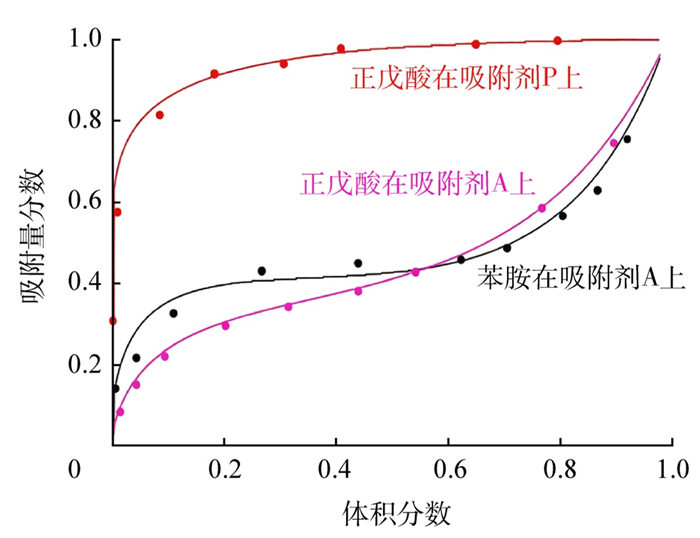 图 1 不同吸附质的水溶液在活性炭上的吸附实验模拟曲线Fig. 1 simulation curves of adsorption experiments of aqueous solutions with different adsorbates on activated carbon
 下载:
全尺寸图片
2.4.2 吸附质在吸附剂表面的姿态[9-10]
骨炭从水溶液中吸附醋酸是一个证明溶液吸附是单分子层吸附很有意义的例子。在18 ℃的恒温条件下,用骨炭从水溶液中吸附醋酸。因为醋酸分子有线性构型,并且水分子与醋酸分子有相同的吸附基团,吸附1个醋酸分子可以从骨炭表面顶替1个水分子,所以,吸附顶替系数p=1。吸附公式可以转换为
$$ \theta = \frac {\varphi_ {\mathrm{A}} \exp \left(K _ {\mathrm{A}} + K _ {\mathrm{B}} \varphi_ {\mathrm{A}}\right)}{1-\varphi_ {\mathrm{A}} \left[ 1-\exp \left(K _ {\mathrm{A}} + K _ {\mathrm{B}} \varphi_ {\mathrm{A}}\right) \right] } 。$$ (22) 不同醋酸平衡浓度下,骨炭从水溶液中吸附醋酸数据列于表 2。因饱和吸附量V∞ =5.01 mol/kg,故有θ = V/V∞ = V/5.01,采用最小二乘法求得系数KA=5.894,KB=-1.126。18 ℃时,醋酸吸附数据的实验值和理论值的偏差为-0.01%~0.10%。相关曲线模拟结果如图 2所示,表明理论公式计算值与实验值相符。9个实验数据点大多精准地落在理论曲线上。骨炭从水溶液中吸附醋酸p=1,也说明了在骨炭从水溶液中吸附醋酸过程中,在骨炭表面醋酸分子是采取官能团向下、烷链向上的站立姿势。
表 2 骨炭从水溶液中吸附醋酸数据比较Table 2 data comparison of adsorption of acetic acid from aqueous solution by bone charcoal物质的量浓度/(mmol·L-1) 吸附量/(mol·kg-1) φA×104 θ实验值 θ计算值 相对偏差/% 2.02 0.202 1.16 0.040 3 0.040 4 0.2 2.46 0.244 1.41 0.048 7 0.048 7 0 3.05 0.299 1.75 0.059 7 0.059 7 0 4.10 0.394 2.35 0.078 6 0.078 5 -0.1 5.81 0.541 3.33 0.108 0 0.108 0 0 12.80 1.050 7.33 0.210 0 0.210 0 0 100.00 3.380 57.20 0.675 0 0.675 0 0 200.00 4.030 114.00 0.804 0 0.805 0 0.1 500.00 4.570 286.00 0.912 0 0.912 0 0 注:φA为醋酸体积分数;θ实验值为摩尔分数实验值;θ计算值为摩尔分数计算值。 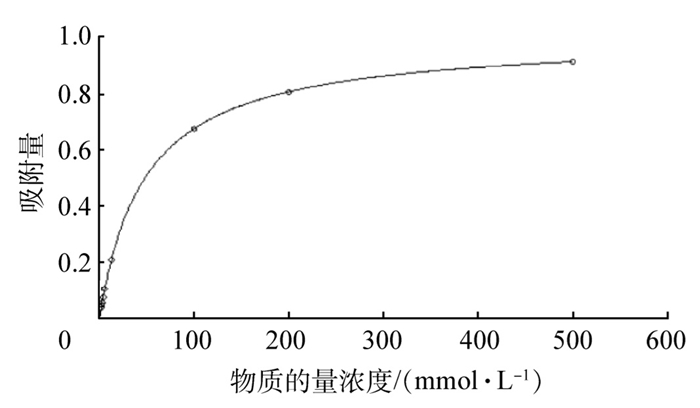 图 2 骨炭从水溶液中吸附醋酸实验模拟曲线Fig. 2 experimental simulation curve of acetic acid adsorption from aqueous solution by bone charcoal下载:
全尺寸图片
2.4.3 碱金属离子在硅胶表面的吸附
硅胶可以从水溶液中吸附碱金属离子,采用的计算公式为
$$ \frac {\theta}{(1-\theta) ^ {7}} = \frac {\varphi_ {\mathrm{A}}}{(1-\varphi_ {\mathrm{A}}) ^ {7}} \exp \left(K _ {\mathrm{A}} + K _ {\mathrm{B}} \times \varphi_ {\mathrm{A}}\right), $$ 此处φA为吸附质的相对饱和浓度。硅胶自水溶液中吸附无机碱金属离子相关数据列于表 3,Li+、Na+、K+和NH4+吸附数据的实验值和理论值的偏差为-0.40%~0.59%、-1.39%~1.85%、-0.66%~2.40% 和-3.15%~1.61%。有关吸附方程系数列于表 4。
表 3 硅胶自水溶液中吸附碱金属离子计算值与实验值的比较Table 3 comparison of calculated and experimental values for adsorption of alkali metal ions from aqueous solution by silica gel吸附质 φA θ实验值 θ计算值 相对偏差% LiOH 0.010 250 0.772 0.772 0 0.005 000 0.632 0.633 0.16 0.002 040 0.496 0.494 -0.40 0.000 817 0.388 0.388 0 0.000 510 0.340 0.342 0.59 NaOH 0.007 160 0.739 0.739 0 0.003 840 0.600 0.598 -0.33 0.002 260 0.487 0.496 1.85 0.001 140 0.391 0.390 -0.26 0.000 455 0.287 0.283 -1.39 KOH 0.005 050 0.775 0.777 0.26 0.002 760 0.660 0.656 -0.61 0.001 270 0.530 0.527 -0.57 0.000 720 0.455 0.452 -0.66 0.000 392 0.375 0.384 2.40 NH4OH 0.076 000 0.586 0.585 -0.17 0.029 800 0.405 0.406 0.20 0.019 100 0.338 0.342 1.18 0.011 200 0.286 0.277 -3.15 0.004 500 0.186 0.189 1.61 表 4 硅胶吸附碱金属离子吸附方程系数Table 4 statistical data of kinetics for adsorption of alkali metal ions by silica gel吸附质 最大吸附量/(mmol·g-1) 饱和浓度/(mol·L-1) KA KB p LiOH 2.5 4.897 9.159 530.60 7 NaOH 2.3 8.800 8.401 779.50 7 KOH 2.0 12.500 9.836 1 120.80 7 NH4OH 2.1 26.000 5.017 34.64 7 计算结果表明,每吸附1个Li+、Na+、K+和NH4+,要释放出7个水分子。其原因可能是在水溶液中每个碱金属离子带有6个H2O形成水合离子,碱金属离子被吸附时,这6个水合水分子被释放出来,而在吸附过程中还要顶替吸附中心原占有的1个H2O,因此总共释放了7个水分子,所以p=7。
温度是影响吸附行为的关键因素,傅鹰先生曾针对炭黑对正丁醇的吸附过程,系统探究了温度效应的作用机制。本文定量计算血炭吸附水溶液中正丁醇不同温度下的吸附量为
$$ \frac {\theta}{(1-\theta) ^ {2}} = \frac {\varphi_ {\mathrm{A}} \exp (0.2 8 6 9 + 1 2 5 8.6/T-2 7 4.6 \times \varphi_ {\mathrm{A}}/T)}{(1-\varphi_ {\mathrm{A}}) ^ {2}}, $$ 相关结果比较如图 3所示。随着溶液中吸附质体积分数的增加,3条曲线逐步趋近,吸附过程的焓变差异减少。吸附过程的焓变与吸附质浓度有关,实验数据证明分子间位能场与溶液成分确实有关。
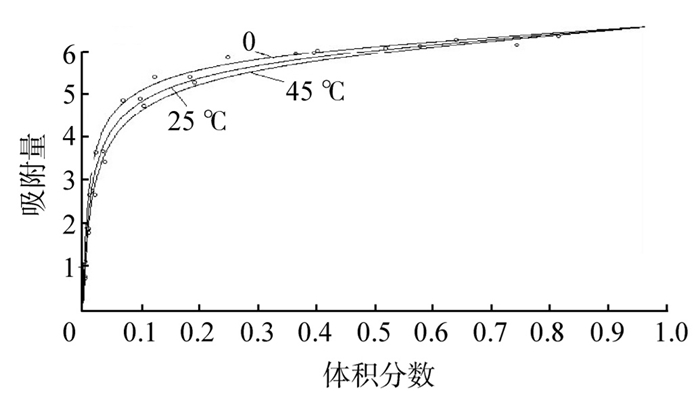 图 3 血炭从水溶液中吸附正丁醇温度效应计算值与实验值的比较Fig. 3 comparison of calculated and experimental values of temperature effect on n-butanol adsorption from aqueous solution by blood charcoal下载:
全尺寸图片
1 mol吸附质从溶液态进入吸附态的焓变为
$$ -\Delta H-8.314 \times\left(1258.6-274.6 \times \varphi_{\mathrm{A}}\right), $$ 溶液浓度的改变引起分子间环境的变化,进而引起分子间位能场变化。吸附过程焓变,是吸附剂表面吸附物质时,van der Waals作用能所作的净功。
理论上,只有吸附剂的作用能大于吸附质分子的动能,才能形成稳定的吸附层;如果吸附的作用能小于吸附质分子的动能,吸附质分子不能受到吸附剂表面van der Waals作用能的有效约束,也就不能形成稳定的吸附层。随着溶质浓度的改变,血炭从水溶液中吸附正丁醇van der Waals作用能的焓变为8.18~10.5 kJ/mol。根据分子运动理论,室温(300 K)时,分子的平均动能大约为3.74 kJ,此数小于吸附过程的焓变。若单层吸附,该过程是可顺利进行的;若为多层吸附,根据van der Waals作用能公式,作用能与分子间质心距离的6次方成反比,第2层与吸附剂表面的有效距离约增加1倍,吸附过程焓变则降为第1层的1/64,大约为128~164 J/mol,此值远小于室温下分子的平均动能,在此情况下,不可能形成第2层吸附,进而言之,更不可能形成第3、4层等吸附层。
关于更多的吸附数据的计算结果,请见参考文献[11]。
3. 非均匀吸附剂吸附方程
均匀吸附剂体系中二元溶液吸附只是溶液吸附的最简单情况,在现实中吸附剂很多是非均匀的,溶液也可能是多种成分的混合物。此时应当如何研究这种情况的吸附方程呢?以下讨论非均匀吸附剂的吸附问题。
非均匀吸附剂是表面吸附位点的能量、结构或活性存在差异(非均一)的吸附材料,其吸附过程遵循非朗格缪尔吸附模型。吸附剂表面有的位点吸附力强、有的弱,不像均匀吸附剂那样所有位点“一视同仁”。非均匀吸附剂常见于活性炭、黏土、金属氧化物等实际应用材料。
对于非均匀吸附剂的数学处理可借鉴与均匀吸附剂的方法。假设在非均匀吸附剂的表面有n种类型的活性中心,如果每种活性中心占有分数为Fi,则有
$$ \sum\limits_ {i = 1} ^ {n} F _ {i} = 1 \text { 。 } $$ 对于每种活性中心有各自符合的式(21)。因此第i类型的活性中心有
$$ \frac {\theta_ {i}}{\left(1-\theta_ {i}\right) ^ {p _ {i}}} = \frac {\varphi_ {\mathrm{A}}}{\left(1-\varphi_ {\mathrm{A}}\right) ^ {p _ {i}}} \exp \left\{K _ {\mathrm{A} i} + K _ {\mathrm{B} i} \varphi_ {\mathrm{A}} \right\}, $$ (23) 式中:θi为第i种活性中心吸附剂表面占有分数;KAi、KBi分别为第i种活性中心的相关系数。各类型吸附中心的吸附量由统一的溶液体积分数φA平衡调节和交换。
总吸附量M为
$$ M = \sum\limits_ {i = 1} ^ {n} \left(\theta_ {i} \times M _ {i} \times F _ {i}\right), $$ (24) 式中Mi为类型i活性中心的饱和吸附量。
此时,吸附质A在吸附剂表面占有分数为
$$ \theta = M/\sum\limits_ {i = 1} ^ {n} \left(M _ {i} \times F _ {i}\right)。 $$ (25) 在吸附剂给定之后,Mi、Fi及$ \sum\limits_ { i \mathop { = } 1 } ^ { n } \bigl (M _ { i } \times F _ { i } \bigr) $均为常数,由式(24)和(25)可见总吸附量M为各活性中心吸附量线性加和,因此,非均匀吸附剂吸附等温线的性质没有改变。非均匀吸附剂吸附等温线也可以用二元溶液吸附方程(21)描述。只是公式中参数的数值取决于各类活性中心吸附占有分数。在非均匀吸附剂吸附等温线方程中溶剂顶替值p也可能出现分数的情况。
4. 残缺数据的拟合
文献中溶液吸附数据大部分是溶液浓度和吸附量,而本文通用的公式都是基于吸附质A在吸附剂表面占有分数θ和溶液中各成分的体积分数。因此,在文献上查到数据后,应先把数据换算成φA和θ后再行计算。但实际上由于吸附质饱和吸附量与饱和浓度量的欠缺使得工作不能进行下去。在没有其他办法的情况下,可以尝试着假设一个合理的饱和吸附量与吸附质饱和浓度进行试算。
在《傅鹰选集》第6页有硅胶自四氯化碳中吸附甲酸、乙酸、丙酸和丁酸的吸附数据。但无从知道这4种酸在硅胶和四氯化碳中饱和吸附量与饱和浓度量。此时,可把文献中溶液浓度作为在吸附界面液相中组分A的体积分数,把吸附量乘或除以适当数值作为被吸附的分子在吸附剂表面占有分数。采用这种尝试法计算4种酸的结果见表 5、图 4、表 6和表 7。表明计算值与实测值还是接近;随着吸附质碳链增长,p值也随之增加;吸附质在吸附剂表面基本都是平躺状态。在此举例只是为了说明在硅胶和四氯化碳体系中,C1∽C4脂肪酸也是单分子层吸附,均能适用于二元溶液吸附方程。虽然在此运用残缺数据计算方法可以得到完整的吸附等温线,但是笔者不建议过度信任外推计算出来的结果。
表 5 硅胶吸附四氯化碳中低级脂肪酸计算参数统计Table 5 statistical parameters of lower fatty acids adsorbed by silica gel from carbon tetrachloride吸附质 KA KB p 方差/% 甲酸 3.84 -0.20 2 5.50 乙酸 5.05 -4.39 4 0.91 丙酸 5.20 -7.55 5 1.40 丁酸 7.91 -4.10 6 0.41 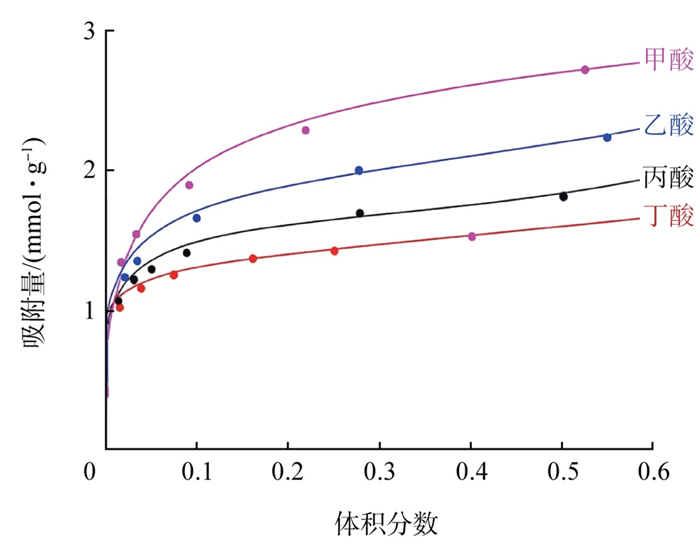 图 4 硅胶自四氯化碳中吸附4种酸的曲线Fig. 4 adsorption of 4 acids by silica gel from carbon tetrachloride下载:
全尺寸图片
表 6 硅胶自四氯化碳中吸附丙酸残缺数据的拟合Table 6 adsorption of propionic acid by silica gel from carbon tetrachloride
平衡浓度 吸附量(实验值) 吸附量除以3(实验值) 吸附量除以3(计算值) 还原吸附量计算值 0.0135 1.07 0.3567 0.330 0.99 0.0309 1.22 0.4067 0.401 1.20 0.0500 1.30 0.4333 0.440 1.32 0.0890 1.41 0.4700 0.483 1.45 0.2779 1.70 0.5667 0.554 1.66 0.5010 1.82 0.6067 0.609 1.83 表 7 硅胶自四氯化碳中吸附丁酸残缺数据的拟合Table 7 adsorption of butyric acid by silica gel from carbon tetrachloride平衡浓度 吸附量(实验值) 吸附量除以2(实验值) 吸附量除以2(计算值) 还原吸附量计算值 0.014 4 1.03 0.515 0.514 1.03 0.039 3 1.16 0.580 0.585 1.17 0.074 0 1.26 0.630 0.628 1.26 0.162 0 1.38 0.690 0.682 1.36 0.251 0 1.43 0.715 0.717 1.43 0.402 5 1.53 0.765 0.766 1.53 5. 多元溶液吸附理论
多元溶液吸附理论是描述多种组分在固体表面同时发生吸附现象的重要理论体系,其理论推导涉及从基础物理化学原理到复杂数学处理的完整过程。理解这些方程的推导逻辑,不仅有助于掌握吸附理论的核心内容,更能为实际应用中的模型选择和参数优化提供理论指导。
采用统计热力学研究溶液吸附过程的原理是,首先要建立两相的模型。用简化假设描述微观粒子(原子、分子等)在体系中的行为和状态,进而推导宏观热力学性质,因此模型之建立是从微观状态统计推测宏观规律的基础是理论框架。一个模型用来描述吸附态表面,通常可用点阵模型;另外一个模型用来描述溶液的性质,简单起见可用均一位势模型。在模型建立之后,根据统计力学原理可以写出相应的配分函数,进一步求得体系的化学势。两相接触达到平衡的条件是物质在两相中的化学势相等,由此可得到吸附线方程。因此,研究结果准确与否最为关键的是建立的模型是否合理。
考虑一个与外界无物质交换的封闭体系。在体系中含有吸附质A、吸附剂S和n种溶剂B1、B2、…、Bn,在本体系中溶液的总配分函数Z为
$$ Z = \left[ \left(\frac {2 {\rm{ \mathsf{ π} }} m _ {\mathrm{A}} k T}{h ^ {2}}\right) ^ {3/2} j _ {\mathrm{A}} ^ {1} \right] ^ {N _ {\mathrm{A}} ^ {1}} \times \prod\limits_ {i = 1} ^ {n} \left[ \left(\frac {2 {\rm{ \mathsf{ π} }} m _ {\mathrm{B} _ {i}} k T}{h ^ {2}}\right) ^ {3/2} j _ {\mathrm{B} _ {i}} ^ {1} \right] ^ {N _ {\mathrm{B} _ {i}} ^ {1}} \times \varOmega , $$ (26) 可得溶质A在溶液中的化学势为
$$ \begin{array}{c} \mu_ {\mathrm{A}} ^ {1} =-R T \left\{-\ln N _ {\mathrm{A}} ^ {1}-\sum\limits_ {i = 1} ^ {n} \left(\frac {\partial N _ {\mathrm{B} _ {i}} ^ {1}}{\partial N _ {\mathrm{A}} ^ {1}} \ln N _ {\mathrm{B} _ {i}} ^ {1}\right)-\frac {1}{k T} \left(\chi_ {\mathrm{A}} ^ {1} + \right. \right. \\ \left. \sum\limits_ {i = 1} ^ {n} \left(\frac {\partial N _ {\mathrm{B} _ {i}} ^ {1}}{\partial N _ {\mathrm{A}} ^ {1}} \chi_ {\mathrm{B} _ {i}} ^ {1}\right)\right) + \left(1 + \sum\limits_ {i = 1} ^ {n} \frac {\partial N _ {\mathrm{B} _ {i}} ^ {1}}{\partial N _ {\mathrm{A}} ^ {1}}\right) \ln V _ {0} + \\ \ln \left[ \left(\frac {2 {\rm{ \mathsf{ π} }} m _ {\mathrm{A}} k T}{h ^ {2}}\right) ^ {3/2} j _ {\mathrm{A}} ^ {1} \right] + \sum\limits_ {i = 1} ^ {n} \left(\frac {\partial N _ {\mathrm{B} _ {i}} ^ {1}}{\partial N _ {\mathrm{A}} ^ {1}} \ln \left[ \left(\frac {2 {\rm{ \mathsf{ π} }} m _ {\mathrm{B} _ {i}} k T}{h ^ {2}}\right) ^ {3/2} j _ {\mathrm{B} _ {i}} ^ {1} \right]\right) \Bigg \}, \end{array} $$ (27) 设在吸附剂表面被吸附的$ \mathrm { A } 、\mathrm { B } _ { 1 } 、\mathrm { B } _ { 2 } 、\cdots \mathrm { B } _ { n } $的分子个数为$ N _ { A } ^ { a }、 N _ { B _ { 1 } } ^ { a } \dotsb 、 N _ { B _ { n } } ^ { a } $,在吸附剂表面各个分子的势能为$ \chi _ { A 、 } ^ { a } \chi _ { B _ { 1 } } ^ { a } 、\dotsb 、 \chi _ { B _ { n } } ^ { a } $,根据理想势阱单分子吸附模型其总配分函数,可以得到组分A在吸附剂表面的化学势为
$$ \begin{array}{l} \mu_ {\mathrm{A}} ^ {\mathrm{a}} =-R T \left\{\left(1 + \sum\limits_ {i = 1} ^ {n} \frac {\partial N _ {\mathrm{B} _ {i}} ^ {\mathrm{a}}}{\partial N _ {\mathrm{A}} ^ {\mathrm{a}}}\right) \ln N _ {\mathrm{S}}-\ln N _ {\mathrm{A}} ^ {\mathrm{a}}-\sum\limits_ {i = 1} ^ {n} \left(\frac {\partial N _ {\mathrm{B} _ {i}} ^ {\mathrm{a}}}{\partial N _ {\mathrm{A}} ^ {\mathrm{a}}} \ln N _ {\mathrm{B} _ {i}} ^ {\mathrm{a}}\right)-\right. \\ \frac {1}{k T} \left[ \chi_ {\mathrm{A}} ^ {\mathrm{a}} + \sum\limits_ {i = 1} ^ {n} \left(\frac {\partial N _ {\mathrm{B} _ {i}} ^ {\mathrm{a}}}{\partial N _ {\mathrm{A}} ^ {\mathrm{a}}} \chi_ {\mathrm{B} _ {i}} ^ {\mathrm{a}}\right) \right] + \ln J _ {\mathrm{A}} ^ {\mathrm{a}} + \sum\limits_ {i = 1} ^ {n} \left(\frac {\partial N _ {\mathrm{B} _ {i}} ^ {\mathrm{a}}}{\partial N _ {\mathrm{A}} ^ {\mathrm{a}}} \ln J _ {\mathrm{B} _ {i}} ^ {\mathrm{a}}\right) \Bigg \} 。 \end{array} $$ (28) 根据平衡时化学势相等原理,最后可得多元溶液的吸附方程为
$$ \begin{array}{c} \ln \left(\frac {\theta_ {\mathrm{A}}}{\varphi_ {\mathrm{A}}}\right) = \sum\limits_ {i = 1} ^ {n} \left(p _ {i} \ln \frac {\theta_ {\mathrm{B} _ {i}}}{\varphi_ {\mathrm{B} _ {i}}}\right)-\ln V _ {\mathrm{A}} + \sum\limits_ {i = 1} ^ {n} \left(p _ {i} \ln V _ {\mathrm{B} _ {i}}\right) + \\ \ln \left(\frac {h ^ {2}}{2 {\rm{ \mathsf{ π} }} m _ {\mathrm{A}} k T}\right) ^ {3/2}-\sum\limits_ {i = 1} ^ {n} \left[ \left(p _ {i} \ln \left(\frac {h ^ {2}}{2 {\rm{ \mathsf{ π} }} m _ {\mathrm{B} _ {i}} k T}\right) ^ {3/2}\right) \right] +\\\frac {1}{k T} \left\{\left[ \left(K _ {\mathrm{AA}}-K _ {\mathrm{AA}} ^ {\mathrm{a}}\right) \chi_ {\mathrm{AA}} \varphi_ {\mathrm{A}} + \sum\limits_ {i = 1} ^ {n} \left[ \left(K _ {\mathrm{AB} _ {i}}-K _ {\mathrm{AB} _ {i}} ^ {\mathrm{a}}\right) \times \chi_ {\mathrm{AB} _ {i}} \varphi_ {\mathrm{B} _ {i}} \right] + \right. \right. \\ \left. \left. \chi_ {\mathrm{A} \text {氢}}-\chi_ {\mathrm{A}} ^ {\mathrm{a}} \right]-\sum\limits_ {i = 1} ^ {n} p _ {i} \left[ \left(K _ {\mathrm{B} _ {i} \mathrm{A}}-K _ {\mathrm{B} _ {i} \mathrm{A}} ^ {a}\right) \chi_ {\mathrm{B} _ {i} \mathrm{A}} \varphi_ {\mathrm{A}} + \right. \right. \\ \left. \left. \sum\limits_ {j = 1} ^ {n} \left[ \left(K _ {\mathrm{B} _ {i} \mathrm{B} _ {j}}-K _ {\mathrm{B} _ {i} \mathrm{B} _ {j}} ^ {\mathrm{a}}\right) \chi_ {\mathrm{B} _ {i} \mathrm{B} _ {j}} \varphi_ {\mathrm{B} _ {j}} \right] + \chi_ {\mathrm{B} _ {i} \text {氢}}-\chi_ {\mathrm{B} _ {i}} ^ {\mathrm{a}} \right] \right\} 。 \end{array} $$ (29) 式中:i、j指不同溶剂。当φA很低时,θA/φA即是吸附平衡常数K。
这是多元溶液吸附中吸附质在两相分布应该满足的方程。当设n=1时,方程将还原为二元溶液吸附方程为
$$ \begin{array}{c} \ln \left(\frac {\theta_ {\mathrm{A}}}{\varphi_ {\mathrm{A}}}\right) = \left(p \ln \frac {\theta_ {\mathrm{B}}}{\varphi_ {\mathrm{B}}}\right)-\ln V _ {\mathrm{A}} + p \ln V _ {\mathrm{B}} + \ln \left(\frac {h ^ {2}}{2 {\rm{ \mathsf{ π} }} m _ {\mathrm{A}} k T}\right) ^ {3/2}- \\ p \ln \left(\frac {h ^ {2}}{2 {\rm{ \mathsf{ π} }} m _ {\mathrm{B}} k T}\right) ^ {3/2} + \frac {1}{k T} \left\{\left(\left(K _ {\mathrm{AA}}-K _ {\mathrm{AA}} ^ {\mathrm{a}}\right) \chi_ {\mathrm{AA}} \varphi_ {\mathrm{A}} + \right. \right. \\ \left[ \left(K _ {\mathrm{AB}}-K _ {\mathrm{AB}} ^ {\mathrm{a}}\right) \times \chi_ {\mathrm{AB}} \varphi_ {\mathrm{B}} \right] + \left. \chi_ {\mathrm{A} \text {氢}}-\chi_ {\mathrm{A}} ^ {\mathrm{a}}\right)-p \left[ \left(K _ {\mathrm{BA}}-\right. \right. \\ \left. \left. \left. K _ {\mathrm{BA}} ^ {\mathrm{a}}\right) \chi_ {\mathrm{BA}} \varphi_ {\mathrm{A}} + \chi_ {\mathrm{B} \text {氢}}-\chi_ {\mathrm{B}} ^ {\mathrm{a}} \right] + \left(K _ {\mathrm{BB}}-K _ {\mathrm{BB}} ^ {\mathrm{a}}\right) \chi_ {\mathrm{BB}} \varphi_ {\mathrm{B}} \right\} \end{array} $$ (30) 式中: $\varphi_ {\mathrm{A}} + \varphi_ {\mathrm{B}} = 1, \theta_ {\mathrm{A}} + \theta_ {\mathrm{B}} = 1 $。
6. 吸附平衡常数与色谱保留值的关系以及吸附方程在色谱理论上的应用
6.1 色谱二元流动相体系(三元吸附体系)的验证
由于色谱保留值与吸附平衡常数有直接关系,运用多元溶液吸附方程(29),可以得到二元流动相正相色谱保留值方程为
$$ \ln k ^ {\prime} = a + b \ln \varphi_ {\mathrm{B} _ {1}} + c \varphi_ {\mathrm{B} _ {1}}, $$ (31) 反相色谱保留值方程为
$$ \ln k ^ {\prime} = a + c \varphi_ {\mathrm{B} _ {1}}, $$ (32) 式中φB为流动相强溶剂的体积分数。从式(29)中还可以导出分子结构参数与液相色谱保留值之间的关系。比如以甲基酮在固定相为YWG-5μ无定型硅胶,流动相为乙酸乙酯+正己烷色谱体系中为例,色谱保留值容量因子k'与其分子中同系物碳数(n)、相对分子质量(mA)、流动相中乙酸乙酯体积分数的关系为
$$ \begin{array}{c} \ln k ^ {\prime} & = 3.9 4 2-0.9 0 5 8 \ln \varphi_ {\mathrm{B} _ {1}} + 3.3 9 2 \varphi_ {\mathrm{B} _ {1}}-1.5 \ln m _ {\mathrm{A}} + \\ & \quad 0.1 1 5 3 n-0.4 7 7 8 \varphi_ {\mathrm{B} _ {1}} n _ {\circ} \end{array} $$ 公式中的系数是从实验数据中获得的。夏金强[12]以甲乙酮至甲壬酮共8种酮为同系物样品,在固定相为YWG-5μ无定型硅胶,流动相为乙酸乙酯和正己烷色谱体系中作了大量实验。本文使用上述实验结果进行色谱二元流动相体系的方程验证,方程计算值与实验值的结果绘图如图 5所示,表明计算方程可以很好地覆盖实验结果。
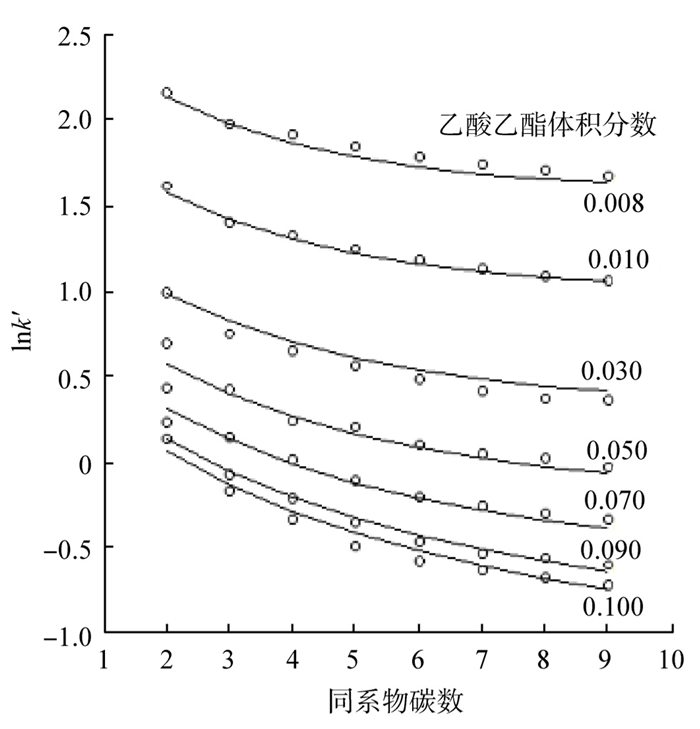 图 5 乙酸乙酯体积分数不同时甲基酮保留值的碳数规律注:k′为色谱保留值容量因子。Fig. 5 carbon number rule of retention values for methyl ketones at different ethyl acetate concentrations下载:
全尺寸图片
6.2 色谱三元流动相体系(四元吸附体系)的验证
三元流动相的液相色谱,加上溶质样品A构成四元吸附体系。考虑到非理想溶液强溶液分子间相互作用对样品A分子势能的影响,从方程(29)可以得到相应色谱保留值方程为
$$ \ln k ^ {\prime} = a + \sum\limits_ {i = 1} ^ {2} \left(b _ {i} \ln \varphi_ {\mathrm{B} _ {i}}\right) + \sum\limits_ {i = 1} ^ {2} \left(c _ {i} \varphi_ {\mathrm{B} _ {i}}\right) + d \varphi_ {\mathrm{B} _ {1}} \varphi_ {\mathrm{B} _ {2} }。 $$ (33) 窦林[13]采用蒽、荧蒽、硝基甲苯和氰苯等11种化合物为样品,在固定相为硅胶,流动相为乙醚、二氯甲烷和正乙烷正相色谱体系中测得大量数据。本文使用上述实验结果进行三元流动相体系的方程验证。按照公式
$$ \begin{array}{c} \ln k ^ {\prime} =-3.0 8-1.6 0 \varphi_ {\mathrm{B} _ {1}}-2.2 4 \varphi_ {\mathrm{B} _ {2}}-0.5 3 \ln \varphi_ {\mathrm{B} _ {1}}-\\ 0.2 0 \ln \varphi_ {\mathrm{B} _ {2}} + 2.7 1 \varphi_ {\mathrm{B} _ {1}} \times \varphi_ {\mathrm{B} _ {2}}, \end{array} $$ 计算对硝基氯苯的实验值与计算值,结果列于表 8中。34组实验数据与理论值均方差为7.6%。陈农[14]在十八烷基键合相为固定相甲醇和水为流动相测得大量数据,本方法得到的所有数据计算值与实验值很接近,说明在吸附质低浓度时,四元吸附体系吸附方程成立。
表 8 硝基氯苯实验三元流动相组成四元吸附体系验证Table 8 verification of quaternary adsorption system with ternary mobile phase composition for p-nitrochlorobenzene experimen乙醚的体积分数 二氯甲烷的体积分数 容量因子实验值 容量因子理论值 偏差/% 0.002 0.050 2.08 1.95 -0.13 0.100 1.68 1.50 -0.18 0.200 0.99 1.03 0.04 0.300 0.44 0.74 0.30 0.700 0.26 0.24 -0.02 0.004 0.010 2.00 2.05 0.05 0.050 1.44 1.35 -0.09 0.100 1.18 1.04 -0.14 0.200 0.67 0.71 0.04 0.300 0.58 0.52 -0.06 0.700 0.15 0.17 0.02 0.010 0.010 1.08 1.25 0.17 0.050 0.90 0.82 -0.08 0.100 0.63 0.64 0.01 0.200 0.46 0.44 -0.02 0.300 0.37 0.32 -0.05 0.700 0.14 0.10 -0.04 0.100 0.010 0.26 0.32 0.06 0.050 0.24 0.22 -0.02 0.100 0.17 0.17 0 0.200 0.13 0.12 -0.01 0.300 0.08 0.09 0.01 0.700 0.02 0.03 0.01 0.300 0.010 0.13 0.13 0 0.050 0.11 0.09 -0.02 0.100 0.08 0.07 -0.01 0.200 0.05 0.05 0 0.300 0.03 0.04 0.01 0.700 0.03 0.02 -0.01 0.600 0.010 0.06 0.06 0 0.100 0.05 0.03 -0.02 0.200 0.02 0.03 0.01 0.300 0.02 0.02 0 0.900 0.050 0.02 0.02 0 6.3 弱电解质溶液平衡体系吸附平衡常数与氢离子浓度的关系
因为液相色谱保留值容量因子k'与吸附公式中θ/φA比值有关,在φA低时k' 与吸附平衡常数K的关系为
$$ k ^ {\prime} = K \div \beta , $$ (34) 式中β为溶液相体积与吸附剂体积的相比。有了这个公式,反过来可以把现有的色谱保留值规律毫无障碍地推广到溶液吸附研究之中。
(1)二元弱酸平衡体系。对于二元弱酸性化合物,在水溶液中有电离平衡
$$ \mathrm{H} _ {2} \mathrm{A} \Leftrightarrow \mathrm{HA} ^ {-} + \mathrm{H} ^ {+}, $$ 其电离常数为K1;第二级电离方程为
$$ \mathrm{HA} ^ {-} \Leftrightarrow \mathrm{A} ^ {2-} + \mathrm{H} ^ {+}, $$ 第二级电离常数为K2;在吸附剂表面有
$$ \mathrm{H} _ {2} \mathrm{A} ^ {1} \Leftrightarrow \mathrm{H} _ {2} \mathrm{A} ^ {\mathrm{a}}, $$ 其吸附平衡常数为K3。
十八烷基键合相在水溶液中不能吸附带电离子。可以导出在以十八烷基键合相固定相上保留值方程为[15]
$$ \ln k ^ {\prime} = \ln \left(K _ {3}/\beta\right)-\ln \left(1 + \frac {K _ {1}}{\left[ H ^ {+} \right]} + \frac {K _ {1} K _ {2}}{\left[ H ^ {+} \right] ^ {2}}\right) 。 $$ (35) 根据色谱保留值方程与吸附等温式相通原理,不难得到二元弱酸性化合物吸附平衡常数
$$ K = k ^ {\prime} \times \beta = K _ {3} \div \left(1 + \frac {K _ {1}}{\left[ \mathrm{H} ^ {+} \right]} + \frac {K _ {1} K _ {2}}{\left[ \mathrm{H} ^ {+} \right] ^ {2}}\right) 。 $$ (36) 方程右端正是观测到的吸附平衡常数K。
(2)一元弱酸或弱碱平衡体系。对于一元弱酸性化合物溶液,因K2=0吸附平衡常数与氢离子浓度的关系是
$$ K = K _ {3} \div \left(1 + \frac {K _ {1}}{\left[ \mathrm{H} ^ {+} \right]}\right) 。 $$ (37) 一元弱碱性化合物溶液吸附平衡常数与氢离子浓度的关系是
$$ K = K _ {3} \div \Big (1 + 1 0 ^ {1 4} K _ {\text {碱}} [ \mathrm{H} ^ {+} ] \Big), $$ (38) 式中K碱为一元弱碱性化合物的电离常数。和二元弱碱性化合物溶液吸附平衡常数与氢离子浓度的关系是
$$ K = K _ {3} \div \left(1 + 1 0 ^ {1 4} K _ {\text {碱} 1} \left[ \mathrm{H} ^ {+} \right] + 1 0 ^ {2 8} K _ {\text {碱} 1} K _ {\text {碱} 2} \left[ \mathrm{H} ^ {+} \right] ^ {2}\right), $$ (39) 式中:K碱1和K碱2分别是弱碱性化合物的一级和二级电离常数。
两性化合物对应为
$$ K = K _ {3} \div \left(1 + \frac {K _ {\text {酸}}}{\left[ \mathrm{H} ^ {+} \right]} + 1 0 ^ {1 4} K _ {\text {碱}} \left[ \mathrm{H} ^ {+} \right]\right) 。 $$ (40) 这些公式的正确性都在十八烷基键合相固定相上得到验证。
这一组公式反映了弱酸性、弱碱性、两性化合物溶液吸附平衡常数与氢离子浓度的关系。而这个关系式均是从色谱理论获得且验证的。
概而言之,现有的色谱理论规律包括分子结构与保留值的规律都可以通过式(34)毫无修改地推广到吸附理论之中。有了这样的理论基础,现有的大量分子结构和构型与色谱保留值规律研究都可以直接转换为分子结构和构型与吸附规律。这2种理论的互通必将促进双方理论的发展。
7. 结束语
本文系统研究了溶液吸附理论的发展历程、理论基础和应用价值,得出以下主要结论:(1)传统的气-固吸附理论(Langmuir、Freundlich、BET理论)虽然在描述气体吸附方面取得了成功,但在处理溶液吸附问题时存在根本性缺陷,主要原因包括忽略溶剂效应、顶替效应、溶液的非理想性、分子之间的作用能等。这些局限性使得建立专门的溶液吸附理论成为必要。(2)基于统计热力学方法建立的溶液吸附理论体系具有坚实的理论基础。该理论采用均一位势模型和理想势阱模型,成功推导出了二元溶液单分子层吸附方程,能够精准描述多种物质在不同吸附剂上的吸附行为。通过大量实验验证,包括有机酸、醇类、芳香族化合物等体系,证实了理论的正确性和普适性。(3)进一步将理论拓展至非均匀吸附剂及多元溶液吸附研究,建立多元溶液吸附方程,并借助液相色谱保留值数据完成三元溶液吸附体系和四元溶液吸附体系吸附质低浓度条件下的验证,构建了更完善的溶液吸附理论系统,为表面化学研究与应用提供了新的思路。(4)提出的溶液吸附理论研究的6个步骤,其中①与⑥为今后溶液吸附研究开拓了巨大的空间。溶液吸附理论的拓展应用显示出巨大潜力。非均匀吸附剂理论通过位点能量分布方法,能够描述实际吸附剂表面的复杂性。多元溶液吸附理论考虑了组分间的竞争吸附,为处理复杂体系提供了工具。这些理论在液相色谱保留值预测、吸附分离工艺优化等领域展现出重要的应用价值。
展望未来,溶液吸附理论仍有广阔的发展空间。一方面,需要进一步完善理论体系,特别是考虑温度等外界条件对吸附行为的影响,以及开发适用于高浓度、强相互作用体系的理论模型。这些进一步的研究可以从式(29)中
$$ \begin{gathered} \frac {1}{k T} \left\{\left[ \left(K _ {\mathrm{AA}}-K _ {\mathrm{AA}} ^ {\mathrm{a}}\right) \chi_ {\mathrm{AA}} \varphi_ {\mathrm{A}} + \sum\limits_ {i = 1} ^ {n} \left[ \left(K _ {\mathrm{AB} _ {i}}-K _ {\mathrm{AB} _ {i}} ^ {\mathrm{a}}\right) \times \chi_ {\mathrm{AB} _ {i}} \varphi_ {\mathrm{B} _ {i}} \right] + \right.\right. \\\left.\chi_ {\mathrm{A} \text {氢}}-\chi_ {\mathrm{A}} ^ {\mathrm{a}} \right]-\sum\limits_ {i = 1} ^ {n} p _ {i} \left[ \left(K _ {\mathrm{B} _ {i} \mathrm{A}}-K _ {\mathrm{AB} _ {i}} ^ {\mathrm{a}}\right) \chi_ {\mathrm{B} _ {i} \mathrm{A}} \varphi_ {\mathrm{A}} + \right. \\\sum\limits_ {j = 1} ^ {n} \left[ \left(K _ {\mathrm{B} _ {i} \mathrm{B} _ {j}}-K _ {\mathrm{B} _ {i} \mathrm{B} _ {j}} ^ {\mathrm{a}}\right) \chi_ {\mathrm{B} _ {i} \mathrm{B} _ {j}} \varphi_ {\mathrm{B} _ {j}} \right] + \chi_ {\mathrm{B} _ {i} \text {氢}}-\chi_ {\mathrm{B} _ {i}} ^ {a} ] \Bigg \} \end{gathered} $$ 项着手找到答案。因为这一项是由分子间作用能决定的,不同的溶液吸附系统或许分子间有不同的作用方式,甚至有分子间配位数呈分段连续函数关系,以及溶液的非理想性,被吸附与吸附分子间相互作用等,这些情况都可以考虑在此解决。随着计算技术的发展,分子模拟与理论计算的结合也将为深入理解吸附机制提供新的手段。此外,将溶液吸附理论与绿色化学、可持续发展等理念相结合,开发环境友好的吸附分离技术,也是未来研究的重要方向。基于统计热力学的溶液吸附理论不仅在理论上具有重要意义,而且在实践中展现出广阔的应用前景。这个理论体系的建立和完善,为表面化学、环境科学、化学工程等相关学科的发展提供了重要的理论支撑[16-23],对推动吸附技术的进步具有深远影响。
志谢: 作为$\fbox{${卢佩章}$}$先生和$\fbox{${李浩春}$}$先生的学生,作者衷心感谢二位先生生前的悉心指导!
© The editorial department of Journal of Capital Normal University (Natural Science Edition) 2025.This is an open access article under the CC BY-NC-ND 4.0 license (https://creativecommons.org/licenses/by-nc-nd/4.0/). -
图 1 不同吸附质的水溶液在活性炭上的吸附实验模拟曲线
Fig. 1 simulation curves of adsorption experiments of aqueous solutions with different adsorbates on activated carbon
下载:
全尺寸图片
图 2 骨炭从水溶液中吸附醋酸实验模拟曲线
Fig. 2 experimental simulation curve of acetic acid adsorption from aqueous solution by bone charcoal
下载:
全尺寸图片
图 3 血炭从水溶液中吸附正丁醇温度效应计算值与实验值的比较
Fig. 3 comparison of calculated and experimental values of temperature effect on n-butanol adsorption from aqueous solution by blood charcoal
下载:
全尺寸图片
图 4 硅胶自四氯化碳中吸附4种酸的曲线
Fig. 4 adsorption of 4 acids by silica gel from carbon tetrachloride
下载:
全尺寸图片
图 5 乙酸乙酯体积分数不同时甲基酮保留值的碳数规律
注:k′为色谱保留值容量因子。
Fig. 5 carbon number rule of retention values for methyl ketones at different ethyl acetate concentrations
下载:
全尺寸图片
表 1 不同吸附剂与吸附质吸附数据
Table 1 adsorption data calculation for different adsorbents and adsorbates
吸附剂 苯胺 苯酚 环己醇 正丁醇 KA KB p 方差 KA KB p 方差 KA KB p 方差 KA KB p 方差 炭A 2.93 -7.11 3 0.032 3.05 -6.60 4 0.032 1.74 -3.53 1 0.014 1.57 -2.97 1 0.013 炭B 1.68 -5.94 2 0.023 1.41 -3.74 1 0.047 1.69 -5.35 2 0.023 1.96 -4.43 2 0.010 炭E 2.27 -4.95 2 0.023 1.46 -3.54 1 0.040 2.08 -4.41 2 0.042 1.67 -3.4 1 0.012 炭F 7.01 -2.59 2 0.045 6.13 -3.38 2 0.031 6.14 0.68 2 0.025 6.34 1.74 3 0.009 炭G 1.92 -4.04 2 0.037 1.91 -6.25 3 0.018 2.12 -3.88 1 0.021 1.59 -3.20 1 0.014 炭H 2.4 -4.87 3 0.034 1.75 -5.25 2 0.037 1.93 -3.45 1 0.013 1.62 -3.09 1 0.008 吸附剂 正己酸 正戊醇 正戊酸 KA KB p 方差 KA KB p 方差 KA KB p 方差 炭A 2.20 -6.36 5 0.009 2.38 -4.85 4 0.020 1.83 -5.08 3 0.008 炭B 2.02 -5.89 5 0.017 2.86 -9.32 7 0.027 1.62 -6.09 3 0.018 炭E 1.88 -5.78 5 0.012 2.50 -8.40 6 0.028 2.61 -7.11 5 0.032 炭F 9.91 3.96 5 0.018 6.23 2.48 3 0.019 6.89 6.55 3 0.016 炭G 1.72 -5.24 5 0.013 1.59 -4.55 2 0.025 1.64 -4.29 3 0.033 炭H 1.84 -6.03 5 0.010 2.09 -4.47 3 0.018 1.77 -5.27 3 0.013 注:KA、KB为与温度有关的系数;p为吸附顶替系数。 表 2 骨炭从水溶液中吸附醋酸数据比较
Table 2 data comparison of adsorption of acetic acid from aqueous solution by bone charcoal
物质的量浓度/(mmol·L-1) 吸附量/(mol·kg-1) φA×104 θ实验值 θ计算值 相对偏差/% 2.02 0.202 1.16 0.040 3 0.040 4 0.2 2.46 0.244 1.41 0.048 7 0.048 7 0 3.05 0.299 1.75 0.059 7 0.059 7 0 4.10 0.394 2.35 0.078 6 0.078 5 -0.1 5.81 0.541 3.33 0.108 0 0.108 0 0 12.80 1.050 7.33 0.210 0 0.210 0 0 100.00 3.380 57.20 0.675 0 0.675 0 0 200.00 4.030 114.00 0.804 0 0.805 0 0.1 500.00 4.570 286.00 0.912 0 0.912 0 0 注:φA为醋酸体积分数;θ实验值为摩尔分数实验值;θ计算值为摩尔分数计算值。 表 3 硅胶自水溶液中吸附碱金属离子计算值与实验值的比较
Table 3 comparison of calculated and experimental values for adsorption of alkali metal ions from aqueous solution by silica gel
吸附质 φA θ实验值 θ计算值 相对偏差% LiOH 0.010 250 0.772 0.772 0 0.005 000 0.632 0.633 0.16 0.002 040 0.496 0.494 -0.40 0.000 817 0.388 0.388 0 0.000 510 0.340 0.342 0.59 NaOH 0.007 160 0.739 0.739 0 0.003 840 0.600 0.598 -0.33 0.002 260 0.487 0.496 1.85 0.001 140 0.391 0.390 -0.26 0.000 455 0.287 0.283 -1.39 KOH 0.005 050 0.775 0.777 0.26 0.002 760 0.660 0.656 -0.61 0.001 270 0.530 0.527 -0.57 0.000 720 0.455 0.452 -0.66 0.000 392 0.375 0.384 2.40 NH4OH 0.076 000 0.586 0.585 -0.17 0.029 800 0.405 0.406 0.20 0.019 100 0.338 0.342 1.18 0.011 200 0.286 0.277 -3.15 0.004 500 0.186 0.189 1.61 表 4 硅胶吸附碱金属离子吸附方程系数
Table 4 statistical data of kinetics for adsorption of alkali metal ions by silica gel
吸附质 最大吸附量/(mmol·g-1) 饱和浓度/(mol·L-1) KA KB p LiOH 2.5 4.897 9.159 530.60 7 NaOH 2.3 8.800 8.401 779.50 7 KOH 2.0 12.500 9.836 1 120.80 7 NH4OH 2.1 26.000 5.017 34.64 7 表 5 硅胶吸附四氯化碳中低级脂肪酸计算参数统计
Table 5 statistical parameters of lower fatty acids adsorbed by silica gel from carbon tetrachloride
吸附质 KA KB p 方差/% 甲酸 3.84 -0.20 2 5.50 乙酸 5.05 -4.39 4 0.91 丙酸 5.20 -7.55 5 1.40 丁酸 7.91 -4.10 6 0.41 表 6 硅胶自四氯化碳中吸附丙酸残缺数据的拟合
Table 6 adsorption of propionic acid by silica gel from carbon tetrachloride
平衡浓度 吸附量(实验值) 吸附量除以3(实验值) 吸附量除以3(计算值) 还原吸附量计算值 0.0135 1.07 0.3567 0.330 0.99 0.0309 1.22 0.4067 0.401 1.20 0.0500 1.30 0.4333 0.440 1.32 0.0890 1.41 0.4700 0.483 1.45 0.2779 1.70 0.5667 0.554 1.66 0.5010 1.82 0.6067 0.609 1.83 表 7 硅胶自四氯化碳中吸附丁酸残缺数据的拟合
Table 7 adsorption of butyric acid by silica gel from carbon tetrachloride
平衡浓度 吸附量(实验值) 吸附量除以2(实验值) 吸附量除以2(计算值) 还原吸附量计算值 0.014 4 1.03 0.515 0.514 1.03 0.039 3 1.16 0.580 0.585 1.17 0.074 0 1.26 0.630 0.628 1.26 0.162 0 1.38 0.690 0.682 1.36 0.251 0 1.43 0.715 0.717 1.43 0.402 5 1.53 0.765 0.766 1.53 表 8 硝基氯苯实验三元流动相组成四元吸附体系验证
Table 8 verification of quaternary adsorption system with ternary mobile phase composition for p-nitrochlorobenzene experimen
乙醚的体积分数 二氯甲烷的体积分数 容量因子实验值 容量因子理论值 偏差/% 0.002 0.050 2.08 1.95 -0.13 0.100 1.68 1.50 -0.18 0.200 0.99 1.03 0.04 0.300 0.44 0.74 0.30 0.700 0.26 0.24 -0.02 0.004 0.010 2.00 2.05 0.05 0.050 1.44 1.35 -0.09 0.100 1.18 1.04 -0.14 0.200 0.67 0.71 0.04 0.300 0.58 0.52 -0.06 0.700 0.15 0.17 0.02 0.010 0.010 1.08 1.25 0.17 0.050 0.90 0.82 -0.08 0.100 0.63 0.64 0.01 0.200 0.46 0.44 -0.02 0.300 0.37 0.32 -0.05 0.700 0.14 0.10 -0.04 0.100 0.010 0.26 0.32 0.06 0.050 0.24 0.22 -0.02 0.100 0.17 0.17 0 0.200 0.13 0.12 -0.01 0.300 0.08 0.09 0.01 0.700 0.02 0.03 0.01 0.300 0.010 0.13 0.13 0 0.050 0.11 0.09 -0.02 0.100 0.08 0.07 -0.01 0.200 0.05 0.05 0 0.300 0.03 0.04 0.01 0.700 0.03 0.02 -0.01 0.600 0.010 0.06 0.06 0 0.100 0.05 0.03 -0.02 0.200 0.02 0.03 0.01 0.300 0.02 0.02 0 0.900 0.050 0.02 0.02 0 -
[1] 黄军, 周颖琳, 吕占霞, 等. 适应创新性人才培养的仪器分析实验教学改革初探[J]. 大学化学, 2022, 37(4): 70-74. DOI: 10.3866/PKU.DXHX202110023. HuangJun, Zhou Yinglin, Lü Zhanxia, et al. Preliminary exploration on the teaching reform of instrumental analysis laboratory for the cultivation of innovative talents[J]. University Chemistry, 2022, 37(4): 70-74. doi: 10.3866/PKU.DXHX202110023 [2] 宗蕊, 胡晓雨, 叶能胜. 仪器分析课程思政建设的探索与实践: 以色谱教学为例[J]. 首都师范大学学报(自然科学版), 2021, 42(4): 69-74. DOI: 10.19789/j.1004-9398.2021.04.012. ZongRui, Hu Xiaoyu, Ye Nengsheng. Exploration and practice of ideological and political theories teaching in Instrumental Analysis course: taking chromatography teaching as an example[J]. Journal of Capital Normal University (Natural Science Edition), 2021, 42(4): 69-74. doi: 10.19789/j.1004-9398.2021.04.012 [3] 乔从德, 杨文轲, 李仲伟, 等. 凝胶渗透色谱-光散射联用表征聚合物摩尔质量的实验教学改革[J]. 色谱, 2024, 42(8): 812-817. DOI: 10.3724/SP.J.1123.2023.12005. QiaoCongde, Yang Wenke, Li Zhongwei, et al. Experimental teaching reform of polymer molar mass determination using gel permeation chromatography coupled with light scattering[J]. Chinese Journal of Chromatography, 2024, 42(8): 812-817. doi: 10.3724/SP.J.1123.2023.12005 [4] 戴朝政, 卢佩章. 关于液相色谱保留值公式lnk' =A+ Bln CB1+CCB1的改进[J]. 科学通报, 1993, 38(7): 623-627. Dai Chaozheng, Lu Peizhang. Improvement of retention value formula lnk' =A+BlnCB1+CCB1 for liquid chromatography[J]. Cinese Science Bulletin, 1993, 38 (7): 623-627. [5] Dai C Z, Lu P Z. A modification on the retention equation of liquid-solid chromatography lnk' =A+BlnCB1+CCB1[J]. Chinese Science Bulletin, 1994(17): 1458-1462. [6] 戴朝政, 卢佩章. 关于液相色谱保留值公式的补充[J]. 色谱, 1994, 12(1): 1-3. Dai Chaozheng, Lu Peizhang. A modification on the retention equation of liquid chromatography lnk' =A+ BlnCB1+CCB1[J]. Chinese Journal of Chromatography, 1994, 12(1): 1-3. [7] 戴朝政, 卢佩章. 二元溶液吸附方程的研究[J]. 色谱, 1994, 12(3): 157-163. Dai Chaozheng, Lu Peizhang. Investigation of adsorption equation in binary solution system[J]. Chinese Journal of Chromatography, 1994, 12(3): 157-163. [8] 傅鹰. 傅鹰选集[M]. 北京: 冶金工业出版社, 1990: 6-12, 45-50. Fu Ying. Selected works of Fu Ying[M]. Beijing: Metallurgical Industry Press, 1990: 6-12, 45-50. [9] 严继民, 张启元, 高敬琮. 吸附与凝聚: 固体的表面与孔[M]. 2版. 北京: 科学出版社, 1986: 93-95. Yan Jimin, Zhang Qiyuan, Gao Jingcong. Adsorption and coagulation: surface and pore of solids[M]. 2nd ed. Beijing: Science Press, 1986: 93-95. [10] 段世铎, 谭逸玲. 界面化学[M]. 北京: 高等教育出版社, 1990: 107-110. Duan Shiduo, Tan Yiling. Surface chemistry [M]. Beijing: Higher Education Press, 1990: 107-110. [11] 戴朝政. 二元溶液体系吸附方程的验证[J]. 分析仪器, 2013(5): 85-98. DOI: 10.3969/j.issn.1001-232x.2013.05.019. Dai Chaozheng. Verification of adsorption equation in binary solution system[J]. Analytical Instrumentation, 2013(5): 85-98. doi: 10.3969/j.issn.1001-232x.2013.05.019 [12] 夏金强. 液固吸附色谱中溶质保留值与其结构和流动相组成关系的研究[D]. 大连: 中国科学院大连化学物理研究所, 1985. Xia Jinqiang. Study on the relationship between solute retention values, structure, and mobile phase composition in liquid solid adsorption chromatography [D]. Dalian: Dalian Institute of Chemical Physics, Chinese Academy of Sciences, 1985. [13] 窦林. 高效液相色谱最佳操作条件的选择[D]. 大连: 中国科学院大连化学物理研究所, 1984. Dou Lin. Selection of optimal operating conditions for high performance liquid chromatography[D]. Dalian: Dalian Institute of Chemical Physics, Chinese Academy of Sciences, 1984. [14] 陈农. 高效液相色谱用不同C18填料上保留规律的研究[D]. 大连: 中国科学院大连化学物理研究所, 1987. Chen Nong. Research on retention rules on different C18 stationary phases in high performance liquid chromatography [D]. Dalian: Dalian Institute of Chemical Physics, Chinese Academy of Sciences, 1987. [15] 卢佩章, 戴朝政. 色谱理论基础[M]. 北京: 科学出版社, 1989. Lu Peizhang, Dai Chaozheng. Fundamentals of chromatography theory[M]. Beijing: Science Press, 1989. [16] 傅献彩, 陈懿. 物理化学[M]. 北京: 人民教育出版社, 1963. FU X C, CHEN Y. Physical chemistry[M]. Beijing: People's Education Press, 1963. [17] 徐光宪. 物质结构-上册[M]. 北京: 人民教育出版社, 1961. Xu Guangxian. Material structure-volume Ⅰ [M]. Beijing: People's Education Press, 1961. [18] 唐有祺. 统计力学及其在物理化学中的应用[M]. 北京: 科学出版社, 1979. Tang Youqi. Statistical mechanics and its application in physical chemistry[M]. Beijing: Science Press, 1979. [19] Adamson A W. A textbook of physical chemistry[M]. Academic Press: New York, 1973. [20] Hirschfelder J O, Curtiss C F, Bird R B. Molecular theory of gases and liquids[M]. Hoboken, New Jersey: John Wiley & Sons Inc., 1954. [21] 郭泽宇, 张明辉, 贺勤. 多孔材料吸附基本理论[M]. 北京: 科学出版社, 2024. Guo Zeyu, Zhang Minghui, He Qin. Basic theory of adsorption of porous materials[M]. Beijing: Science Press, 2024. [22] 马季铭, 戴乐蓉, 程虎民. 表面化学[M]. 北京: 科学出版社, 1999. Ma Jiming, Dai Lerong, Cheng Humin. Surface chemistry[M]. Beijing: Science Press, 1999. [23] 卢佩章, 戴朝政. 色谱理论原理[M]. 成都: 四川科学技术出版社, 2026(待出版). Lu Peizhang, Dai Chaozheng. Principles of Chromatography theory [M]. Chengdu: Sichuan Science and Technology Press, 2026 (publishing).
