

AI-assisted synthesis in reticular framework materials
-
摘要:
网状框架材料凭借其可精确调控的结构和多样化的功能特性,已在能源存储、药物递送及环境修复等领域展现出广泛的应用潜力。然而,其复杂的合成途径和高度多样的结构特征对理性设计与规模化制备构成了巨大挑战。近年来,尤其是基于Transformer架构和大型语言模型的人工智能(AI)技术,正通过大规模数据挖掘、材料性质精准预测以及智能化实验设计指导,促成网状化学的研究范式革新。本文综述了AI在网状框架材料发现与合成领域所带来的变革性影响,重点阐明了其在结构设计、性能预测与合成条件优化等环节中的关键作用。进一步将AI与自动化实验平台深度集成,构建可实现自动实验方案生成、合成参数自适应调控以及结果实时反馈与迭代优化的自动实验室,正在重塑研究的组织方式与技术路径。这一系列发展不仅加速了网状框架材料发现进程,提升了实验可重复性,还极大拓展了网状框架材料的可设计空间。AI与实验室自动化的深度耦合,将持续推动网状框架材料发现与合成走向更加智能、高效且具有更强预测力与创新驱动能力的新时代。
Abstract:Reticular framework materials, distinguished by their precisely engineered architectures and highly tailorable functional environments, have emerged as a versatile platform for applications in energy storage, drug delivery, and environmental remediation. However, the complexity of their synthetic routes and the vast diversity of accessible topologies and compositions still pose substantial obstacles to rational design and large-scale production. In recent years, artificial intelligence (AI), in particular transformer-based models and large language models, has begun to transform reticular chemistry by enabling large-scale data mining, accurate prediction of materials properties, and algorithmic guidance for experimental design. This review summarizes the disruptive impact of AI on the discovery and synthesis of reticular framework materials, with a focus on its roles in structural design, performance prediction, and optimization of synthetic conditions. We further discuss the deep integration of AI with automated experimental platforms to build autonomous laboratories capable of generating experimental protocols, adaptively adjusting reaction parameters, and iteratively refining conditions based on real-time feedback. These developments not only accelerate the discovery cycle and improve experimental reproducibility, but also greatly expand the accessible design space of reticular frameworks. The close coupling between AI methodologies and laboratory automation is expected to steer the field toward a new research paradigm that is more intelligent, efficient, and predictive, and that enables genuinely innovation-driven discovery and synthesis.
-
0. 引言
网状框架材料是一系列通过强化学键把分子构建单元规整连接而形成的结晶多孔材料,其主要包括金属有机框架(metal-organic frameworks,MOFs)、共价有机框架(covalent organic frameworks,COFs)以及分子编织结构等[1-2]。由于网状框架材料的构建单元设计性和可修饰性强,每年都有大量关于新型网状框架化合物的合成及应用扩展研究,促使“网状化学”(reticular chemistry)这一新兴学科的诞生。网状化学的兴起,使得多功能材料的理性设计变得可行,也为高通量发现提供了重要研究平台[3-5]。实际上,材料设计主要依赖研究人员的经验判断和不断试错,这种经验的实验方式不能满足复杂体系的设计要求。传统方法的主要问题是体现在效率低下而且缺少普适性的理论与预测方法。为了实现高效设计,必须系统揭示材料合成条件、结构构筑与性能调控之间的机理,但由于实验成本高以及专业知识体系深入,网状框架材料的发现和优化受到了极大的限制。
人工智能(artificial intelligence,AI)是一门高度交叉的学科,致力于开发能够模拟和扩展人类智能的理论、方法和技术[6-8]。近年来,AI正在改变网状框架材料的研究方式(图 1),推动材料科学研究从经验模式转向数据驱动和智能化模式。借助机器学习、深度学习与大语言模型(large language models,LLMs)等工具,研究人员能够预测材料结构、优化合成方法并改善材料性能,这有效提升了网状框架材料的设计合成效率与准确性[9-10]。通过AI分析材料结构与性能之间的内在联系,可以加快新型网状框架材料的设计与发现。将AI与自动化实验结合构成自动实验室(self-driving laboratories,SDL)[11-12],是推动化学研究智能化的重要方向。本文重点介绍深度学习与LLMs在网状框架材料设计合成中的最新进展和应用前景,并对AI驱动的智能材料合成研究进行系统总结。
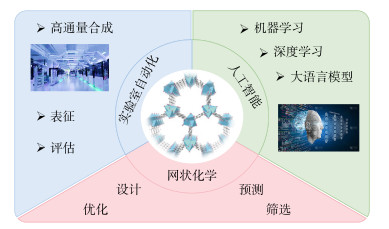 图 1 人工智能(AI)辅助网状化学研究Fig. 1 artificial intelligence(AI)-assisted in reticular chemistry research
 下载:
全尺寸图片
1. 网状框架材料合成方法
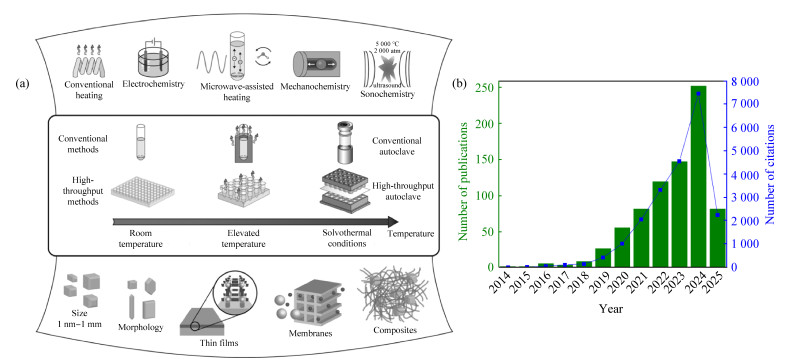
网状框架材料的合成方法在过去二三十年里已形成一套相对成熟但仍在不断扩展的技术路线,传统的合成方法包括但不限于水热/溶剂热合成、微波/超声辅助合成、微波加热、电化学合成以及机械化学合成等(图 2[13-14])。溶剂热技术虽设备需求较高,却能在产率与结晶度方面表现更佳。Yaghi团队首次报道MOF-5以来[15],在有机溶剂或水相中于密闭反应釜中在中高温条件下缓慢升温、长时间保温,已发展为获得高结晶度MOFs的“标准”合成路线;兰州大学王为教授等开发了一种单晶COFs的快速合成策略[16],显著将结晶时间从原来的15~80 d缩短至1~2 d,该方法实现了高品质大尺寸单晶(最大可达150 μm)的快速生长。近年发展出多种改进或替代的合成技术。如:Dey等[17]采用微波辅助法在分钟时间尺度内快速优化合成基于给体-受体结构的高结晶TzPm-COF,可以在较短时间内完成体系快速均匀加热,大大缩短了材料晶化时间;Biswal等[18]运用研磨或球磨等机械化学法成功制备了正交COFs,在近无溶剂条件下实现配位或缩合反应的加速,有望减少有机溶剂的使用并简化后处理过程;此外还有界面合成、室温扩散法以及电化学合成等方法生长网状框架材料。上述方法为研究网状框架材料的结构构筑机理及其合成规律奠定了重要基础。但在上述方法中,溶剂热技术耗时耗能,微波/声波法不容易放大制备,机械合成法虽然可以方便放大但对结晶的损耗大等,并且通常合成周期较长,人工参与度较高、实验难以重复以及实验数据易产生不一致性等问题,容易受到人为操作的影响以及环境因素的影响[19-22],从而导致实验结果可能会出现不一致性的可能。在网状框架材料制备表征以及性能测试方面,类似的挑战同样存在。在大规模实验条件下,借助传统实验模式的人工操作,不仅低效、高成本,且不易保证系统数据的可靠性[23-25]。为此,将AI引入网状框架材料的合成与表征过程,有望显著提升数据采集与分析的高通量水平,并在实验方案设计、工艺参数优化及结果预测等关键环节实现智能化决策。在此基础上进一步发展实验室自动化技术,将重塑网状框架材料研究的技术体系与发展格局[26]。目前,AI对网状化学领域的推动主要体现在大规模数据挖掘与性能预测方面,使研究人员更深入理解材料的结构与性质的关系,基于性能预测优化结构设计,促进材料实验设计的合理化与高效化。
 下载:
全尺寸图片
2. AI辅助网状框架材料合成
2.1 深度学习
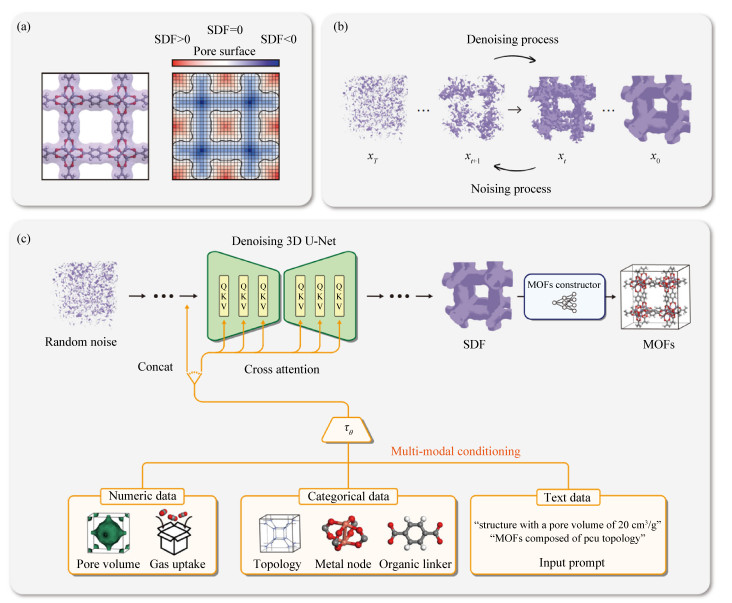
深度学习是一类基于多层神经网络的机器学习方法,具有较强的特征表达能力和非线性建模能力,尤其适合处理复杂、高维和跨尺度的科学问题。近年来深度学习在网状框架材料领域的研究发展迅速。目前已被广泛用于预测材料性能、设计新型结构以及优化合成路径等方面。以下基于深度神经网络模型[27-28]、Transformer模型[29-31]和扩散模型[32-34]等汇总MOFs研究的相关进展。Raccuglia等[35]采用深度神经网络,从大量实验和模拟数据中提取材料特征,通过整合这些数据,构建了能够揭示网状框架材料结构与性能关系的预测模型;Yao等[36]与Kim等[37]在Transformer模型中引入了可视化注意力权重分析技术, 通过识别金属簇、有机连接体及整体拓扑之间的相互作用,模型能够在高维特征空间中找出影响目标性能的关键结构单元;Park等[38]在Transformer基础上,提出了一种基于深度强化学习的MOFs逆向设计框架(图 3),该系统由生成器和性能预测器组成,生成器在潜在结构空间中提出候选MOFs骨架,性能预测器则快速评估其吸附性能,并向生成器反馈奖励信号以优化搜索策略;该框架成功生成了吸附性能优异的MOFs材料,为网状材料的理性筛选与高通量发现提供了算法支持。近年来,扩散模型也被用于MOFs结构生成,代表性工作包括MOFDiff和GHPMOFassemble共2种结构生成框架[39-40]。GHPMOFassemble主要关注有机连接体生成,而MOFDiff则通过扩散过程将随机噪声转化为MOFs的粗粒度三维结构,生成具有宏观有序性的材料。然而,这2类模型存在结构多样性不足、化学有效性有限等问题。针对这些局限,Park等[41]提出了MOFFUSION框架,该方法采用符号距离函数(signed distance function,SDF)精确描述MOFs的微观孔道结构,结合三维几何建模、深度学习与注意力机制,在生成结构的准确性和多样性方面取得了进展(图 4),MOFFUSION所生成的结构有效性高,支持多种条件控制,有望进一步拓展MOFs材料的生成应用。Cleeton等[42]提出的深度梦境方法,为MOFs结构自动化设计提供了新思路,该方法允许研究人员在计算环境中直接优化候选结构,显著提高了优化效率,并拓宽了MOFs的设计范围;Wang等[43]开发了Uni-MOF多任务预测框架,通过对大量三维MOFs表示进行学习,提升了模型的泛化能力与预测精度,实现了对MOFs气体吸附性能的准确预测。
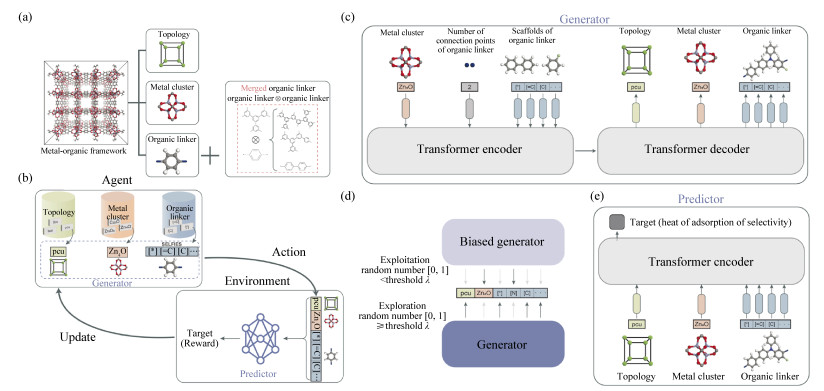 图 3 MOFs材料深度强化学习框架示意[38](a)材料结构;(b)强化学习框架;(c)架构设计;(d)生成器示意;(e)性能预测器架构Fig. 3 schematic illustration of the reinforcement learning framework for the inverse design of MOFs[38](a) schematic of data representation; (b) reinforcement learning framework; (c) the architecture design; (d) the schematic illustrates the generator; (e) the architecture of the predictor下载:
全尺寸图片
 下载:
全尺寸图片
在网状框架材料研究中,不同的深度学习模型各有特点,能够相互补充。如Transformer等模型擅长处理复杂的三维结构信息,其能整合多尺度数据,并准确预测材料在多种条件下的性质。基于SDF表示和扩散模型的方法,则侧重于保证材料孔道拓扑的连续性与几何约束的一致性,这使生成结构更具合理性,也更易按特定要求进行设计。深度强化学习则在逆向设计和优化搜索中表现突出,其能有效调控合成条件,寻找最优的材料设计方案。因此,Transformer等模型适合特征提取与属性预测,扩散模型适合高样本多样结构生成,而强化学习或混合体系则更适合与逆向设计和策略化、目标导向的优化搜索。此外,网状框架材料的发展离不开建设大规模结构数据库、发展高性能AI计算平台,以及开发自动化数据处理工具等基础设施,这将为数据驱动的材料设计、筛选与优化提供坚实基础,从网状框架结构建模的总体趋势来看,精确的结构表示会直接影响生成结构的尺寸、预测精度和模型的可解释性。将Transformer、扩散模型等技术与完善数据体系结合,进行精准调优,就能更有效地探索、表征和筛选网状框架材料。这一技术路径有望在未来实质性推动该领域的理性设计、优化与新材料的发现[44-47]。
2.2 LLMs阶段
LLMs通过在大量语料上的自监督训练,可系统地学习语言的语法结构、语义关联及上下文依赖关系,并具备跨任务的知识抽取与推理能力[8]。尽管从技术层面看,大语言模型可被视为深度学习的一种特定形式,但其核心优势并不体现在传统意义上的数值预测精度,而在于对非结构化文本信息的建模能力,以及对跨文献知识的整合与推理潜力。因此,本节将LLMs单独讨论,重点强调其在网状化学中的独特作用。典型的LLMs模型包括GPT系列(GPT-3、GPT-4、GPT-5)、DeepSeek、BERT[48-50]等。除用于文献信息的自动化挖掘与语义结构化处理外,LLMs在化学领域应用已拓展至性质预测、反应机理解析以及新分子、材料的智能生成等方向。凭借LLMs在跨尺度知识整合、上下文推理和复杂模式捕获方面的优势。使其可在多源化学数据与结构信息之间建立更具表达力的关联,将为加速理解化学行为和推动材料的计算设计提供新的技术路径。以下是汇总基于LLMs新模型网状化学领域研究的相关进展。
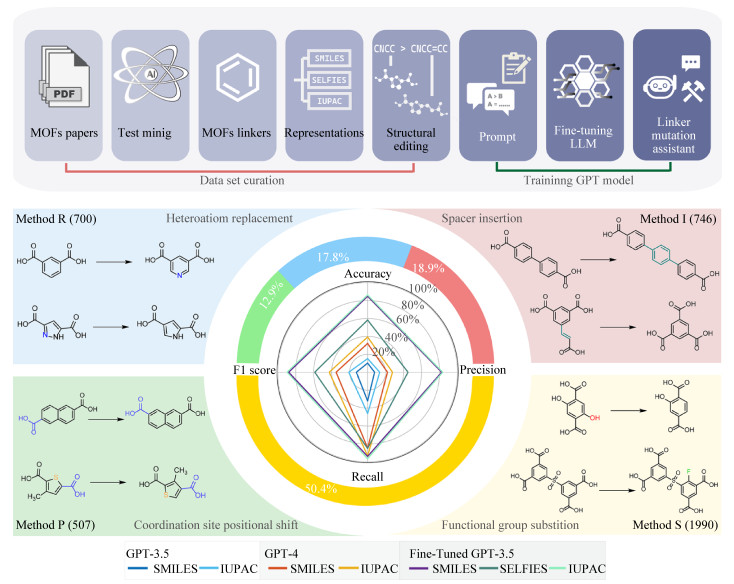
2023年, Yaghi课题组设计了GPT-4 Reticular Chemist框架[51],微调了GPT-3.5 Turbo,针对MOFs有机连接体生成的高品质数据库,展示了GPT模型在高性能MOFs的智能设计方面的巨大潜力;该课题组还结合ChemPrompt Engineering策略和ChatGPT模型(图 5)[52],实现了从MOFs合成条件数据的大规模有效挖掘和整理,显著加快了结构化数据集的构建进程,促进了基于机器学习预测MOFs晶体化条件预测模型发展;又将ChatGPT与贝叶斯优化(Bayesian optimization,BO)相结合[53],构建了一个可在化学实验室中并行协调多份科研工作的多智能体协同系统,加速搜索并验证了最佳的微波合成条件,显著提升了MOF-321、MOF-322和COF-323的结晶度,并同时优化了孔隙率与吸水性能。除Yaghi课题组之外,Dagdelen团队开发的MOF-JSON模型专为从MOFs文本中自动识别化学式、应用场景和客体分子等关键细节[54],实现高准确率与灵活性,为构建大规模结构化材料数据库提供了技术支撑;Kang和Kim[55]提出了ChatMOF模型,专为满足材料结构、性质以及合成过程的复杂任务要求;Liu课题组设计了配体变异和构建单元筛选模型的MOFs-LLM特化模型[56-57],进而实现跨越数十万种MOFs结构空间的搜索,并筛选出具有优异氢气储存性能的新型MOFs结构,为高性能网状骨架的探索提供了巨大的结构空间。
 下载:
全尺寸图片
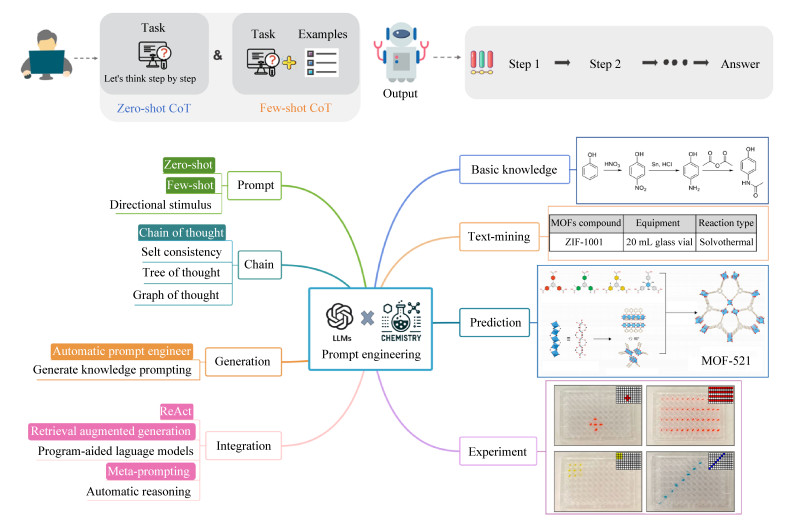
在已知前驱体组分的前提下,LLMs通过调整模型权重,对网状框架材料的制备可能性进行预测,在对大规模MOFs、COFs、沸石咪唑酯骨架(zeolitic imidazolate frameworks,ZIFs)等网状化学数据资料进行训练的基础上开发专门的LLMs模型[58-61], 可以精确预估材料的制备结果(图 6)[61]。Pruyn等[62]开发了MOF-ChemUnity模型,为基于文献的智能辅助,包括在文献检索、结构与性质关联推理以及MOFs材料推荐等方面有更准确、解释性和可信度;Zhang等[63]利用LLMs模型对由20种胺和26种醛为前驱体衍生构建的COFs材料进行筛选,仅需通过实验证实11种COFs即制备出了高发光量子产率为41.3%的COFs材料。传统的网状化学实验过程往往费时费力,其主要困难在于结晶条件需要通过大范围的筛选获得。为提高网状化学的实验效率,LLMs可以与实验室环境进行无缝整合,从而实现与研究人员、数字化控制系统、物理实验设备等的无缝对接,一方面使得不善于使用自动化工具或数字化设备的研究人员能够通过LLMs的界面快速访问和使用这些工具与平台; 另一方面,LLMs也得以成为实验室的一种辅助工具,极大地提高了实验室工作效率,加速发现新材料并优化新材料。
 下载:
全尺寸图片
尽管AI在网状框架材料的设计发现和性质预测上取得了显著进展,并展现出了广阔的前景,但在多方面仍存在局限性和挑战,需要进一步完善[64]。首先,训练数据的品质、覆盖范围等直接制约AI预测能力。研究表明缺乏高品质、多样化数据集会显著影响化学反应和材料预测模型的性能与可靠性,且传统置信度估计不能真正反映模型的不确定性。其次,大多数AI模型难以提供明确的因果机制或化学原理,这种不可解释性限制了模型在复杂合成路径选择和实验设计中的应用可信度。此外,在设计过程中产生的误差不仅限于AI模型预测,任何仿真或实验也具有一定的准确性。因此,了解误差在整个设计过程中的传播非常重要。再次,大多数研究集中在对AI辅助某些性能指标的优化,如MOFs对CO2吸附能力等。然而如果全面考虑设计过程,这种方法不仅限制了为整个设计过程找到真正最优解,还可能会带来了输出偏差,仅专注于某些指标的优化会限制发现新型网状框架材料的能力,而且这些材料的应用也可能是基于尚未研究的作用机制。因此,为了更广泛的网状框架材料设计流程,提升每个阶段的创新性将比单一指标的优化更为重要。这关键是发展能够衡量科学发现评估中新颖性的指标,有助于减少这种偏差。最后,即便AI提出了候选结构或优化路径,合成可行性问题仍然是实际的瓶颈。许多模型推荐的复杂网状框架材料在实际实验室条件下可能难以合成,原因包括未知的反应条件、催化剂选择、热力学/动力学限制等。
3. SDL促进网状框架材料合成
随着网状框架材料的不断发现和创新,以及化学研究体系的复杂度不断提升,实验中的变量越来越多,而现代实验平台合成实验所产生的数据呈指数级增长,传统实验中的调节手段在进行高维度化学空间的研究时,越来越表现出局限性。基于这一事实,从实验研究中引入AI已是提高研究效率的必然选择,因此发展并形成了SDL。该类研究通常并非单一算法的应用,而是将AI模型(包括深度学习与LLMs模型)与机器人平台、原位表征及反馈优化机制相结合,从而实现材料合成与性能评估的闭环运行。采用SDL与AI控制调节系统,SDL能够在高维度的反应变量空间中高效探索最优合成路线,代替以往需要依靠经验随机筛选的方式。在实际应用中,SDL可以对前驱物的配比、溶剂、温度程序、反应时长及添加比例等重要参数进行自动全面的控制并结合原位监测技术,对实验中的结晶过程、相变及产物形状等进行跟踪,在利用机器学习模型的反馈对策略进行实时调整的基础上,可以实现对实验中的合成条件进行自适应优化。Pilz等[25]利用SyCoFinder网络应用程序同时优化多项合成参数(如图 7(a)),成功实现了表面锚定MOFs生长过程中高结晶度与高取向性;Pilz等[65]进一步开展了降低MOFs薄膜的表面粗糙度系统研究,表明机器学习方法能够在逐层沉积过程中,通过优化多种沉积参数,有效引导HKUST-1薄膜的生长取向(图 7(b));Xie等[66]将机器人平台与BO相结合,引入了随机森林模型作为代理模型,辅助BO算法识别ZIF-67的最优合成条件(图 7(c));Smit团队借助最远点抽样技术和遗传算法及基于微波加热的机器人实验平台[67],对AI-PMOF的合成条件进行了系统性的优化与改进,实现了近80%的产率与结晶度,同时显著缩短了反应所需时间;Dai等[68]、Zhao等[69]介绍了SDL有望在新型网状材料的表征与性能评估环节发挥日益重要的作用(图 7(d))。SDL可实现实验流程的高度自动化与智能化,从前驱体与试剂的精准制备、反应条件的精准调控,到实时数据的获取、解析与反馈优化,各关键步骤均由AI系统自主执行,保证了实验的高效稳定性,这样可以提高实验的成功率和实验结果的重复性,消除人为因素的影响,实现实验的精确性。但是,网状框架材料的合成十分复杂,温度、压力、pH和反应时间等各种反应条件均对材料有影响,而且网状框架材料结构多样,每种合成产物都需要详细表征,而反应优化通常需要迭代实验,使得标准化和自动化变得困难。因此,网状框架材料的合成自动化技术和实验设备的整体成熟度仍然有限,阻碍了其广泛应用。想要真正实现端到端的AI全自主实验仍面临诸多瓶颈,包括实验设备自动化性能的进一步提升、样品处理与数据传输机制的优化等关键问题[68-70],这还需要更多层面的技术支持。此外,还需要开发实时原位表征与机器人自动化平台的深度集成系统,实时原位表征对于研究材料合成过程,捕捉反应中间态、理解动力学机制至关重要,但其与机器人平台的时序协调、设备兼容性、数据同步处理仍不成熟,这直接影响到自动决策算法的响应速度与优化效果;在多参数协同优化与反馈延迟问题方面,SDL系统面临高维参数空间(例如温度、反应时间、组成比等)优化时反馈循环的延迟问题尤为突出。由于实验执行与表征本身具有时间成本,模型在进行多参数优化时往往受限于延迟反馈带来的不确定性,从而影响优化路径速度。此外,现有算法在处理实验噪声和非平稳反馈时仍有不足,容易产生误导性决策。因此,未来研究趋势包括引入更具鲁棒性的实时数据融合与不确定性量化框架、多模型集成策略等自适应优化方法,以改进反馈响应和全局搜索能力,从而真正实现高效、可靠的闭环自主实验流程。
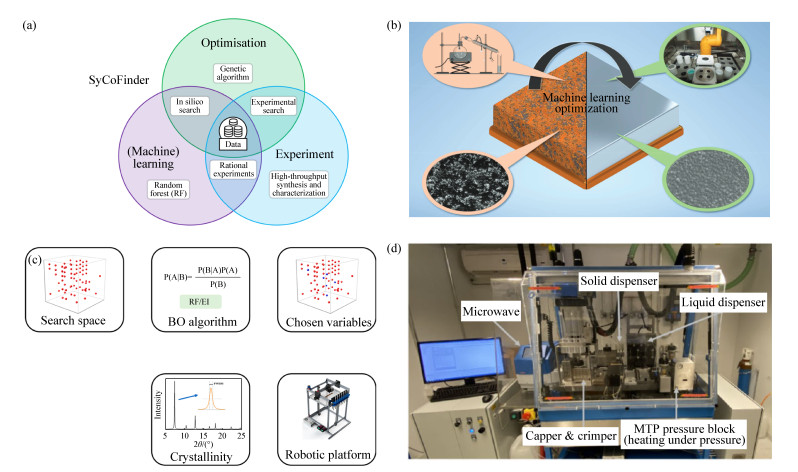 图 7 自动实验室(SDL)促进网状框架材料合成注:BO为贝叶斯优化; EI为期望改进;MTP为MOFs拓扑结构预测。
(a)SyCoFinder部分示意[25];(b)机器学习方法和自动化系统示意[65];(c)机器人平台与贝叶斯优化算法集成合成具有改进结晶度ZIF-67的过程[66];(d)机器人平台示意[69]Fig. 7 advancing the synthesis of reticular framework materials through self-driving laboratories (SDL)(a) a schematic of SyCoFinder[25]; (b) schematic illustration of machine learning and automated systems[65]; (c) schematic showing a process of synthesizing ZIF-67 with improved crystallinity via the integration of a robotic platform with the Bayesian optimization algorithm[66]; (d) robotic platform[69]下载:
全尺寸图片
4. 结束语
通过引入高效的AI算法,特别是基于大规模网状框架材料数据训练的Transformer与LLMs,研究人员能够更准确地预测材料性能,并为实验方案提供指导。这加快了新型网状框架材料的发现与优化速度。随着计算资源的不断增强,以及高性能深度学习架构、LLMs和SDL的发展,AI辅助工具正逐渐成为网状化学研究的常规手段。近期的研究进一步表明,多模态大模型正逐步融入材料科学研究,通过联合利用结构信息、表征数据与文本知识,实现对材料生成与性质预测的协同建模;与此同时,联合学习等新兴策略也开始被探索用于跨机构数据共享,在保护数据隐私的同时提升模型泛化能力,为构建更大规模、更高品质的材料智能体系提供了新的可能。尽管仍存在一些挑战,但网状化学的研究模式也将会发生转变:从过去依赖经验的合成方式,转向以数据和模型推理为核心的科研范式。这一转变将帮助我们更高效地探索复杂材料体系,推动实现更深层次、更有价值的科学突破。
-
图 1 人工智能(AI)辅助网状化学研究
Fig. 1 artificial intelligence(AI)-assisted in reticular chemistry research
下载:
全尺寸图片
下载:
全尺寸图片
图 3 MOFs材料深度强化学习框架示意[38]
(a)材料结构;(b)强化学习框架;(c)架构设计;(d)生成器示意;(e)性能预测器架构
Fig. 3 schematic illustration of the reinforcement learning framework for the inverse design of MOFs[38]
(a) schematic of data representation; (b) reinforcement learning framework; (c) the architecture design; (d) the schematic illustrates the generator; (e) the architecture of the predictor
下载:
全尺寸图片
下载:
全尺寸图片
下载:
全尺寸图片
下载:
全尺寸图片
图 7 自动实验室(SDL)促进网状框架材料合成
注:BO为贝叶斯优化; EI为期望改进;MTP为MOFs拓扑结构预测。
(a)SyCoFinder部分示意[25];(b)机器学习方法和自动化系统示意[65];(c)机器人平台与贝叶斯优化算法集成合成具有改进结晶度ZIF-67的过程[66];(d)机器人平台示意[69]Fig. 7 advancing the synthesis of reticular framework materials through self-driving laboratories (SDL)
(a) a schematic of SyCoFinder[25]; (b) schematic illustration of machine learning and automated systems[65]; (c) schematic showing a process of synthesizing ZIF-67 with improved crystallinity via the integration of a robotic platform with the Bayesian optimization algorithm[66]; (d) robotic platform[69]
下载:
全尺寸图片
-
[1] YAGHI O M, O'KEEFFE M, OCKWIG N W, et al. Reticular synthesis and the design of new materials[J]. Nature, 2003, 423(6941): 705-714. DOI: 10.1038/nature01650. [2] MOOSAVI S M, NANDY A, JABLONKA K M, et al. Understanding the diversity of the metal-organic framework ecosystem[J]. Nature Communications, 2020, 11: 4068. DOI: 10.1038/s41467-020-17755-8. [3] FURUKAWA H, CORDOVA K E, O'KEEFFE M, et al. The chemistry and applications of metal-organic frameworks[J]. Science, 2013, 341(6149): 1230444. DOI: 10.1126/science.1230444. [4] JABLONKA K M, ROSEN A S, KRISHNAPRIYAN A S, et al. An ecosystem for digital reticular chemistry[J]. ACS Central Science, 2023, 9(4): 563-581. DOI: 10.1021/acscentsci.2c01177. [5] LÜ H, JI Z, WUTTKE S, et al. Digital reticular chemistry[J]. Chem, 2020, 6(9): 2219-2241. DOI: 10.1016/j.chempr.2020.08.008. [6] WANG H C, FU T F, DU Y Q, et al. Scientific discovery in the age of artificial intelligence[J]. Nature, 2023, 620(7972): 47-60. DOI: 10.1038/s41586-023-06221-2. [7] REN Z C, REN Z K, ZHANG Z, et al. Autonomous experiments using active learning and AI[J]. Nature Reviews Materials, 2023, 8(9): 563-564. DOI: 10.1038/s41578-023-00588-4. [8] WHITE A D. The future of chemistry is language[J]. Nature Reviews Chemistry, 2023, 7(7): 457-458. DOI: 10.1038/s41570-023-00502-0. [9] BURGER B, MAFFETTONE P M, GUSEV V V, et al. A mobile robotic chemist[J]. Nature, 2020, 583(7815): 237-241. DOI: 10.1038/s41586-020-2442-2. [10] JIA X W, LYNCH A, HUANG Y H, et al. Anthropogenic biases in chemical reaction data hinder exploratory inorganic synthesis[J]. Nature, 2019, 573(7773): 251-255. DOI: 10.1038/s41586-019-1540-5. [11] KLUCZNIK T, MIKULAK-KLUCZNIK B, MCCORMACK M P, et al. Efficient syntheses of diverse, medicinally relevant targets planned by computer and executed in the laboratory[J]. Chem, 2018, 4(3): 522-532. DOI: 10.1016/j.chempr.2018.02.002. [12] SEGLER M H S, PREUSS M, WALLER M P. Planning chemical syntheses with deep neural networks and symbolic AI[J]. Nature, 2018, 555(7698): 604-610. DOI: 10.1038/nature25978. [13] STOCK N, BISWAS S. Synthesis of metal-organic frameworks (MOFs): routes to various MOF topologies, morphologies, and composites[J]. Chemical Reviews, 2011, 112(2): 933-969. DOI: 10.1021/cr200304e. [14] OZCAN A, COUDERT F X, ROGGE S M J, et al. Artificial intelligence paradigms for next-generation metal-organic framework research[J]. Journal of the American Chemical Society, 2025, 147(27): 23367-23380. DOI: 10.1021/jacs.5c08214. [15] LI H L, EDDAOUDI M, O'KEEFFE M, et al. Design and synthesis of an exceptionally stable and highly porous metal-organic framework[J]. Nature, 1999, 402(6759): 276-279. DOI: 10.1038/46248. [16] HAN J, FENG J, KANG J, et al. Fast growth of single-crystal covalent organic frameworks for laboratory X-ray diffraction[J]. Science, 2024, 383(6686): 1014-1019. DOI: 10.1126/science.adk8680. [17] DEY A, CHAKRABORTY S, SINGH A, et al. Microwave assisted fast synthesis of a donor‐acceptor COF towards photooxidative amidation catalysis[J]. Angewandte Chemie International Edition, 2024, 63(28): e202403093. DOI: 10.1002/anie.202403093. [18] BISWAL B P, CHANDRA S, KANDAMBETH S, et al. Mechanochemical synthesis of chemically stable isoreticular covalent organic frameworks[J]. Journal of the American Chemical Society, 2013, 135(14): 5328-5331. DOI: 10.1021/ja4017842. [19] GENG K Y, HE T, LIU R Y, et al. Covalent organic frameworks: design, synthesis, and functions[J]. Chemical Reviews, 2020, 120(16): 8814-8933. DOI: 10.1021/acs.chemrev.9b00550. [20] JIANG D L, TAN V G W, GONG Y F, et al. Semiconducting covalent organic frameworks[J]. Chemical Reviews, 2025, 125(13): 6203-6308. DOI: 10.1021/acs.chemrev.4c00950. [21] WANG Q, ASTRUC D. State of the art and prospects in metal-organic framework (MOF)-based and MOF-derived nanocatalysis[J]. Chemical Reviews, 2019, 120(2): 1438-1511. DOI: 10.1021/acs.chemrev.9b00223. [22] ZHAO M T, HUANG Y, PENG Y W, et al. Two-dimensional metal-organic framework nanosheets: synthesis and applications[J]. Chemical Society Reviews, 2018, 47(16): 6267-6295. DOI: 10.1039/c8cs00268a. [23] CHONG S Y, LEE S, KIM B, et al. Applications of machine learning in metal-organic frameworks[J]. Coordination Chemistry Reviews, 2020, 423: 213487. DOI: 10.1016/j.ccr.2020.213487. [24] ORHAN I B, DAGLAR H, KESKIN S, et al. Prediction of O2/N2 selectivity in metal-organic frameworks via high-throughput computational screening and machine learning[J]. ACS Applied Materials & Interfaces, 2021, 14(1): 736-749. DOI: 10.1021/acsami.1c18521. [25] PILZ L, NATZECK C, WOHLGEMUTH J, et al. Fully automated optimization of robot‐based MOF thin film growth via machine learning approaches[J]. Advanced Materials Interfaces, 2023, 10(3): 2201771. DOI: 10.1002/admi.202201771. [26] MOLINER M, SERRA J M, CORMA A, et al. Application of artificial neural networks to high-throughput synthesis of zeolites[J]. Microporous and Mesoporous Materials, 2005, 78(1): 73-81. DOI: 10.1016/j.micromeso.2004.09.018. [27] ZHANG X Q, JABLONKA K M, SMIT B. Deep learning-based recommendation system for metal-organic frameworks (MOFs)[J]. Digital Discovery, 2024, 3(7): 1410-1420. DOI: 10.1039/d4dd00116h. [28] LI W X, SITU Y Z, DING L F, et al. MOF-GRU: a MOFid-aided deep learning model for predicting the gas separation performance of metal-organic frameworks[J]. ACS Applied Materials & Interfaces, 2023, 15(51): 59887-59894. DOI: 10.1021/acsami.3c11790. [29] CHEN P C, TANG Z Y, ZENG Z M, et al. Machine-learning-guided morphology engineering of nanoscale metal-organic frameworks[J]. Matter, 2020, 2(6): 1651-1666. DOI: 10.1016/j.matt.2020.04.021. [30] GHOSH K, STUKE A, TODOROVIĆ M, et al. Deep learning spectroscopy: neural networks for molecular excitation spectra[J]. Advanced Science, 2019, 6(9): 1801367. DOI: 10.1002/advs.201801367. [31] KUMAR S, IGNACZ G, SZEKELY G. Synthesis of covalent organic frameworks using sustainable solvents and machine learning[J]. Green Chemistry, 2021, 23(22): 8932-8939. DOI: 10.1039/d1gc02796d. [32] IGASHOV I, STÄRK H, VIGNAC C, et al. Equivariant 3D-conditional diffusion model for molecular linker design[J]. Nature Machine Intelligence, 2024, 6(4): 417-427. DOI: 10.1038/s42256-024-00815-9. [33] WATSON J L, JUERGENS D, BENNETT N R, et al. De novo design of protein structure and function with RFdiffusion[J]. Nature, 2023, 620(7976): 1089-1100. DOI: 10.1038/s41586-023-06415-8. [34] LYNGBY P, THYGESEN K S. Data-driven discovery of 2D materials by deep generative models[J]. NPJ Computational Materials, 2022, 8(1): 232. DOI: 10.1038/s41524-022-00923-3. [35] RACCUGLIA P, ELBERT K C, ADLER P D F, et al. Machine-learning-assisted materials discovery using failed experiments[J]. Nature, 2016, 533(7601): 73-76. DOI: 10.1038/nature17439. [36] YAO Z P, SÁNCHEZ-LENGELING B, BOBBITT N S, et al. Inverse design of nanoporous crystalline reticular materials with deep generative models[J]. Nature Machine Intelligence, 2021, 3(1): 76-86. DOI: 10.1038/s42256-020-00271-1. [37] KIM B, LEE S, KIM J. Inverse design of porous materials using artificial neural networks[J]. Science Advances, 2020, 6(1): eaax9324. DOI: 10.1126/sciadv.aax9324. [38] PARK H, MAJUMDAR S, ZHANG X Q, et al. Inverse design of metal-organic frameworks for direct air capture of CO2 via deep reinforcement learning[J]. Digital Discovery, 2024, 3(4): 728-741. DOI: 10.1039/d4dd00010b. [39] PARK H, YAN X L, ZHU R J, et al. A generative artificial intelligence framework based on a molecular diffusion model for the design of metal-organic frameworks for carbon capture[J]. Communications Chemistry, 2024, 7(1): 21. DOI: 10.1038/s42004-023-01090-2. [40] FU X, XIE T, ROSEN A S, et al. Mofdiff: coarse-grained diffusion for metal-organic framework design[PP/OL]. arXiv(2023-10-16)[2025-09-12]. https://arxiv.org/abs/2310.10732. [41] PARK J, LEE Y, KIM J. Multi-modal conditional diffusion model using signed distance functions for metal-organic frameworks generation[J]. Nature Communications, 2025, 16: 34. DOI: 10.1038/s41467-024-55390-9. [42] CLEETON C, SARKISOV L. Inverse design of metal-organic frameworks using deep dreaming approaches[J]. Nature Communications, 2025, 16: 4806. DOI: 10.1038/s41467-025-59952-3. [43] WANG J Q, LIU J P, WANG H S, et al. A comprehensive transformer-based approach for high-accuracy gas adsorption predictions in metal-organic frameworks[J]. Nature Communications, 2024, 15: 1904. DOI: 10.1038/s41467-024-46276-x. [44] BOYD P G, CHIDAMBARAM A, GARCÍA-DÍEZ E, et al. Data-driven design of metal-organic frameworks for wet flue gas CO2 capture[J]. Nature, 2019, 576(7786): 253-256. DOI: 10.1038/s41586-019-1798-7. [45] BOBBITT N S, SHI K H, BUCIOR B J, et al. MOFX-DB: an online database of computational adsorption data for nanoporous materials[J]. Journal of Chemical & Engineering Data, 2023, 68(2): 483-498. DOI: 10.1021/acs.jced.2c00583. [46] BURNER J, LUO J, WHITE A, et al. ARC-MOF: a diverse database of metal-organic frameworks with DFT-derived partial atomic charges and descriptors for machine learning[J]. Chemistry of Materials, 2023, 35(3): 900-916. DOI: 10.1021/acs.chemmater.2c02485. [47] WILMER C E, LEAF M, LEE C Y, et al. Large-scale screening of hypothetical metal-organic frameworks[J]. Nature Chemistry, 2011, 4(2): 83-89. DOI: 10.1038/nchem.1192. [48] ZHENG Z L, ZHANG O F, BORGS C, et al. ChatGPT chemistry assistant for text mining and the prediction of MOF synthesis[J]. Journal of the American Chemical Society, 2023, 145(32): 18048-18062. DOI: 10.1021/jacs.3c05819. [49] BRAN A M, COX S, SCHILTER O, et al. Augmenting large language models with chemistry tools[J]. Nature Machine Intelligence, 2024, 6(5): 525-535. DOI: 10.1038/s42256-024-00832-8. [50] JABLONKA K M, SCHWALLER P, ORTEGA-GUERRERO A, et al. Leveraging large language models for predictive chemistry[J]. Nature Machine Intelligence, 2024, 6(2): 161-169. DOI: 10.1038/s42256-023-00788-1. [51] ZHENG Z L, RONG Z C, RAMPAL N, et al. A GPT‐4 reticular chemist for guiding MOF discovery[J]. Angewandte Chemie International Edition, 2023, 62(46): e202311983. DOI: 10.1002/anie.202311983. [52] ZHENG Z L, ALAWADHI A H, CHHEDA S, et al. Shaping the water-harvesting behavior of metal-organic frameworks aided by fine-tuned GPT models[J]. Journal of the American Chemical Society, 2023, 145(51): 28284-28295. DOI: 10.1021/jacs.3c12086. [53] ZHENG Z L, ZHANG O F, NGUYEN H L, et al. ChatGPT research group for optimizing the vrystallinity of MOFs and COFs[J]. ACS Central Science, 2023, 9(11): 2161-2170. DOI: 10.1021/acscentsci.3c01087. [54] DAGDELEN J, DUNN A, LEE S, et al. Structured information extraction from scientific text with large language models[J]. Nature Communications, 2024, 15: 1418. DOI: 10.1038/s41467-024-45563-x. [55] KANG Y H, KIM J. ChatMOF: an artificial intelligence system for predicting and generating metal-organic frameworks using large language models[J]. Nature Communications, 2024, 15: 4705. DOI: 10.1038/s41467-024-48998-4. [56] LIU Z M, SU Y Q, GUO Y J, et al. Post-pretraining large language model enabled reverse design of MOFs for hydrogen storage[PP/OL]. ChemRxiv(2024-03-21)[2025-09-12]. https://chemrxiv.org/engage/chemrxiv/article-details/65fbf03366c1381729744c2d. [57] ZHANG Z Y, HAN X, LIU Z Y, et al. ERNIE: enhanced language representation with informative entities[PP/OL]. arXiv(2019-05-17)[2025-09-12]. https://arxiv.org/abs/1905.07129. [58] ZHU X Y, LI J, LIU Y, et al. A survey on model compression for large language models[J]. Transactions of the Association for Computational Linguistics, 2024, 12: 1556-1577. DOI: 10.1162/tacl_a_00704. [59] XIANG H X, ZENG L, HOU L L, et al. A molecular video-derived foundation model for scientific drug discovery[J]. Nature Communications, 2024, 15: 9696. DOI: 10.1038/s41467-024-53742-z. [60] ZHENG Z L, RAMPAL N, INIZAN T J, et al. Large language models for reticular chemistry[J]. Nature Reviews Materials, 2025, 10(5): 369-381. DOI: 10.1038/s41578-025-00772-8. [61] LUO F F, ZHANG J L, WANG Q L, et al. Leveraging prompt engineering in large language models for accelerating chemical tesearch[J]. ACS Central Science, 2025, 11(4): 511-519. DOI: 10.1021/acscentsci.4c01935. [62] PRUYN T M, ASWAD A, KHAN S T, et al. MOF-ChemUnity: literature-informed large language models for metal-organic framework research[J]. Journal of the American Chemical Society, 2025, 147(47): 43474-43486. DOI: 10.1021/jacs.5c11789. [63] ZHANG L, DU J H, XIE Z K, et al. Discovery of highly fluorescent covalent organic frameworks through AI-assisted iterative experiment-learning cycles[J]. Nature Chemistry, 2025, 17(11): 1645-1654. DOI: 10.1038/s41557-025-01974-x. [64] MOOSAVI S M, JABLONKA K M, SMIT B. The role of machine learning in the understanding and design of materials[J]. Journal of the American Chemical Society, 2020, 142(48): 20273-20287. DOI: 10.1021/jacs.0c09105. [65] PILZ L, KOENIG M, SCHWOTZER M, et al. Enhancing the quality of MOF thin films for device integration through machine learning: a case study on HKUST‐1 SURMOF optimization[J]. Advanced Functional Materials, 2024, 34(44): 2404631. DOI: 10.1002/adfm.202404631. [66] XIE Y C, ZHANG C, DENG H, et al. Accelerate synthesis of metal-organic frameworks by a robotic platform and Bayesian optimization[J]. ACS Applied Materials & Interfaces, 2021, 13(45): 53485-53491. DOI: 10.1021/acsami.1c16506. [67] DOMINGUES N P, MOOSAVI S M, TALIRZ L, et al. Using genetic algorithms to systematically improve the synthesis conditions of Al-PMOF[J]. Communications Chemistry, 2022, 5(1): 170. DOI: 10.1038/s42004-022-00785-2. [68] DAI T W, VIJAYAKRISHNAN S, SZCZYPIŃSKI F T, et al. Autonomous mobile robots for exploratory synthetic chemistry[J]. Nature, 2024, 635(8040): 890-897. DOI: 10.1038/s41586-024-08173-7. [69] ZHAO Y M, ZHAO Y J, WANG J, et al. Artificial intelligence meets laboratory automation in discovery and synthesis of metal-organic frameworks: a review[J]. Industrial & Engineering Chemistry Research, 2025, 64(9): 4637-4668. DOI: 10.1021/acs.iecr.4c04636. [70] MOOSAVI S M, CHIDAMBARAM A, TALIRZ L, et al. Capturing chemical intuition in synthesis of metal-organic frameworks[J]. Nature Communications, 2019, 10: 539. DOI: 10.1038/s41467-019-08483-9.
