

Shot noise and its spectral decomposition in hybrid system of double quantum dots-topological superconductor
-
摘要: 研究了双量子点-拓扑超导纳米线混合系统中电子输运过程的散粒噪声。该系统中可存在多种相干隧穿机制,本文研究了混合系统中,Majorana束缚态和Poorman’s Majorana束缚态都不存在、二者分别存在和同时存在时4种情形下的散粒噪声。研究表明,2种束缚态相对应的相干隧穿都使低频和零频散粒噪声显著提升,但对散粒噪声特征谷深度和动力学行为的影响显著不同,这可作为区别二者的证据。此外,对散粒噪声谱进行分解,各噪声分量显示,系统-环境相互作用、单电子输运可以和电子相干隧穿相互竞争。本研究有助于深入理解Majorana束缚态的本质。
-
关键词:
- Majorana束缚态 /
- 量子点 /
- 散粒噪声 /
- 量子输运 /
- 谱分解
Abstract: The shot noise of electron transport processes in a hybrid system of double quantum dots coupled to topological superconducting nanowire is studied. There may be various coherent tunneling mechanisms in the system, and we investigate the shot noise in four cases of mixed systems, when the Majorana bound state and the Poorman's Majorana bound state do not exist, and when they exist respectively and simultaneously. It is found that two coherent tunneling mechanisms corresponding to the two bound states result in significant enhancement of the low and zero frequency shot noise, but affect the depth and dynamics behavior of the characteristic valley of shot noise significantly differently. It can provide evidence to distinguish Majorana bound states and Poorman's Majorana bound state. In addition, the shot noise spectral is decomposed. Studying the components, one finds that system-environment interactions, as well as single electron transport, competes with electron coherent tunneling. This paper contributes to a deeper understanding of the nature of Majorana bound states. -
0. 引言
Majorana费米子的反粒子为自身。理论表明,凝聚态物质中存在符合上述特性的准粒子,即Majorana束缚态(Majorana bound state,MBS)。MBS高度非局域化和基态简并,有望用于实现拓扑量子计算。目前已有多种实现MBS的模型,如半导体纳米线-超导体混合模型[1-2]、量子点阵列[3]、铁基超导体[4-5]和Josephson结[6-8]等。但是,二、三维模型较复杂,实验上难以被理想制备[9-12];量子点(quantum dot,QD)模型产生的零能束缚态不受拓扑保护,不满足拓扑的要求[13]。而一维拓扑超导(topological-superconducting,TSC)纳米线模型极具潜力,制备工艺也较成熟[14]。
基于这些模型,产生了多种检测MBS的方法,如对比不存在MBS时,MBS导致的共振Andreev反射使零偏压附近的电导率形成数值为2e2/h的峰,即零偏压电导峰(zero-bias peak,ZBP)[15-16];或MBS存在时的4π周期Josephson效应等[17-18]。但平凡Andreev束缚态(Andreev bound state,ABS)等也能产生类似信号[19-22],Cao等[23]研究了理想模型中存在或不存在MBS时,零频和低频散粒噪声显著不同,但实际模型可能存在与MBS相似的杂质态,而杂质态可能也产生相似信号。因此,应研究比较MBS和相似量子态的行为和性质。
由于电子输运的随机性,实际检测常用固定时长统计方法,这会遗失很多信息。近年来电子实时检测技术的进步促进了对介观系统动力学的研究[24-25]。在此基础上,统计隧穿固定数目粒子的时间及其涨落的散粒噪声可提供更多有益信息,并且除ZBP外,相对其他方法,散粒噪声法已有较大实验进展,有望在检测MBS上发挥重要作用[26-27]。
散粒噪声是载流子传输的离散特性导致的非平衡电流瞬时涨落,反映介观量子结构传输特性和载流子间不同类型相互作用等信息[28-31]。此外,对散粒噪声进行谱分解,研究各子过程的关联函数,可提供更多详细信息[32-33]。因此,可借助散粒噪声及其谱分解得到电子通过介观系统的输运特性,从而揭示MBS和相似量子态的不同性质,以及相应的电子相互作用类型。
本文考虑用“QD-TSC纳米线-QD”组成开放系统,再耦合普通电极形成测量回路。纳米线两端可产生并维持受拓扑保护的MBS;双量子点(double quantum dots,DQDs)既可作隧穿光谱仪揭示MBS的特征和拓扑跃迁,又能为隐形传态[34]和操纵MBS等研究提供思路[35-36]。一定条件下,QD耦合MBS的系统可形成平凡ABS[37]。此外,Leijnse和Flensberg[38]证实,DQDs中可形成所谓Poorman’s MBS(PMBS),这时,平凡ABS为PMBS取代。相比平凡ABS,PMBS与MBS更为相似,但不受拓扑保护,因此极具代表性。简单起见,本文模型中形成PMBS而非平凡ABS。
研究显示,相对于没有相干隧穿,MBS和PMBS都使零频和低频散粒噪声显著上升。这说明文献[23]所得表征MBS的信号在更一般的情形中不能唯一表征MBS。但本文研究显示,MBS和PMBS分别存在时散粒噪声特征谷深显著不同,可作为区别MBS和PMBS的信号。此外,MBS和PMBS的混杂使特征谷分裂,且MBS和PMBS的变化对系统行为的影响不同。由哈密顿量对角化可知MBS和PMBS对系统本征能级产生不同影响,另外对非局域能量本征态的局域态叠加权重也产生不同影响,这些影响反映在散粒噪声及其分量的波形变化中。
1. 模型
开放系统耦合普通金属电极组成的系统示意如图 1所示,QD-TSC纳米线-QD组成开放系统并且弱耦合到2个金属电极。纳米线两端承载MBS,DQDs处于强库伦阻塞区。电子在系统与金属电极之间,在系统各点位之间,通过量子隧穿进行传输。
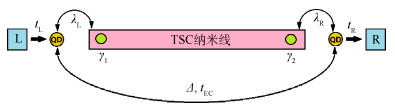 图 1 开放系统耦合普通金属电极组成的系统示意注:L和R分别表示左和右,QD表示量子点,TSC代表拓扑超导;γi (i= 1,2)为纳米线末端的Majorana束缚态;tα (α= L,R)为量子点和邻近电极的耦合强度;λα为量子点与邻近Majorana束缚态的耦合强度;Δ为超导邻近效应导致的双量子点耦合强度;tEC为双量子点间的弹性共隧穿强度。
 下载:
全尺寸图片
整个系统的哈密顿量(HT)表达式为
$$ H_{\mathrm{T}}=H_{\text {leads }}+H_{\text {tun }}+H_{\text {sys }}, $$ (1) 式中:Hleads表示左右电极的哈密顿量;Htun表示开放系统与电极相互作用的哈密顿量;Hsys表示开放系统的哈密顿量。其表达式分别为:
$$ H_{\text {leads }}=\sum\limits_{\alpha=\mathrm{L}, \mathrm{R}} \sum\limits_k \varepsilon_{\alpha k} c_{\alpha k}^{+} c_{\alpha k}, $$ (2) $$ H_{\text {tun }}=\sum\limits_{\alpha=\mathrm{L}, \mathrm{R}} \sum\limits_k t_\alpha d_\alpha c_{\alpha k}^{+}+\text {h.c. }, $$ (3) $$ \begin{aligned} & H_{\mathrm{sys}}=\varepsilon_{\mathrm{L}} d_{\mathrm{L}}^{+} d_{\mathrm{L}}+\varepsilon_{\mathrm{R}} d_{\mathrm{R}}^{+} d_{\mathrm{R}}+\frac{\mathrm{i}}{2} \varepsilon_{\mathrm{m}} \gamma_1 \gamma_2+\lambda_{\mathrm{L}}\left(d_{\mathrm{L}}^{+}-d_{\mathrm{L}}\right) \gamma_1+ \\ & \mathrm{i} \lambda_{\mathrm{R}}\left(d_{\mathrm{R}}^{+}+d_{\mathrm{R}}\right) \gamma_1+\mathit{\Delta }\left(d_{\mathrm{L}}^{+} d_{\mathrm{R}}^{+}+d_{\mathrm{R}} d_{\mathrm{L}}\right)+t_{\mathrm{EC}}\left(d_{\mathrm{L}}^{+} d_{\mathrm{R}}+d_{\mathrm{R}}^{+} d_{\mathrm{L}}\right), \end{aligned} $$ (4) 式中:cαk+ (cαk)(α = L,R)为电极α中的电子产生(湮灭)算符;εαk和k分别为电极中电子能量和波矢;dα+ (dα) 为QD中的电子产生(湮灭)算符;tα为QD和邻近电极的耦合强度;γi (i= 1,2) 为纳米线末端承载的MBS,满足γi = γi+,{γi,γj} = 2δij;εα为QD的能级,εm ~e-l/ξSC为纳米线两端MBS间的分裂能,l为纳米线长度,ξSC为超导相干长度;λα为QD与邻近MBS间的耦合强度,不考虑电子自旋时取为实数;Δ为超导邻近效应导致的DQDs耦合强度;tEC为DQDs间的弹性共隧穿强度。本文选超导化学势为能量参考点。
引入非局域Dirac费米子(f)表示拓扑纳米线中的非局域电子,f满足{f,f+} = 1。令γ1 = f+ + f,γ2= i (f+-f)。Hsys可改写为
$$ \begin{gathered} H_{\mathrm{sys}}=\varepsilon_{\mathrm{L}} d_{\mathrm{L}}^{+} d_{\mathrm{L}}+\varepsilon_{\mathrm{R}} d_{\mathrm{R}}^{+} d_{\mathrm{R}}+\varepsilon_{\mathrm{m}}\left(f^{+} f-\frac{1}{2}\right)+ \\ \lambda_{\mathrm{L}}\left(d_{\mathrm{L}}^{+} f+f^{+} d_{\mathrm{L}}\right)+\eta_1 \lambda_{\mathrm{L}}\left(d_{\mathrm{L}}^{+} f^{+}+f d_{\mathrm{L}}\right)+ \\ \lambda_{\mathrm{R}}\left(d_{\mathrm{R}}^{+} f+f^{+} d_{\mathrm{R}}\right)-\eta_2 \lambda_{\mathrm{R}}\left(d_{\mathrm{R}}^{+} f^{+}+f d_{\mathrm{R}}\right)+ \\ \mathit{\Delta }\left(d_{\mathrm{L}}^{+} d_{\mathrm{R}}^{+}+d_{\mathrm{R}} d_{\mathrm{L}}\right)+t_{\mathrm{EC}}\left(d_{\mathrm{L}}^{+} d_{\mathrm{R}}+d_{\mathrm{R}}^{+} d_{\mathrm{L}}\right), \end{gathered} $$ (5) 式中:非局域Dirac费米子占据数nf = f+ f;普通Dirac费米子占据数nα = dα+ dα。上述过程中,引入η1 =η2 = 1或0。η1 = η2 = 1时,系统中存在MBS和QD的耦合,此时DQDs和纳米线间存在超导邻近效应导致的电子配对耦合(∝ dα+ f+,fdα),表明超导体可吸收来自左(右)QD和纳米线的一对电子形成库珀对,或分裂一个库珀对并释放一对电子占据左(右)QD和纳米线,使电子数不守恒;η1 = η2= 0时不存在这样的耦合。Dirac费米子在粒子数表象中,系统状态可表示为|nLnRnf〉,其中nL,nR,nf取0或1,为各点位电子占据数。因此,|nLnRnf〉张开八维希尔伯特空间,并被分为偶宇称子空间{|000〉,|011〉,|101〉,|110〉}和奇宇称子空间{|001〉,|010〉,|100〉,|111〉}。
在粒子数表象中将上述局域态按顺序取为基矢。哈密顿量对角化可得系统本征能级和能量本征态。简便起见,取tEC = Δ ≥ 0,λL = λR = λ ≥ 0,εm = εL = εR = 0,则奇偶宇称空间本征能级简并,均为±Δ,$\pm \sqrt{\mathit{\Delta }^2+4 \lambda^2}$,偶宇称空间相应的能量本征态分别为{{1,(Δ + $\sqrt{\mathit{\Delta }^2+\lambda^2}$)/(2λ),- (Δ + $\sqrt{\mathit{\Delta }^2+\lambda^2}$)/(2λ),1},{-1,0,0,1},{0,1,1,0},{1,(Δ - $\sqrt{\mathit{\Delta }^2+\lambda^2}$)/(2λ),(- Δ+ $\sqrt{\mathit{\Delta }^2+\lambda^2}$)/(2λ),1}};奇宇称空间能量本征态分别为{{-1,(-Δ+$\sqrt{\mathit{\Delta }^2+\lambda^2}$)/(2λ),(- Δ+ $\sqrt{\mathit{\Delta }^2+\lambda^2}$)/(2λ),1},{0,- 1,1,0},{1,0,0,1},{-1,(- Δ - $\sqrt{\mathit{\Delta }^2+\lambda^2}$)/(2λ),(- Δ - $\sqrt{\mathit{\Delta }^2+\lambda^2}$)/(2λ),1}}(本征态按能级由低到高排列)。
2. 量子主方程和散粒噪声
将系统作为研究对象,左右电极及导线连通部分视为系统所处的环境,由Markov广义主方程可得系统约化密度矩阵运动方程[39]。在Born、Markov近似和大电压极限下系统密度算符(ρ)的表达式为(取$\hbar$ = e= 1)
$$ \begin{gathered} \dot{\rho}=L_{\mathrm{sys}} \rho-\frac{1}{2} \mathit{\Gamma }_{\mathrm{L}}\left(\rho d_{\mathrm{L}} d_{\mathrm{L}}^{+}+d_{\mathrm{L}} d_{\mathrm{L}}^{+} \rho-2 d_{\mathrm{L}}^{+} \rho d_{\mathrm{L}}\right)- \\ \frac{1}{2} \mathit{\Gamma }_{\mathrm{R}}\left(\rho d_{\mathrm{R}}^{+} d_{\mathrm{R}}+d_{\mathrm{R}}^{+} d_{\mathrm{R}} \rho-2 d_{\mathrm{R}} \rho d_{\mathrm{R}}^{+}\right), \end{gathered} $$ (6) 式中:Lsys O=- i [Hsys,O];Γα = 2πga|tα|2,ga是电极α中的态密度,假定电极不受电子隧穿扰动。大电压近似下,电子在系统内单向运动,系统的全部通道参与输运。
不失代表性,研究电子从右QD离开系统的跳跃过程,取跳跃算符为JR,将式(6)重写为
$$ \dot{\rho}=L \rho, L=L_0+J_{\mathrm{R}}, $$ (7) 式中JR ρ = ΓR dR ρdR+描述电子离开系统的跳跃过程。
由式(7)易得系统输运性质。右电极测得的散粒噪声定义为[40]
$$ S_{\mathrm{RR}}(\omega)=\frac{1}{2} \int_{-\infty}^{\infty} \mathrm{d} t\left(\mathrm{e}^{-\mathrm{i} \omega t}\left\langle\left\{\delta \hat{I}_{\mathrm{R}}(t), \delta \hat{I}_{\mathrm{R}}(0)\right\}\right\rangle\right), $$ (8) 式中δ ÎR(t) = ÎR(t) - 〈ÎR(t)〉,ÎRρ = JR ρ[41]。运用McDonald公式和量子回归定理[40, 42]可得
$$ S_{\mathrm{RR}}(\omega)=I_{\mathrm{R}}-\frac{1}{2}\left\{{\sum}_{ \pm} \operatorname{Tr} J_{\mathrm{R}} \frac{1}{ \pm \mathrm{i} \omega+L} J_{\mathrm{R}} \rho_0+(\mathrm{R} \leftrightarrow \mathrm{R})\right\}, $$ (9) 式中:ρ0为稳态密度算符;IR = Tr [JR ρ]。
为探究电子经过系统时子输运过程的关联性及其反映的输运特性,将SRR分解[40]为
$$ J_{\mathrm{R}}={\sum}_k J_{\mathrm{R}}^k, S_{\mathrm{RR}}={\sum}_{k, l} S_{\mathrm{RR}}^{k, l}, $$ (10) 式中:k,l代表子跳跃过程类型,取值为1~8的整数。JR1ρ表示电子从右QD隧穿到右电极,使系统由|010〉跃迁到|000〉;JR2 ρ使系统由|111〉跃迁到|101〉;JR3 ρ使系统由|011〉跃迁到|001〉;JR4 ρ使系统由|110〉跃迁到|100〉;JR5 ρ~JR8ρ表示跳跃前系统处于某子空间内局域态相干的态,跳跃后处于另一子空间内局域态相干的态。易得
$$ S_{\mathrm{RR}}^{k, l}(\omega)=\delta_{k l} I_l-\frac{1}{2}\left\{{\sum}_{ \pm} \operatorname{Tr} J_{\mathrm{R}}^k \frac{1}{ \pm \mathrm{i} \omega+L} J_{\mathrm{R}}^l \rho_0+(k \leftrightarrow l)\right\} 。 $$ (11) 显然,SRRkl (ω) 对k,l对称,以下SRRkl (ω) 均记作Skl (ω)。
3. 结果与分析
3.1 系统的散粒噪声
本研究中始终取εL = εR = εm = 0,ΓR = ΓL。首先验证前人提出的一种用以表征MBS的信号,将其结果和含PMBS的系统以及普通系统的结果进行对比研究,并进一步比较MBS和PMBS混杂时二者分别变化的影响,相应的含频散粒噪声如图 2所示。
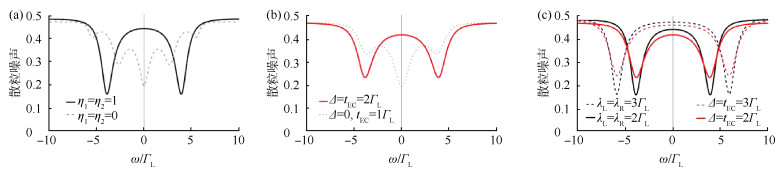 图 2 MBS和PMBS分别存在时含频散粒噪声 (a)含MBS系统与普通系统的比较;(b)含PMBS系统与普通系统的比较;(c)含MBS系统与含PMBS系统的比较注:MBS为Majorana束缚态;PMBS为Poorman’s MBS。下载:
全尺寸图片
含MBS的系统如图 2(a)所示。取λL = λR = 2ΓL,Δ = tEC= 0,相对η1 = η2= 0,η1 = η2= 1时系统零频和低频噪声显著提高。这表明,η1 = η2= 1时超导体与纳米线-QD间的(MBS相关)相干隧穿使零频与低频噪声显著提升。此外,本文做了另一种探讨,取λL = λR= 0,含PMBS的系统如图 2(b)所示。由于λL = λR= 0,图中没有MBS相关的相干隧穿,但可能存在超导体与DQDs间(PMBS相关)的相干隧穿。PMBS也使零频与低频噪声显著增大,可知零频与低频噪声显著提升并非MBS的真实特征信号。
为得到MBS真实特征信号,本文比较了MBS和PMBS分别存在时的散粒噪声,如图 2(c)所示,取η1=η2 = 1。MBS(Δ = tEC = 0)和PMBS(λL = λR = 0)都使零频和低频噪声形成峰,在ω ≈ ±2λ (或Δ) 处形成谷。随MBS或PMBS的效应增强,零频和低频噪声逐渐上升,谷逐渐向高频移动。但MBS对应的谷明显比PMBS深,可做区分MBS和PMBS的依据。
而二者混杂时,散粒噪声呈现不同特征,如图 3所示,始终取η1 = η2= 1。2种量子态混杂时相互影响导致谷分裂,在ω ≈ 2λ处形成峰,而正频(或负频)两谷间距≈ 2Δ。取MBS不变(λL = λR = 2ΓL),随PMBS增强,零频和低频噪声基本不变,但内侧谷向低频移动,外侧谷向高频移动(图 3(a));取PMBS不变(Δ = tEC= 1ΓL),随MBS增强,零频和低频噪声逐渐增强,谷都向高频移动,正频谷间距不变(图 3(b))。MBS和PMBS对谷行为的影响根本不同,这也可用以区分MBS和PMBS。
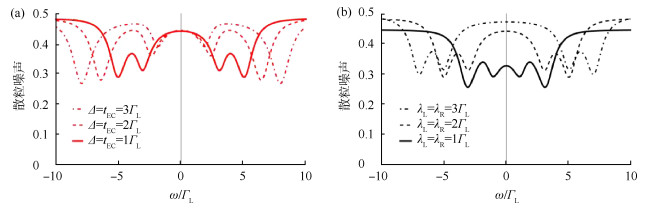 图 3 MBS和PMBS混杂时分别对含频散粒噪声的影响 (a)MBS不变,PMBS变化;(b)PMBS不变,MBS变化下载:
全尺寸图片
谷的行为反映系统本征能级差的变化。由哈密顿对角化可知,MBS和PMBS混杂导致本征能级分裂。PMBS开始与MBS作用使最初零能级产生线性分裂,新能级为±Δ,基态能级和最高激发态能级为$\pm \sqrt{16+\mathit{\Delta }^2}$,随PMBS效应增强,$- \sqrt{16+\mathit{\Delta }^2}$与±Δ的差分别变小和变大,能级±Δ的差为2Δ(图 3(a))。MBS开始与PMBS作用使能级±1中分出新能级$\pm \sqrt{(2 \lambda)^2+1}$,随MBS效应增强,基态能级$- \sqrt{(2 \lambda)^2+1}$与能级±1的差都变大,能级±1的差恒为2,见图 3(b)。
3.2 噪声谱分解及其分量研究
为研究各分量的贡献及MBS和PMBS对分量的影响,对散粒噪声进行谱分解,各分量对应的跳跃和演化过程如表 1所示。
表 1 散粒噪声分量对应的跳跃和演化过程分量 跳跃过程 演化过程 S11 (ω) |010 > -- > |000 > →|010 > -- > |000 > |010 > -- > |000 > →|010 > -- > |000 > S22 (ω) |111 > -- > |101 > →|111 > -- > |101 > |111 > -- > |101 > →|111 > -- > |101 > S33 (ω) |011 > -- > |001 > →|011 > -- > |001 > |011 > -- > |001 > →|011 > -- > |001 > S44 (ω) |110 > -- > |100 > →|110 > -- > |100 > |110 > -- > |100 > →|110 > -- > |100 > S14 (ω) |010 > -- > |000 > →|110 > -- > |100 > |110 > -- > |100 > →|010 > -- > |000 > S23 (ω) |111 > -- > |101 > →|011 > -- > |001 > |011 > -- > |001 > →|111 > -- > |101 > S12 (ω) |010 > -- > |000 > →|111 > -- > |101 > |111 > -- > |101 > →|010 > -- > |000 > S13 (ω) |010 > -- > |000 > →|011 > -- > |001 > |011 > -- > |001 > →|010 > -- > |000 > S24 (ω) |111 > -- > |101 > →|110 > -- > |100 > |110 > -- > |100 > →|111 > -- > |101 > S34 (ω) |011 > -- > |001 > →|110 > -- > |100 > |110 > -- > |100 > →|011 > -- > |001 > 注:表中-- > 表示跳跃过程;→表示演化过程。 首先比较含MBS的系统(η1 = η2= 1)和普通系统(η1 = η2= 0)的散粒噪声谱分解,如图 4所示,取λL=λR = 2ΓL,Δ = tEC = 0。总散粒噪声的确等于各分量之和,自关联分量对SRR (ω) 的贡献占主要地位。相干隧穿使各不恒为零的分量的零频和低频噪声明显上升,S14 (0) 和S23 (0)(及对称分量)最显著。S11 (0)、S22 (0)、S33 (0)、S44 (0)、S14 (0) 和S23 (0)均 > 0,S12 (0)、S13 (0)、S24 (0) 和S34 (0) 均 < 0。结合表 1可知,nf点位占据数在演化始末发生0、1转换的分量,零频噪声 < 0;未转换的 > 0。对Sij (0) > 0(< 0),nL点位变化的分量,零频噪声相对更小。表明距右电极越近的点位上电子产生和湮灭导致的波函数变化对右电极测的零频噪声影响越大。相对η1 = η2= 0,相干输运大幅抑制各点位单独变化,使各不恒为零的分量的零频和低频噪声提高。
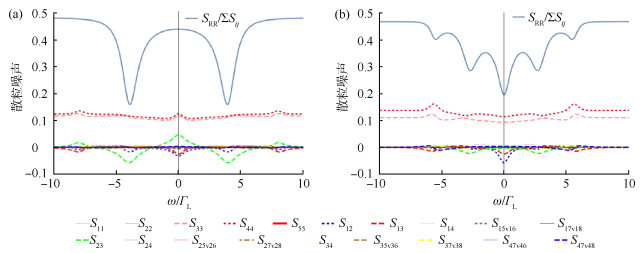 图 4 普通系统和MBS系统的含频散粒噪声及其分解 (a)含MBS系统;(b)普通系统注:每对对称分量相等,其他缺少分量为0;Sij (ω) 均简写为Sij。下载:
全尺寸图片
由图 4(a)可知,S14 (ω) 和S23 (ω) 对总相干散粒噪声线形影响特别显著。由表 1和非局域能量本征态知,S14(ω) 和S23(ω) 对应的演化过程为幺正演化,通过吸收、释放能量,系统态在能量本征态间跃迁,而基态的叠加局域态间更易发生相干隧穿,低激发态的叠加局域态间更易发生单电子隧穿。其他分量对应的演化过程受JL跳跃或单电子输运影响,发生能量本征态间跃迁的概率较小。
进一步研究MBS和PMBS混杂对能级的影响和各分量对散粒噪声及其波形的贡献,PMBS的变化对含频散粒噪声及分量的影响如图 5所示。MBS始终不变(λL = λR= 2ΓL),能级变化主要反映为S14 (ω) 和S23 (ω) 的行为变化,其谷行为与图 3(a)中总谱一致。随PMBS增强,不恒为零的分量的零频和低频噪声强度均增强,相应的峰和谷都变得越来越尖锐,但是其变化相互抵消,使总谱的零频和低频噪声基本不变。变化过程中,基态能级$-\sqrt{16+\mathit{\Delta }^2}$和能级- Δ靠近,从而基态和第一激发态趋向简并;基态的叠加局域态中DQDs配对耦合和非配对耦合的态叠加权重逐渐产生差距,使局域态被分为2组,一组利于相干隧穿,一组利于非相干隧穿。即PMBS的增强强化了DQDs之间的联系,而PMBS不受拓扑保护,使DQDs间的单电子输运和相干输运均更易发生,从而正的和负的零频和低频噪声强度都增强,但变化量相互抵消。
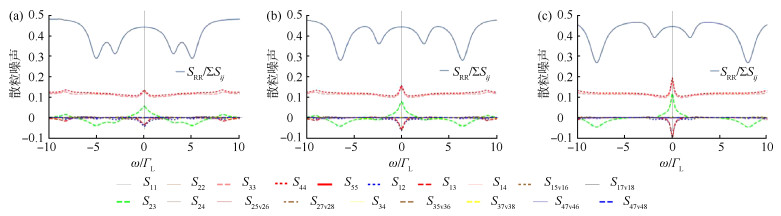 图 5 PMBS的变化对含频散粒噪声及分量的影响 (a)Δ = tEC = 1ΓL;(b)Δ = tEC = 2ΓL;(c)Δ = tEC = 3ΓL下载:
全尺寸图片
MBS的变化对含频散粒噪声及分量的影响如图 6所示。PMBS始终不变(Δ = tEC= 1ΓL),随MBS与QD耦合强度增强,负的零频和低频噪声被进一步抑制,S11 (ω) 和S33 (ω) 上移与其他自关联分量趋于重叠,S14 (ω) 和S23 (ω) 的谷向高频移动。MBS受拓扑保护,随MBS与QD耦合强度增强,有关相干隧穿更易发生,对单电子输运的抑制变强。结合哈密顿量对角化和表 1知,基态中的nL,nf点位和nR,nf点位分别配对耦合的局域态叠加权重趋向均等,因此自关联分量逐渐重叠,同时更有利于MBS关联的相干隧穿。这2点导致总噪声谱的零频和低频噪声逐渐升高。
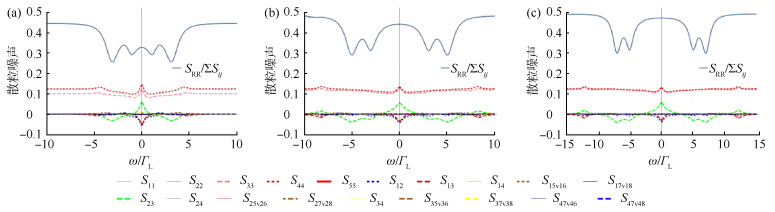 图 6 MBS的变化对含频散粒噪声及分量的影响 (a)λL = λR = 1ΓL;(b)λL = λR = 2ΓL;(c)λL = λR = 3ΓL下载:
全尺寸图片
4. 结论
本文研究了4种情况下系统的散粒噪声。研究表明:(1)系统中存在相干隧穿时,零频和低频噪声显著升高。但系统中可存在多种相干隧穿,其中一种与MBS相关,一种与PMBS相关。(2)二者分别存在时,散粒噪声某些行为相似,但有明显不同的特征谷深度;二者混杂时,散粒噪声随MBS和PMBS的变化表现出不同行为。这是因为MBS和PMBS对系统本征能级和非局域能量本征态的局域态叠加权重有不同的影响,这些都可作为MBS存在的证据。(3)通过散粒噪声谱分解,表明相干噪声与系统演化中的电子相互作用有关,系统-环境相互作用以及单电子输运可与相干隧穿相互抑制,其相互作用导致了噪声谱中谷和峰的变化。
-
图 1 开放系统耦合普通金属电极组成的系统示意
注:L和R分别表示左和右,QD表示量子点,TSC代表拓扑超导;γi (i= 1,2)为纳米线末端的Majorana束缚态;tα (α= L,R)为量子点和邻近电极的耦合强度;λα为量子点与邻近Majorana束缚态的耦合强度;Δ为超导邻近效应导致的双量子点耦合强度;tEC为双量子点间的弹性共隧穿强度。
下载:
全尺寸图片
图 2 MBS和PMBS分别存在时含频散粒噪声 (a)含MBS系统与普通系统的比较;(b)含PMBS系统与普通系统的比较;(c)含MBS系统与含PMBS系统的比较
注:MBS为Majorana束缚态;PMBS为Poorman’s MBS。
下载:
全尺寸图片
图 3 MBS和PMBS混杂时分别对含频散粒噪声的影响 (a)MBS不变,PMBS变化;(b)PMBS不变,MBS变化
下载:
全尺寸图片
图 4 普通系统和MBS系统的含频散粒噪声及其分解 (a)含MBS系统;(b)普通系统
注:每对对称分量相等,其他缺少分量为0;Sij (ω) 均简写为Sij。
下载:
全尺寸图片
图 5 PMBS的变化对含频散粒噪声及分量的影响 (a)Δ = tEC = 1ΓL;(b)Δ = tEC = 2ΓL;(c)Δ = tEC = 3ΓL
下载:
全尺寸图片
图 6 MBS的变化对含频散粒噪声及分量的影响 (a)λL = λR = 1ΓL;(b)λL = λR = 2ΓL;(c)λL = λR = 3ΓL
下载:
全尺寸图片
表 1 散粒噪声分量对应的跳跃和演化过程
分量 跳跃过程 演化过程 S11 (ω) |010 > -- > |000 > →|010 > -- > |000 > |010 > -- > |000 > →|010 > -- > |000 > S22 (ω) |111 > -- > |101 > →|111 > -- > |101 > |111 > -- > |101 > →|111 > -- > |101 > S33 (ω) |011 > -- > |001 > →|011 > -- > |001 > |011 > -- > |001 > →|011 > -- > |001 > S44 (ω) |110 > -- > |100 > →|110 > -- > |100 > |110 > -- > |100 > →|110 > -- > |100 > S14 (ω) |010 > -- > |000 > →|110 > -- > |100 > |110 > -- > |100 > →|010 > -- > |000 > S23 (ω) |111 > -- > |101 > →|011 > -- > |001 > |011 > -- > |001 > →|111 > -- > |101 > S12 (ω) |010 > -- > |000 > →|111 > -- > |101 > |111 > -- > |101 > →|010 > -- > |000 > S13 (ω) |010 > -- > |000 > →|011 > -- > |001 > |011 > -- > |001 > →|010 > -- > |000 > S24 (ω) |111 > -- > |101 > →|110 > -- > |100 > |110 > -- > |100 > →|111 > -- > |101 > S34 (ω) |011 > -- > |001 > →|110 > -- > |100 > |110 > -- > |100 > →|011 > -- > |001 > 注:表中-- > 表示跳跃过程;→表示演化过程。 -
[1] SCHURAY A, RAMMLER M, RECHER P. Signatures of the Majorana spin in electrical transport through a Majorana nanowire[J]. Physical Review B, 2020, 102(4): 045303. doi: 10.1103/PhysRevB.102.045303 [2] GHARAVI K, HOVING D, BAUGH J. Readout of Majorana parity states using a quantum dot[J]. Physical Review B, 2016, 94(15): 155417. doi: 10.1103/PhysRevB.94.155417 [3] STENGER J P T, WOODS B D, FROLOV S M, et al. Control and detection of Majorana bound states in quantum dot arrays[J]. Physical Review B, 2018, 98(8): 085407. doi: 10.1103/PhysRevB.98.085407 [4] WANG D F, KONG L Y, FAN P, et al. Evidence for Majorana bound states in an iron-based superconductor[J]. Science, 2018, 362(6412): 333-335. doi: 10.1126/science.aao1797 [5] PERRIN V, CIVELLI M, SIMON P. Identifying Majorana bound states by tunneling shot-noise tomography[J]. Physical Review B, 2021, 104(12): 121406. doi: 10.1103/PhysRevB.104.L121406 [6] YAVILBERG K, GINOSSAR E, GROSFELD E. Differentiating Majorana from Andreev bound states in a superconducting circuit[J]. Physical Review B, 2019, 100(24): 241408(R). doi: 10.1103/PhysRevB.100.241408 [7] PENG C N, HAIM A, KARZIG T, et al. Floquet Majorana bound states in voltage-biased planar Josephson junctions[J]. Physical Review Research, 2021, 3: 023108. doi: 10.1103/PhysRevResearch.3.023108 [8] MELO A, RUBBERT S, AKHMEROV A R. Supercurrent-induced Majorana bound states in a planar geometry[J]. SciPost Physics, 2019, 7: 039. doi: 10.21468/SciPostPhys.7.3.039 [9] PAN X H, LUO X J, GAO J H, et al. Detecting and braiding higher-order Majorana corner states through their spin degree of freedom[J]. Physical Review B, 2022, 105(19): 195106. doi: 10.1103/PhysRevB.105.195106 [10] YAN Z B, WU Z G, HUANG W. Vortex end Majorana zero modes in superconducting Dirac and Weyl semimetals[J]. Physical Review Letters, 2020, 124(25): 257001. doi: 10.1103/PhysRevLett.124.257001 [11] SCHULZ F, PLEKHANOV K, LOSS D, et al. Majorana bound states in topological insulators with hidden Dirac points[J]. Physical Review Research, 2020, 2(3): 033215. doi: 10.1103/PhysRevResearch.2.033215 [12] OSHIMA D, IKEGAYA S, SCHNYDER A P, et al. Flat-band Majorana bound states in topological Josephson junctions[J]. Physical Review Research, 2022, 4(2): 022051. [13] WANG X Q, WU B H, ZHANG S F, et al. Influences of electron-phonon interaction on quantum transport through one quantum-dot system with side-coupled Majorana zero mode[J]. Annals of Physics, 2020, 415(1): 168127. [14] FU W, KE S S, GUO Y, et al. Waiting time distribution and current correlations via a Majorana single-charge transistor[J]. Physical Review B, 2022, 106(7): 075404. doi: 10.1103/PhysRevB.106.075404 [15] WIMMER M, AKHMEROV A R, DAHLHAUS J P, et al. Quantum point contact as a probe of a topological superconductor[J]. New Journal of Physics, 2011, 13: 053016. doi: 10.1088/1367-2630/13/5/053016 [16] LAW K T, LEE P A, NG T K. Majorana Fermion induced resonant Andreev reflection[J]. Physical Review Letters, 2009, 103(23): 237001. doi: 10.1103/PhysRevLett.103.237001 [17] FU L, KANE C L. Josephson current and noise at a superconductor/quantum- spin- Hall- insulator/superconductor junction[J]. Physical Review B, 2009, 79(16): 161408(R). doi: 10.1103/PhysRevB.79.161408 [18] ROKHINSON L P, LIU X, FURDYNA J K. The fractional a. c. Josephson effect in a semiconductor-superconductor nanowire as a signature of Majorana particles[J]. Nature Physics, 2012, 8(11): 795-799. doi: 10.1038/nphys2429 [19] LIU J, WANG J, ZHANG F C. Controllable nonlocal transport of Majorana fermions with the aid of two quantum dots[J]. Physical Review B, 2014, 90(3): 035307. doi: 10.1103/PhysRevB.90.035307 [20] HELL M, FLENSBERG K, LEIJNSE M. Distinguishing Majorana bound states from localized Andreev bound states by interferometry[J]. Physical Review B, 2018, 97(16): 161401(R). doi: 10.1103/PhysRevB.97.161401 [21] LAUBSCHERA K, KLINOVAJA J. Majorana bound states in semiconducting nanostructures[J]. Journal of Applied Physics, 2021, 130(8): 081101. doi: 10.1063/5.0055997 [22] LUTCHYN R M, BAKKERS E P A M, KOUWENHOVEN L P, et al. Majorana zero modes in superconductor-semiconductor heterostructures[J]. Nature Reviews Materials, 2018, 3: 52-68. doi: 10.1038/s41578-018-0003-1 [23] CAO Y S, WANG P Y, XIONG G, et al. Probing the existence and dynamics of Majorana fermion via transport through a quantum dot[J]. Physical Review B, 2012, 86(11): 115311. doi: 10.1103/PhysRevB.86.115311 [24] GUSTAVSSON S, LETURCQ R, SIMOVIČ B, et al. Counting statistics of single electron transport in a quantum dot[J]. Physical Review Letters, 2006, 96: 076605. doi: 10.1103/PhysRevLett.96.076605 [25] FUJISAWA T, HAYASHI T, TOMITA R, et al. Bidirectional counting of single electrons[J]. Science, 2006, 312(5780): 1634-1636. doi: 10.1126/science.1126788 [26] HATA T, DELAGRANGE R, ARAKAWA T, et al. Enhanced shot noise of multiple Andreev reflections in a carbon nanotube quantum dot in SU (2) and SU (4) Kondo regimes[J]. Physical Review Letters, 2018, 121: 247703. doi: 10.1103/PhysRevLett.121.247703 [27] THUPAKULA U, PERRIN V, PALACIO-MORALES A, et al. Coherent and incoherent tunneling into Yu-Shiba-Rusinov states revealed by atomic scale shot-noise spectroscopy[J]. Physical Review Letters, 2022, 128(24): 247001. doi: 10.1103/PhysRevLett.128.247001 [28] HUANG Y L, ZHAO H K. Differential conductance and shot noise of a graphene quantum dot coupled with Majorana bound states[J]. The European Physical Journal B, 2019, 92: 256. doi: 10.1140/epjb/e2019-100222-5 [29] SCHOELKOPF R J, BURKE P J, KOZHEVNIKOV A A, et al. Frequency dependence of shot noise in a diffusive mesoscopic conductor[J]. Physical Review Letters, 1997, 78(17): 3370-3373. doi: 10.1103/PhysRevLett.78.3370 [30] WALLDORF N, BRANGE F, PADURARIU C, et al. Noise and full counting statistics of a Cooper pair splitter[J]. Physical Review B, 2020, 101(20): 205422. doi: 10.1103/PhysRevB.101.205422 [31] LU H F, GUO Z, KE S S, et al. Shot noise as a measure of the lifetime and energy splitting of Majorana bound states[J]. Journal of Applied Physics, 2015, 117(16): 164312. doi: 10.1063/1.4919748 [32] BUŁKA B R. Coherent current correlations in a double-dot Cooper pair splitter[J]. Physical Review B, 2021, 104(15): 155410. doi: 10.1103/PhysRevB.104.155410 [33] MICHAŁEK G, BUŁKA B R. Dynamical current correlations in Cooper pair splitters based on proximized quantum dots[J]. New Journal of Physics, 2021, 23(2): 023009. doi: 10.1088/1367-2630/abd2e3 [34] LI X Q, XU L T. Nonlocality of Majorana zero modes and teleportation: self-consistent treatment based on the Bogoliubov-de Gennes equation[J]. Physical Review B, 2020, 101(20): 205401. doi: 10.1103/PhysRevB.101.205401 [35] RANCIC M J, HOFFMAN S, SCHRADE C, et al. Entangling spins in double quantum dots and Majorana bound states[J]. Physical Review B, 2019, 99(16): 165306. doi: 10.1103/PhysRevB.99.165306 [36] MIN B, FAJARDO B, PEREG-BARNEA T, et al. Dynamical approach to improving Majorana qubits and distinguishing them from trivial bound states[J]. Physical Review B, 2022, 105(15): 155412. doi: 10.1103/PhysRevB.105.155412 [37] LIU C X, SAU J D, STANESCU T D, et al. Andreev bound states versus Majorana bound states in quantum dot-nanowire-superconductor hybrid structures: trivial versus topological zero-bias conductance peaks[J]. Physical Review B, 2017, 96(7): 075161. doi: 10.1103/PhysRevB.96.075161 [38] LEIJNSE M, FLENSBERG K. Parity qubits and poor man's Majorana bound states in double quantum dots[J]. Physical Review B, 2012, 86(13): 134528. doi: 10.1103/PhysRevB.86.134528 [39] LI X Q, LUO J Y, YANG Y G, et al. Quantum master equation approach to quantum transport through mesoscopic systems[J]. Physical Review B, 2005, 71(20): 205804. [40] BRANDES T. Waiting times and noise in single particle transport[J]. Annalen Der Physik, 2008, 17(7): 477-496. doi: 10.1002/andp.20085200704 [41] FLINDT C, NOVOTNÝ T, JAUHO A P. Current noise in a vibrating quantum dot array[J]. Physical Review B, 2004, 70(20): 205334. doi: 10.1103/PhysRevB.70.205334 [42] LAMBERT N, AGUADO R, BRANDES T. Nonequilibrium entanglement and noise in coupled qubits[J]. Physical Review B, 2007, 75(4): 045340. doi: 10.1103/PhysRevB.75.045340
