0 引 言
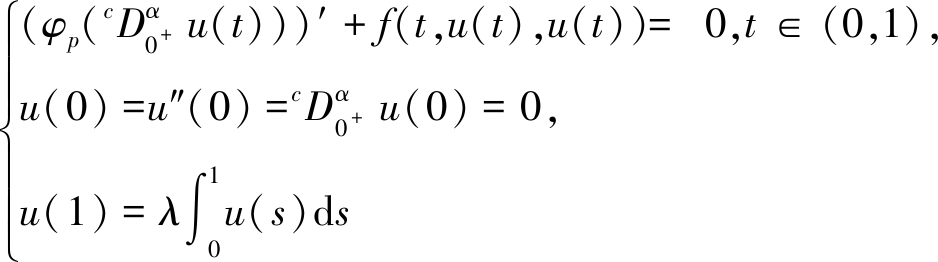
本文研究下述分数阶微分方程边值问题
(0.1)
解的存在唯一性.其中

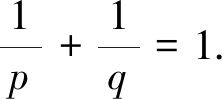
是α阶Caputo型分数阶导数,φp(s)=|s|p-2s,p>1,f:(0,1)×[0,+ )×(0,+)→[0,+),f(t,x,y)在y=0和t=0,1可以是奇异的.众所周知,φp是可逆的,它的逆算子是φq,其中常数q>1满足
近年来,分数阶微分方程在数学及其应用中都引起了广泛的关注,特别是应用于工程和科学研究的许多领域,如物理、化学、电力科学和生物学等,详情参见文献[1-7].带有p-Laplacian算子的分数阶微分方程的理论背景和应用,详情参见文献[8-10].此外,在该类分数阶微分方程中,其边值条件是积分形式的情况也引起了许多的关注,详情参见文献[11-14].
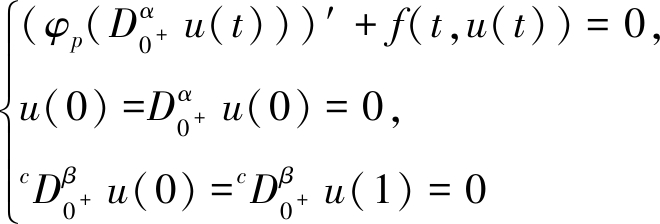
文献[10]研究了下列带有p-Laplacian算子的分数阶微分方程边值问题.
解的存在唯一性.其中

和 分别是α阶Riemann-Liouville型分数阶导数和β阶Caputo型分数阶导数,f:[0,1]×R→R是连续函数.应用Guo-Krasnoselskii不动点定理和Banach压缩映射原理证明了解的存在唯一性.
文献[14]研究了如下带有积分边值条件的非线性分数阶微分方程
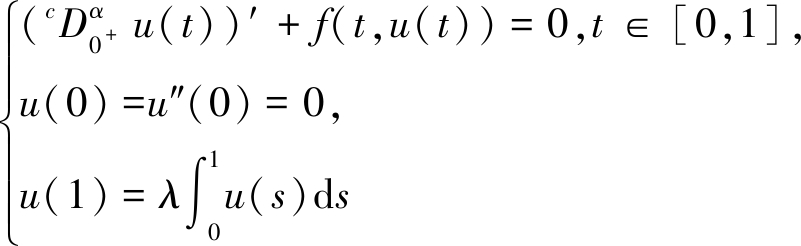
正解的存在性.其中2< α<3 ,0<λ<2 ,f:[0,1]×[0,+)→[0,+)是连续函数.运用Guo-Krasnoselskii不动点定理证明了正解的存在性.
受以上文献的启发,研究问题(0.1)解的存在性和唯一性,其证明的主要方法是运用混合单调算子的不动点定理.不同于以上其他文章,本文中的非线性项f包含了可奇异的点.
1 预备知识
下面介绍分数阶微积分理论的相关定义和引理,其详情参见文献[1-3].
定义1.1 函数u:[0,+)→R的α>0阶Riemann-Liouville型分数阶积分为

上式右端在R+内是诸点定义的.其中Γ(α)是欧拉Gamma函数,定义如下
Γ(α)= e-ttα-1dt,α>0.
定义1.2 函数u:[0,+)→R的α>0阶Caputo型分数阶导数为

其中n=[α]+1.
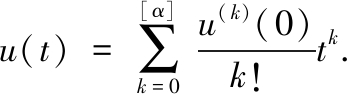
引理1.1[1] 设α>0,则分数阶微分方程
cDαu(t)=0
有唯一解,其表达式为
引理1.2[1] 设α>0及u∈C[0,1],则
引理1.3[1] 若α>0,n=[α]+1及u∈ACn[0,1],则

设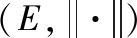 是实Banach空间,P是E中的锥,且θ是E中的零元素,P在E中诱导出偏序“≤”.如果存在常数C>0,满足对任意x,y∈E及θ≤x≤y,都有
 则锥P称为正规的.对于任意x,y∈E,当存在常数λ,μ>0,满足λy≤x≤μy时,用x~y表示.显然,~是等价关系.给定h>θ,用Ph表示集合Ph={x∈E:x~h}.
定义1.3[3] 定义算子A:P×P→P,若A(x,y)关于x递增且关于y递减,即当ui,vi(i=1,2)∈P,u1≤u2,v1≥v2时,有
A(u1,v1)≤A(u2,v2),
则称A为混合单调算子.若A(x,x)=x.则称元素x为A的一个不动点.
引理1.4[3] 设Ph⊂P,若A:Ph×Ph→Ph是混合单调算子,并且满足下列条件: 对于任意的u,v∈Ph和t∈(0,1),存在φ(t)∈(t,1),有
A(tu,t-1v)≥φ(t)A(u,v),
则算子方程A(x,x)=x有唯一正解x*∈Ph.同时,对于任意的初值x0,y0∈Ph,序列
xn=A(xn-1,yn-1), yn=A(yn-1,xn-1),n=1,2,…,
当n→时,有
2 主要结果
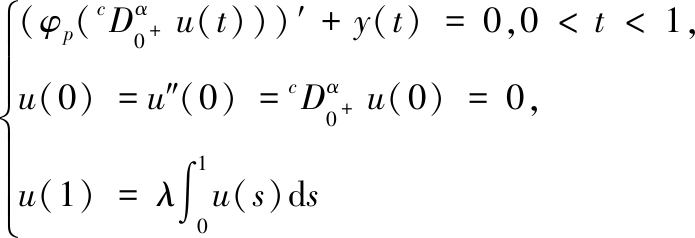
引理2.1 设y∈C[0,1]∩L[0,1],2< α≤3,0< λ<2 .则下列边值问题
(2.1)
有唯一解
u(t)= G(t,s)φq(
 y(τ)dτ)ds,
(2.2)
其中

(2.3)
证明 对(2.1)的第一个方程在[0,t]上积分,得

将 带入上式,有

对上式两边作用φq,得

根据引理1.3,对上式两边求α阶积分,有

C0+C1t+C2t2.
(2.4)
再把u(0)=u″(0)=0带入(2.4),得C0=C2=0,因此

(2.5)
对(2.5)在[0,1]上积分,即


(2.6)
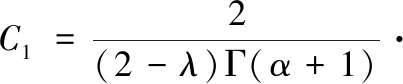
由边值条件u(1)=λu(s)ds,结合(2.5)和(2.6),得

(2.7)
把(2.7)带入(2.5),可以得到边值问题(2.1)的唯一解是

(2.8)
其中G(t,s)是(2.3)所示的格林函数.证毕.
积分方程 是边值问题(2.1)的解当且仅当
 是边值问题(0.1)的解,其中G(t,s)是(2.3)所示的格林函数,y∈C[0,1]∩L[0,1],f:(0,1)×[0,+)×(0,+)→[0,+)是连续函数.
注1 引理2.1中的边值问题与文献[14]中的边值问题方程不同,但是部分边值条件相同,使得所求的格林函数相同.所以本文中的格林函数与文献[14]中的格林函数具有相同的性质.
引理2.2[14] 由(2.3)定义的格林函数G(t,s)满足下列性质:
(1)对于任意的s∈(0,1),λ∈(0,2),有G(1,s)>0;
(2)对于任意的t,s∈(0,1),λ∈(0,2),有G(t,s)>0;
(3)对于任意的t,s∈(0,1),λ∈(0,2),有J(s)t≤G(t,s)≤K(s)t,
其中
J(s)=G(1,s),

设Banach空间E=C[0,1],E中的范数是

定义E中的锥P为
P={u∈E:u(t)≥0,对任意的t∈[0,1]},
并定义

(2.9)
其中h(t)=t,t∈(0,1).
在空间E中有锥P导出的如下偏序关系
x,y∈E,x≤y⟺x(t)≤y(t),对任意的t∈[0,1].
给出下列假设:
(H1)对任意的t∈(0,1),f(t,x,y)关于x递增且关于y递减;
(H2)对任意的x∈[0,+),y∈(0,+),t∈(0,1),存在γ∈(0,p-1),当0< r<1 时,有
f(t,rx,r-1y)≥rγf(t,x,y);
(H3)对任意的t∈(0,1),有f(t,0,1)≢0并且
f(t,1,t)dt< +.
注2 由(H2)可以推出,当r≥1时,有f(t,rx,r-1y)≤rγf(t,x,y);由(H1)知f(t,0,1)< f(t,1,t),再根据(H3)中的f(t,0,1)≢0,可知f(t,1,t)≢0.
定理2.1 设(H1)—(H3)成立,则问题(0.1)有唯一正解u*∈Ph.对于任意的初值u0,v0∈Ph,序列

vn+1(t)=G(t,s)φq(f(τ,vn(τ),un(τ))dτ)ds,
n=0,1,2,…,
当n→时,

证明 考虑下列积分方程

(u∈Ph)
正解的存在性,其中G(t,s)是(2.3)所示的格林函数. 为此,定义算子A:Ph×Ph→P,其表达式为
A(u,v)(t)=
对于任意的u∈Ph,v∈Ph,令 其中au,bu,av,bv如(2.9)所示,因此
 v(t)≤Mu,vh(t).
首先,证明算子A:Ph×Ph→P是良定义的.对于任意的u∈Ph,v∈Ph,由引理2.2和条件(H1)—(H3),有
A(u,v)(t)=G(t,s)φq(f(τ,u(τ),v(τ))dτ)ds
≤K(s)tφq( f(τ,Mu,vh(τ),
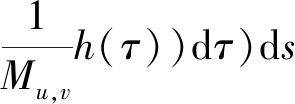
≤K(s)tφq(Mu,vγf(τ,h(τ),
h(τ))dτ)ds
=Mu,vγ(q-1)tK(s)φq(f(τ,τ,τ)dτ)ds
≤Mu,vγ(q-1)tK(s)φq(f(τ,1,τ)dτ)ds
< +.
(2.10)
那么,算子A:Ph×Ph→P是良定义的.
其次,证明算子A:Ph×Ph→Ph.对于任意的u∈Ph,v∈Ph,取

由(2.10)有
A(u,v)(t)≤Mu,vγ(q-1)tK(s)φq(f(τ,1,τ)dτ)ds
≤Qu,vt=Qu,vh(t);
由条件(H2)和引理2.2,得
A(u,v)(t)
=G(t,s)φq(f(τ,u(τ),v(τ))dτ)ds





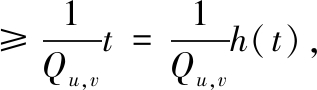
所以,有

从而得到算子A:Ph×Ph→Ph.
另一方面,验证算子A满足引理1.4的所有条件.
首先,证明A是混合单调算子.事实上,对于任意的ui,vi∈Ph,i=1,2,设u1≥u2,v1≤v2.由条件(H1)和φq的单调递增性,有
A(u1,v1)(t)=G(t,s)φq(f(τ,u1(τ),v1(τ))dτ)ds
≥G(t,s)φq(f(τ,u2(τ),v2(τ))dτ)ds
=A(u2,v2)(t).
因此,A是混合单调算子.
对于任意的u,v∈Ph,r∈(0,1),由条件(H2),可以得到
A(ru,r-1v)(t)
=G(t,s)φq(f(τ,ru(τ),r-1v(τ))dτ)ds
≥G(t,s)φq(rγf(τ,u(τ),v(τ))dτ)ds
=(rγ)q-1A(u,v)(t),
设φ(t)=(tγ)q-1,t∈(0,1),由0< γ(q-1)<1 ,可知对任意的t∈(0,1),都有φ(t)∈(t,1).所以,
A(tu,t-1v)(t)≥φ(t)A(u,v)(t).
从而满足引理1.4的所有条件,那么,存在u*∈Ph,使得A(u*,u*)=u*.同时,对于任意的初值u0,v0∈Ph,序列
un+1=A(un,vn),vn+1=A(vn,un),n=0,1,2,…,
当n→时,

更确切地,当n→时,有
un+1(t)=
vn+1(t)=
3 例 子
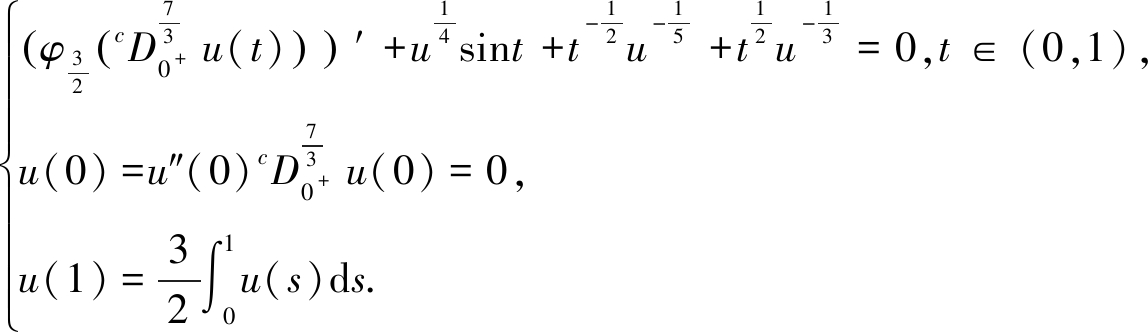
考虑下列例题
(3.1)
观察(3.1),显然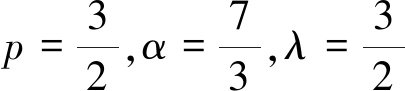 并且

通过简单的计算得q=3.
可以验证,f(t,x,y)满足条件(H1).
又 有
f(t,1,t)dt< +,
那么,条件(H2)满足.
下面验证满足条件(H3),取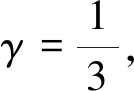 则
 因此,对于任意的r∈(0,1),x∈[0,+),y∈(0,+),有
f(t,rx,r-1y)



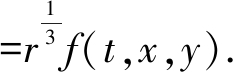
因此,它满足定理2.1的所有条件.那么,问题(3.1)有唯一的正解u*∈Ph,其中h(t)=t,t∈(0,1).并且,对于任意的初值u0,v0∈Ph,序列

 n=0,1,2,…,
其中G(t,s)是(2.3)定义的格林函数,当n→时,

[1] GRAEF J, YANG B. Positive solutions of a nonlinear fourth order boundary value problem[J]. Commun Appl Nonlinear Anal, 2007, 14(1): 61-73.
[2] ZHAO Z Q. Existence and uniqueness of fixed points for some mixed monotone operators[J].Nonlinear Analysis—Theory Methods & Applications, 2010, 73(6):1481-1490.
[3] WANG L, ZHAI C B. Uniqueness and properties of positive solutions for infinite-point fractional differential equation with p-Laplacian and a parameter[J]. J Nonlinear Sci Appl,2017(10): 5156-5164.
[4] ZHAO Z Q. Positive solutions of semipositone Hammerstein integral equations and applications[J]. Appl Math Comput, 2012, 219(5): 2789-2797.
[5] LI S Y, ZHANG X Q. Existence and uniqueness of monotone positive solutions for an elastic beam equation with nonlinear boundary conditions[J]. Comput Math Appl, 2012, 63: 1355-1360.
[6] ZHAI C B, ANDERSON D R. A sum operator equation and applications to nonlinear elastic beam equations and Lane-Emden-Fowler equations[J]. J Math Anal Appl, 2011, 375(2): 388-400.
[7] LIU X P, JIA M, XIANG X F. On the solvability of a fractional differential equation model involving the p-Laplacian operator[J]. Comput Math Appl, 2015, 64(10): 3267-3275.
[8] CHEN T Y, LIU W B, HU Z G. A boundary value problems for fractional differential equation with p-Laplacian operator at resonance[J]. Nonlinear Anal, 2012, 75(6): 3210-3217.
[9] WANG G T. Boundary value problems for systems of nonlinear integro-differential equations with deviating arguments[J]. J Comput Appl Math, 2010, 234: 1356-1363.
[10] BAI C Z. Existence and uniqueness of solutions for fractional boundary value problems with p-Laplacian operator[J]. Adv Differ Equ, 2018(1): 4.
[11] ZHAI C B, HAO M R. Fixed point theorems for mixed monotone operators with perturbation and applications to fractional differential equation boundary value problems[J]. Nonlinear Anal, 2012, 75(4): 2542-2551.
[12] ZHAI C B, ZHANG L L. New fixed point theorems for mixed monotone operators and local existence-uniqueness of positive solutions for nonlinear boundary value problems[J]. J Math Anal Appl, 2011, 382(2): 594-614.
[13] ZHANG X Q, ZHONG Q Y. Triple positive solutions for nonlocal fractional differential equations with singularities both on time and space variables[J]. Appl Math Lett, 2018, 80: 12-19.
[14] CABADA A, WANG G T. Positive solutions of nonlinear fractional differential equations with integral boundary value conditions[J]. J Math Anal Appl, 2012, 389(1):403-411.