

Soliton solutions of two-component Bose-Einstein condensates with Lee-Huang-Yang correction
-
摘要:
选择双曲正弦函数作为带有李黄杨(LHY)修正的双组份玻色-爱因斯坦凝聚体孤子解的试探波函数,变分法导出欧拉-拉格朗日方程,通过求解不含时欧拉-拉格朗日方程,得到静态孤子解析解,将静态孤子解析解与静态孤子数值解对比。结果表明:无谐振子势的情况下,试探波函数可以得到较好的静态孤子近似解;有谐振子势的情况下,当$ 0 < G < \mathrm{0.40, 0} < {g}_{ii}-{g}_{ij} < 4.0 $时,试探波函数可以得到较好的静态孤子近似解。
-
关键词:
- 玻色-爱因斯坦凝聚 /
- 李黄杨(LHY)修正 /
- Gross-Pitaevskii方程
Abstract:This article selects the hyperbolic sine function as the trial wave function for the two-component Bose-Einstein condensate soliton solution with Lee-Huang-Yang (LHY) corrections. The Euler-Lagrange equation is derived by variational method, and the static soliton analytical solution is obtained by solving the time-independent Euler-Lagrange equation. The static soliton analytical solution is compared with the static soliton numerical solution. The results show that in the absence of the harmonic potential, the trial wave function provides a good approximation for the static soliton solution, in the presence of the harmonic potential, when $ 0 < G < \mathrm{0.40, 0} < {g}_{ii}-{g}_{ij} < 4.0 $, the trial wave function also provides a good approximation for the static soliton solution.
-
0. 引言
孤子作为一种非线性波,在自然界中广泛存在,其在传播过程中能保持波形、振幅不变,有较好的稳定性。玻色-爱因斯坦凝聚体(Bose-Einstein condensate,BEC)[1]的集体性质可以用Gross-Pitaevskii(GP)方程[2]进行描述,该方程中相互作用项为非线性项,当相互作用为吸引和排斥时,分别形成亮孤子[3]和暗孤子[4]。在光纤通信领域中,孤子有很高的应用价值,因此对BEC中孤子的研究有重要意义[5]。自20世纪90年代以来,BEC中孤子的研究逐渐成为凝聚态物理领域的重要方向。Burger等[6]于1999年首次用87Rb原子BEC制备出暗孤子;Khaykovich等[7]观察到超冷的7Li气体中亮孤子;Strecker等[8]在准一维光学陷阱中创建的7Li原子形成亮孤子列;Anderson等[9]在双组份的玻色子凝聚物中创建环状暗孤子,至今BEC中孤子的研究仍在持续[10]。
2021年,Luo等[11]在BEC中发现了量子液滴现象。在凝聚体的双组份混合物中,量子液滴能够维持稳定,因为原子间有效短程吸引相互作用与量子涨落引起的排斥相互作用之间的竞争[12-14]。从理论上讲,可以通过引入超平均场项来模拟量子涨落的贡献,即李黄杨(Lee-Huang-Yang,LHY)修正[15]。LHY修正已经在超冷原子气体实验中得到证实[16-21],自提出以来便引起了极大关注[22-26]。
LHY项作为相互作用项的竞争项,对于由非线性相互作用项形成的孤子会有影响。研究带有LHY修正和自旋轨道耦合[27]的BEC孤子能够丰富当前研究的模型,对BEC孤子的研究和应用具有一定价值。变分法[28]作为孤子的一种常见解法,验证变分法求解本文模型的精确程度,为带有LHY项的双组份BEC静态孤子解的解析解提供理论依据,为今后深入研究该系统的性质和物理含义奠定基础。
本文以带有LHY修正的双组份BEC为研究对象,假设2个分量的种内原子相互作用强度相同,取双曲正弦函数为试探波函数,利用变分法推导欧拉-拉格朗日方程,并求出该方程的固定点解。通过对比试探解与数值解,可验证静态孤子解析解的适用范围。
1. 含有LHY修正的双组份BEC孤子解
考虑沿x方向的含有LHY项的准一维双组份BEC,虽然种内原子相互作用强度不相等时也可能存在稳定的孤子[29],但为简单起见,本文仅讨论种内原子相互作用强度相同的情况。系统的动力学性质可用无量纲化GP方程描述为[23, 26]:
$$ \begin{aligned} \mathrm{i} \frac{\partial \psi_{\uparrow}}{\partial t}=- & \frac{1}{2} \frac{\partial^2 \psi_{\uparrow}}{\partial x^2}+g_{i i}\left|\psi_{\uparrow}\right|^2 \psi_{\uparrow}-g_{i j}\left|\psi_{\downarrow}\right|^2 \psi_{\uparrow}- \\ & \frac{3}{2} G \sqrt{\left|\psi_{\uparrow}\right|^2+\left|\psi_{\downarrow}\right|^2} \psi_{\uparrow}, \end{aligned} $$ (1-1) $$ \begin{aligned} \mathrm{i} \frac{\partial \psi_{\downarrow}}{\partial t}=- & \frac{1}{2} \frac{\partial^2 \psi_{\downarrow}}{\partial x^2}+g_{i i}\left|\psi_{\downarrow}\right|^2 \psi_{\downarrow}-g_{i j}\left|\psi_{\uparrow}\right|^2 \psi_{\downarrow}- \\ & \frac{3}{2} G \sqrt{\left|\psi_{\uparrow}\right|^2+\left|\psi_{\downarrow}\right|^2} \psi_{\downarrow}, \end{aligned} $$ (1-2) 式中:$ {\psi }_{\sigma }(x, t) $($ \sigma $=$ \uparrow $,$ \downarrow $代表2个不同的分量)为描述2个分量动力学性质的波函数,满足归一化条件$ {\int }_{-\infty }^{\infty }\left({\left|{\psi }_{\uparrow }\right|}^{2}+{\left|{\psi }_{\downarrow }\right|}^{2}\right)\mathrm{d}x=1 $,$ x $和$ t $分别为空间坐标和时间;$ {g}_{ij} $是分量$ i $和$ j $的相互作用强度,$ G $是LHY项的作用强度。
在目前的冷原子实验中,使用同种原子的双组份BEC很难实现相混合参数$ {\varDelta }_{g}=\frac{{g}_{12}}{\sqrt{{g}_{11}{g}_{22}}}-1 $为小正数(即$ {g}_{11}{g}_{22} < {g}_{12}^{2} $)的参数条件[30]。然而,近年研究表明,利用Feshbach共振技术[31]可以在特定同种原子双组份BEC中实现这一条件。因此,基于$ {g}_{11}{g}_{22} < {g}_{12}^{2} $在实验上具有可行性,本文展开相关研究。
利用变分近似法研究系统动力学性质,在变分法中,系统对应的拉格朗日量为
$$ \begin{gathered} \mathcal{L}(t)= \\ \int_{-\infty}^{+\infty}\left[\frac{\mathrm{i}}{2} \sum\limits_{\sigma=\uparrow, \downarrow}\left(\psi_\sigma^* \frac{\partial \psi_\sigma}{\partial t}-\psi_\sigma \frac{\partial \psi_\sigma^*}{\partial t}\right)+\frac{1}{2} \psi_{\uparrow}^* \frac{\partial^2 \psi_{\uparrow}}{\partial x^2}+\frac{1}{2} \psi_{\downarrow}^* \frac{\partial^2 \psi_{\downarrow}}{\partial x^2}-\right. \\ \left.\frac{1}{2} g_{i i}\left(\left|\psi_{\uparrow}\right|^4+\left|\psi_{\downarrow}\right|^4\right)+g_{i j}\left|\psi_{\uparrow}\right|^2\left|\psi_{\downarrow}\right|^2+G n^{\frac{3}{2}}\right] \mathrm{d} x, \end{gathered} $$ (2) 式中:$ {}^{*} $代表复共轭;$ n={\left|{\psi }_{\uparrow }\right|}^{2}+{\left|{\psi }_{\downarrow }\right|}^{2} $为总密度分布。
使用双曲正弦函数作为孤子的试探波函数,并取2个组份孤子的宽度$ {\eta }^{-1} $相等,即
$$ \begin{array}{c}\psi ={\psi }_{\uparrow }={\psi }_{\downarrow }=\frac{\sqrt{\eta }}{2}\mathrm{sech}\left(\eta x\right), \end{array} $$ (3) 式中$ \eta $为变分参数,是时间的函数,将式(3)代入式(2),得到
$$ \begin{array}{c}\mathcal{L}\left(t\right)=-\frac{1}{6}{\eta }^{2}-\frac{1}{12}{g}_{ii}\eta +\frac{1}{12}{g}_{ij}\eta +\frac{G\pi \sqrt{2\eta }}{8}。\end{array} $$ (4) 将式(4)代入欧拉-拉格朗日方程$ \frac{\partial \mathcal{L}}{\partial A}-\frac{\mathrm{d}}{\mathrm{d}t}\left(\frac{\partial \mathcal{L}}{\partial \dot{A}}\right)=0 $,其中$ A $是变分参数$ \eta $,且$ \dot{A}=\frac{\mathrm{d}A}{\mathrm{d}t} $,可得
$$ \begin{array}{c}\eta +\left(\frac{1}{4}{g}_{ii}-\frac{1}{4}{g}_{ij}\right)-\frac{3\sqrt{2}G\pi }{16{\eta }^{\frac{1}{2}}}=0。\end{array} $$ (5) 取$ {g}_{ii}=3.2, {g}_{ij}=1.6, $根据卡尔达诺公式求解式(5),并选取合适的$ \eta $,可得静态孤子解。如图 1(a)所示,孤子波函数的宽度随LHY强度($ G $)的增加而变窄。式(5)表明孤子宽度仅由原子间相互作用和$ G $决定。图 1(b)进一步显示:$ {g}_{ii}/{g}_{ij} $为定值时, 随G的增加, η单调递增,波函数波形变窄。在$ G $相同的情况下,随着$ {g}_{ii}/{g}_{ij} $变大,$ \eta $变小,波函数波形变宽;$ {g}_{ii}/{g}_{ij} $ > 1,排斥势占主导作用,波函数波形变宽;$ {g}_{ii}/{g}_{ij} $ < 1,吸引势占主导作用,波函数波形变窄。
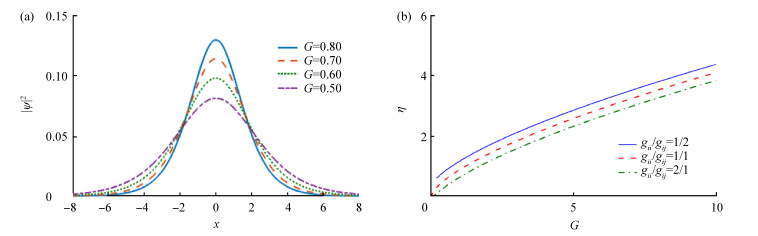 图 1 含有李黄杨(LHY)修正的双组份BEC孤子解的波函数注:G是李黄杨项的作用强度;gii/gij表示分量间相互作用强度比。
(a)不同G情况下波函数的对比;(b)η随G的变化Fig. 1 wave functions of the two-component BEC soliton solution with the Li-Huang-Yang (LHY) correction(a)comparison of wave functions under different G conditions; (b)the variation of η with G 下载:
全尺寸图片
变分法是一种近似方法,有必要将变分法求得的静态孤子解与GP方程的数值基态解作对比,本文采用Crank-Nicolson方法进行数值模拟得到静态孤子数值解,参数取值为$ {g}_{ii}=1.2, {g}_{ij}=1.0, G=0.50 $,变分孤子静态解与GP方程数值解的对比如图 2(a)所示。对比显示固定点解与GP方程的静态孤子数值解相一致。因此,带有LHY修正的双组份BEC中变分法可以得到很好的静态孤子近似解。本文取的参数区间为$ G > 0.35, {g}_{ii}-{g}_{ij} < 10.0 $,其他情况得不到波形较好的孤子解波函数,因此不予讨论。
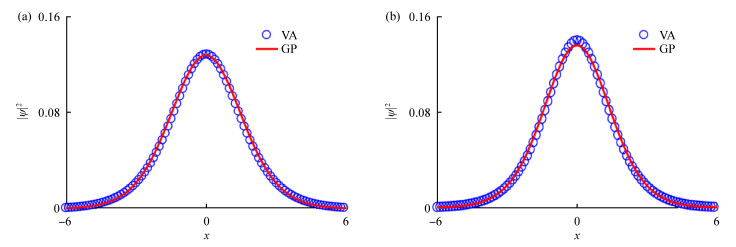 图 2 无谐振子势情况下变分孤子静态解与GP方程数值解的对比注:VA为变分法得到的基态波函数;GP为数值方法求解得到的基态波函数。
(a)$ g_{i i} \neq g_{i j} $;(b)$ g_{i i}=g_{i j}$Fig. 2 comparison between the variational soliton static solution and the numerical solution of the GP equation in the absence of a harmonic oscillator potential(a)$ g_{i i} \neq g_{i j} $; (b)$ g_{i i}=g_{i j}$下载:
全尺寸图片
为了进一步验证含有LHY项的变分孤子解的精确程度,令$ {g}_{ii}={g}_{ij}=10.0, G=0.5 $0,从而完全抑制平均场能量,使LHY修正项的作用更加突出,以便观察LHY项对静态孤子解稳定性的影响。这种情况下,固定点解与数值模拟得到的静态孤子解拟合的较好(图 2(b)),静态孤子解较为稳定。
2. 有谐振子势且含有LHY修正的双组份BEC孤子解
到目前为止,本文讨论的是没有外势的自由空间的情况,有谐振子势情况下的无量纲GP方程为:
$$ \begin{gathered} \mathrm{i} \frac{\partial \psi_{\uparrow}}{\partial t}=-\frac{1}{2} \frac{\partial^2 \psi_{\uparrow}}{\partial x^2}+g_{i i}\left|\psi_{\uparrow}\right|^2 \psi_{\uparrow}-g_{i j}\left|\psi_{\downarrow}\right|^2 \psi_{\uparrow}- \\ \frac{3}{2} G \sqrt{\left|\psi_{\uparrow}\right|^2+\left|\psi_{\downarrow}\right|^2} \psi_{\uparrow}+\frac{1}{2} \lambda^2 x^2 \psi_{\uparrow}, \end{gathered} $$ (6-1) $$ \begin{gathered} \mathrm{i} \frac{\partial \psi_{\downarrow}}{\partial t}=-\frac{1}{2} \frac{\partial^2 \psi_{\downarrow}}{\partial x^2}+g_{i i}\left|\psi_{\downarrow}\right|^2 \psi_{\downarrow}-g_{i j}\left|\psi_{\uparrow}\right|^2 \psi_{\downarrow}- \\ \frac{3}{2} G \sqrt{\left|\psi_{\uparrow}\right|^2+\left|\psi_{\downarrow}\right|^2} \psi_{\downarrow}+\frac{1}{2} \lambda^2 x^2 \psi_{\downarrow}, \end{gathered} $$ (6-2) 式中$ \lambda $是势阱调节因子。
本文通过比较含有谐振子势与不含谐振子势的波函数,参数设为$ {g}_{ii}=1.2, {g}_{ij}=1.0, G=0.35 $,$ \lambda =1 $,观察到含有谐振子势的波函数波形变窄(图 3)。这是由于谐振子势对波函数施加了一种约束条件,限制了波函数的传播空间,使其被束缚在一个较小的范围内,从而表现为孤子的宽度减小。
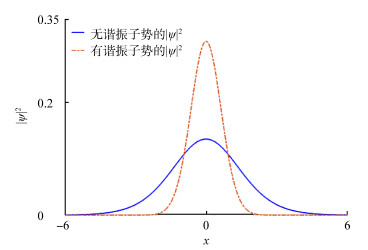 图 3 含有谐振子势与不含谐振子势的波函数对比Fig. 3 comparison of wave functions with and without a harmonic oscillator potential下载:
全尺寸图片
本文利用变分近似法研究系统动力学性质,在变分法中,系统对应的拉格朗日量为
$$ \begin{gathered} \mathcal{L}(t)=\int_{-\infty}^{+\infty}\left[\frac{\mathrm{i}}{2} \sum\limits_{\sigma=\uparrow ,\downarrow}\left(\psi_\sigma^* \frac{\partial \psi_\sigma}{\partial t}-\psi_\sigma \frac{\partial \psi_\sigma^*}{\partial t}\right)+\frac{1}{2} \psi_{\uparrow}^* \frac{\partial^2 \psi_{\uparrow}}{\partial x^2}+\right. \\ \frac{1}{2} \psi_{\downarrow}^* \frac{\partial^2 \psi_{\downarrow}}{\partial x^2}-\frac{1}{2} g_{i i}\left(\left|\psi_{\uparrow}\right|^4+\left|\psi_{\downarrow}\right|^4\right)+g_{i j}\left|\psi_{\uparrow}\right|^2\left|\psi_{\downarrow}\right|^2+ \\ \left.G n^{\frac{3}{2}}-\frac{1}{2} \lambda^2 x^2\left(\left|\psi_{\uparrow}\right|^2+\left|\psi_{\downarrow}\right|^2\right)\right] \mathrm{d} x。 \end{gathered} $$ (7) 将式(3)代入式(7),得到
$$ \begin{array}{c}\mathcal{L}\left(t\right)=-\frac{1}{6}{\eta }^{2}-\frac{1}{12}{g}_{ii}\eta +\frac{1}{12}{g}_{ij}\eta +\frac{G\pi \sqrt{2\eta }}{8}-\frac{{\lambda }^{2}{\pi }^{2}}{24{\eta }^{2}}。\end{array} $$ (8) 通过欧拉-拉格朗日方程$ \frac{\partial \mathcal{L}}{\partial A}-\frac{\mathrm{d}}{\mathrm{d}t}\left(\frac{\partial \mathcal{L}}{\partial \dot{A}}\right)=0 $,解得
$$ \begin{array}{c}-\frac{\eta }{3}-\frac{1}{12}{g}_{ii}+\frac{1}{12}{g}_{ij}+\frac{G\pi \sqrt{2}}{16\sqrt{\eta }}+\frac{{\lambda }^{2}{\pi }^{2}}{12{\eta }^{3}}=0。\end{array} $$ (9) 将固定点解和GP方程的数值解进行对比,在$ 0 < G < \mathrm{0.40, 0} < {g}_{ii}-{g}_{ij} < 4.0 $的情况下,固定点解与GP方程的静态孤子数值解相吻合,如图 4(a)所示。变分法可以得到较好的静态孤子近似解。其他情况下,固定点解与GP方程的静态孤子数值解差值较大,如图 4(b)所示。这表明谐振子势使得系统变得复杂,导致试探波函数无法通过变分法准确逼近GP方程的数值解,因此需要采用其他形式的试探波函数。
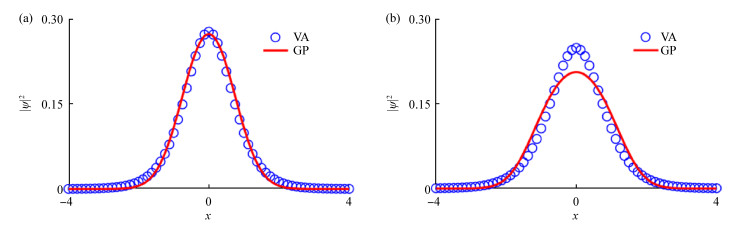 图 4 有谐振子势情况下变分静态解与GP方程数值解的对比(a)g ii = 14.0,g ij = 12.0,G = 0.50,λ = 1;(b)g ii = 20.0,g ij = 10.0,G = 1.00,λ = 1Fig. 4 comparison between the variational static solution and the numerical solution of the GP equation in the presence of a harmonic oscillator potential(a)g ii = 14.0, g ij = 12.0, G = 0.50, λ = 1;(b)g ii = 20.0, g ij = 10.0, G = 1.00, λ = 1下载:
全尺寸图片
3. 结论
本文以含有LHY修正的准一维双组份BEC为研究对象,使用变分法求出的固定点解和GP方程的静态孤子数值解差值较小,变分法可以得到较好的静态孤子近似解。$ G $相同的情况下,随着$ {g}_{ii}/{g}_{ij} $的变大,$ \eta $变小,排斥势占主导作用,波函数变宽。$ {g}_{ii}/{g}_{ij} $不变的情况下,$ \eta 随G $的增加而单调递增,孤子宽度$ {\eta }^{-1} $越来越小,波函数波形越来越窄。有谐振子势的情况下,当$ 0 < G < \mathrm{0.40, 0} < {g}_{ii}-{g}_{ij} < 4.0 $时,固定点解与GP方程的静态孤子数值解差值并不大,可以得到较好的静态孤子近似解。本文的研究对于获得含有LHY修正的准一维双组份BEC静态孤子解析解提供了理论支持,为今后研究该系统的性质和物理内涵提供了帮助。
-
图 1 含有李黄杨(LHY)修正的双组份BEC孤子解的波函数
注:G是李黄杨项的作用强度;gii/gij表示分量间相互作用强度比。
(a)不同G情况下波函数的对比;(b)η随G的变化Fig. 1 wave functions of the two-component BEC soliton solution with the Li-Huang-Yang (LHY) correction
(a)comparison of wave functions under different G conditions; (b)the variation of η with G
下载:
全尺寸图片
图 2 无谐振子势情况下变分孤子静态解与GP方程数值解的对比
注:VA为变分法得到的基态波函数;GP为数值方法求解得到的基态波函数。
(a)$ g_{i i} \neq g_{i j} $;(b)$ g_{i i}=g_{i j}$Fig. 2 comparison between the variational soliton static solution and the numerical solution of the GP equation in the absence of a harmonic oscillator potential
(a)$ g_{i i} \neq g_{i j} $; (b)$ g_{i i}=g_{i j}$
下载:
全尺寸图片
图 3 含有谐振子势与不含谐振子势的波函数对比
Fig. 3 comparison of wave functions with and without a harmonic oscillator potential
下载:
全尺寸图片
图 4 有谐振子势情况下变分静态解与GP方程数值解的对比
(a)g ii = 14.0,g ij = 12.0,G = 0.50,λ = 1;(b)g ii = 20.0,g ij = 10.0,G = 1.00,λ = 1
Fig. 4 comparison between the variational static solution and the numerical solution of the GP equation in the presence of a harmonic oscillator potential
(a)g ii = 14.0, g ij = 12.0, G = 0.50, λ = 1;(b)g ii = 20.0, g ij = 10.0, G = 1.00, λ = 1
下载:
全尺寸图片
-
[1] BOSE S N. Plancks gesetz und lichtquantenhypothese[J]. Zeitschrift für Physik, 1924, 26(1): 178-181. DOI: 10.1007/BF01327326. [2] CUNILLERA F, GERMANI C. The Gross-Pitaevskii equations of a static and spherically symmetric condensate of gravitons[J]. Classical and Quantum Gravity, 2018, 35(10): 105006. DOI: 10.1088/1361-6382/aab97b. [3] KHAYKOVICH L, SCHRECK F, FERRARI G, et al. Formation of a matter-wave bright soliton[J]. Science, 2002, 296(5571): 1290-1293. DOI:10.1126/science. 107102. [4] BUSCH T, ANGLIN J R. Motion of dark solitons in trapped Bose-Einstein condensates[J]. Physical Review Letters, 2000, 84(11): 2298-2301. DOI: 10.1103/PhysRevLett.84.2298. [5] HASEGAWA A, TAPPERT F. Transmission of stationary nonlinear optical pulses in dispersive dielectric fibers I. Anomalous dispersion[J]. Applied Physics Letters, 1973, 23(3): 142-144. DOI: 10.1063/1.1654847. [6] BURGER S, BONGS K, DETTMER S, et al. Dark solitons in Bose-Einstein condensates[J]. Physical Review Letters, 1999, 83(25): 5198-5201. DOI: 10.1103/PhysRevLett.83.5198. [7] KHAYKOVICH L, SCHRECK F, FERRARI G, et al. Formation of a matter-wave bright soliton[J]. Science, 2002, 296(5571): 1290-1293. DOI:10.1126/science. 1071021. [8] STRECKER K E, PARTRIDGE G B, TRUSCOTT A G, et al. Formation and propagation of matter-wave soliton trains[J]. Nature, 2002, 417(6885): 150-153. DOI: 10.1038/nature747. [9] ANDERSON B P, HALJAN P C, REGAL C A, et al. Watching dark solitons decay into vortex rings in a Bose-Einstein condensate[J]. Physical Review Letters, 2001, 86(14): 2926-2969. DOI: 10.1103/PhysRevLett.86.2926. [10] KARTASHOV Y V, MALOMED B A, TORNER L. Solitons in nonlinear lattices[J]. Reviews of Modern Physics, 2011, 83(1): 247-305. DOI: 10.1103/RevModPhys.83.247. [11] LUO Z H, PANG W, LIU B, et al. A new form of liquid matter: quantum droplets[J]. Frontiers of Physics, 2021, 16(3): 1-21. DOI: 10.1007/s11467-020-1020-2. [12] KADAU H, SCHMITT M, WENZEL M, et al. Observing the Rosensweig instability of a quantum ferrofluid[J]. Nature, 2016, 530(7589): 194-197. DOI: 10.1038/nature16485. [13] FERRIER-BARBUT I, KADAU H, SCHMITT M, et al. Observation of quantum droplets in a strongly dipolar Bose gas[J]. Physical Review Letters, 2016, 116(21): 215301. DOI: 10.1103/PhysRevLett.116.215301. [14] CHOMAZ L, BAIER S, PETTER D, et al. Quantum-fluctuation-driven crossover from a dilute Bose-Einstein condensate to a macrodroplet in a dipolar quantum fluid[J]. Physical Review X, 2016, 6(4): 041039. DOI: 10.1103/PhysRevX.6.041039. [15] LEE T D, HUANG K, YANG C N. Eigenvalues and eigenfunctions of a Bose system of hard spheres and its low-temperature properties[J]. Physical Review Journals Archive, 1957, 106: 1135. DOI: 10.1103/PhysRev.106.1135. [16] JAKSCH D, BRUDER C, CIRAC J I, et al. Cold bosonic atoms in optical lattices[J]. Physical Review Letters, 1998, 81(15): 3108-3111. DOI: 10.1103/PhysRevLett.81.3108. [17] GREINER M, MANDEL O, ESSLINGER T, et al. Quantum phase transition from a superfluid to a Mott insulator in a gas of ultracold atoms[J]. Nature, 2002, 415(6867): 39-44. DOI: 10.1038/415039a. [18] BLOCH I, DALIBARD J, NASCIMBENE S. Quantum simulations with ultracold quantum gases[J]. Nature Physics, 2012, 8(4): 267-276. DOI: 10.1038/nphys2259. [19] GROSS C, BLOCH I. Quantum simulations with ultracold atoms in optical lattices[J]. Science, 2017, 357(6355): 995-1001. DOI: 10.1126/science.aal3837. [20] YANG B, SUN H, HUANG C J, et al. Cooling and entangling ultracold atoms in optical lattices[J]. Science, 2020, 369(6503): 550-553. DOI: 10.1126/science.aaz6801. [21] ZHANG X B, HUNG C L, TUNG S K, et al. Observation of quantum criticality with ultracold atoms in optical lattices[J]. Science, 2012, 335(6072): 1070-1072. DOI: 10.1126/science.1217990. [22] TONONI A, WANG Y M, SALASNICH L. Quantum solitons in spin-orbit-coupled Bose-Bose mixtures[J]. Physical Review A, 2019, 99(6): 063618. DOI: 10.1103/PhysRevA.99.063618. [23] GANGWAR S, RAVISANKAR R, MURUGANANDAM P, et al. Dynamics of quantum solitons in Lee-Huang-Yang spin-orbit-coupled Bose-Einstein condensates[J]. Physical Review A, 2022, 106(6): 063315. DOI: 10.1103/PhysRevA.106.063315. [24] 梁庭维, 王林红, 孙青, 等. 单分量和二分量玻色-爱因斯坦凝聚体亮孤子解的李黄杨修正[J]. 首都师范大学学报(自然科学版), 2024, 45(2): 74-83. DOI: 10.19789/j.1004-9398.2024.02.008. LIANG T W, WANG L H, SUN Q, et al. Lee-Huang-Yang correction for bright soliton solutions of single and two component Bose-Einstein condensates[J]. Journal of Capital Normal University(Natural Science Edition), 2024, 45(2): 74-83. doi: 10.19789/j.1004-9398.2024.02.008 [25] LIN W, YI L, JING Z, et al. Effects of linear Zeeman splitting on the dynamics of bright solitons in spin-orbit coupled Bose-Einstein condensates[J]. Acta Physica Sinica, 2019, 68(8): 080301. DOI:10.7498/aps. 68.20182013. [26] LIU Z Y, JI A C, SUN Q. Fluctuation-driven self-trapping in Bose-Bose mixtures[J]. Physical Review Research, 2024, 6(1): 013014. DOI: 10.1103/PhysRevResearch.6.013014. [27] LIN Y J, JIMÉNEZ-GARCÍA K, SPIELMAN I B. Spin-orbit-coupled Bose-Einstein condensates[J]. Nature, 2011, 471(7336): 83-86. DOI: 10.1038/nature09887. [28] MALOMED B A. Soliton management in periodic systems[M]. New York: Springer US, 2006. [29] LIU X X, PU H, XIONG B, et al. Formation and transformation of vector solitons in two-species Bose-Einstein condensates with a tunable interaction[J]. Physical Review A, 2009, 79(1): 013423. DOI: 10.1103/PhysRevA.79.013423. [30] 张天琪. 双组份玻色-爱因斯坦凝聚体的混溶性[D]. 太原: 山西大学, 2023. ZHANG T Q. Miscibility of dual-species Bose-Einstein condensates[D]. Taiyuan: Shanxi University, 2023. [31] WEN L, GUO H, WANG Y J, et al. Effects of atom numbers on the miscibility-immiscibility transition of a binary Bose-Einstein condensate[J]. Physical Review A, 2020, 101(3): 033610. DOI:10.1103/PhysRevA. 101.033610.
