

Design and analysis of high-Q and high-sensitivity terahertz metasurface sensors
-
摘要:
高品质因子(Q)和高灵敏度太赫兹超表面传感器在生化传感领域被广泛研究,但传统的超表面传感器中常用的电感-电容(LC)谐振和偶极子谐振的辐射损耗较大,限制了超表面传感器品质因子和透射率。本文设计了一种非对称双开口金属对环的太赫兹超表面传感器,打破单元结构的对称性,激发电偶极谐振和类电磁感应透明谐振,提高了超表面传感器的性能。分析了不同结构参数对超表面传感器的性能影响,并通过优化结构参数,提高传感器的传感性能。研究结果表明传感器存在2个谐振频点:f1 = 1.561 THz处电偶极谐振的Q = 385,传感灵敏度S = 302 GHz/RIU;f2 = 1.794 THz处类电磁感应透明谐振的Q = 279,S = 315 GHz/RIU。实现了高Q高灵敏度的双谐振传感。
Abstract:High-quality factor (Q) and high-sensitivity terahertz metasurface sensors have been widely studied in the field of biochemical sensing. However, the large radiation loss of the inductor-capacitor (LC) resonance and dipole resonance commonly used in conventional metasurface sensors limits the metasurface sensor quality factor and transmittance. In this paper, we design an asymmetric double-open metal pair ring of terahertz metasurface sensor to break the symmetry of the unit structure and to excite the electric dipole resonance and the electromagnetic induction-like transparent resonance, which improves the performance of the metasurface sensor. The effects of different structural parameters on the performance of the metasurface sensor are analysed, and the sensing performance of the sensor is improved by optimising the structural parameters. The results show that there are two resonance frequency points of the sensor, the quality factor Q = 385 and the sensing sensitivity S = 302 GHz/RIU for the electric dipole resonance at f1 = 1.561 THz, and the quality factor Q = 279 and the sensing sensitivity S = 315 GHz/RIU for the electromagnetically induced transparent resonance at f2 = 1.794 THz, which achieves the high Q high and sensitivity dual resonance sensing.
-
Keywords:
- terahertz /
- metasurface /
- sensor /
- high quality factor /
- high sensitivity
-
0. 引言
太赫兹波段位于微波和红外辐射之间,通常指0.1~10.0 THz频段的电磁波[1-2],具有非电离性[3]、低散射性[4]、低能量性[5]和高穿透性[6]等突出优势。大部分生物分子在太赫兹波段具有独特的振动和转动特征信息[7]。因此,太赫兹波可识别生物分子独特的指纹特征,并对微量物质进行非接触式、无损检测[8]。
电磁感应透明(electromagnetically induced transparency,EIT)谐振是原子物理中一种非常重要的物理现象[9-10]。2016年,在对三能级原子系统原子跃迁的研究中,Han和Dayal等[11-12]证实了一种新的谐振模式,该谐振模式同洛伦兹谐振相比,具有非常明显的感应透明效应以及非对称线形[13],并将其命名为类EIT谐振。类EIT谐振具有高灵敏度和高分辨率的特点,可以用于设计高灵敏度传感器。
超表面是一种人工设计的二维超材料,具有周期性阵列结构、负折射率、负磁导率和负介电常数等特性[14-16]。将太赫兹技术与电磁超材料相结合,可以增强电磁场局域效应,实现对微量生化分子的高效检测[17-18]。品质因子(Q)和灵敏度(S)是衡量超表面设计的重要指标。2018年,潘武等[19]设计了一种由开口环和金属条组合的非对称结构传感器,实现了类EIT效应,仿真分析得到该传感器Q=92,S=61 GHz/RIU;2019年,Samy等[20]提出了一个中心对称双螺旋结构的超材料生物传感器,该传感器Q=22,S=300 GHz/RIU;2020年,霍红等[21]提出了一种基本单元为双开口谐振环和金属短线组合结构的太赫兹高S传感器,仿真得到传感器的Q=83,S=171 GHz/RIU;2022年,王晨和王爽[22]提出一种基于半圆形开口谐振环结构的太赫兹环偶极子超表面,超表面激发了环偶极子与类EIT效应,Q最高可达27。目前基于金属结构的超表面传感器研究已有不少,有工字型结构[23]、双开口环结构[24]、金属条与开口谐振环组合结构[25]和双椭圆结构[26]等单元结构的超表面传感器。但这些器件依旧不能满足许多测量领域对高Q和高S的需求。
本文提出并设计一种新型的太赫兹超表面传感器设计方案,该超表面由聚酰亚胺衬底上的非对称双开口金属对环单元结构周期性排列构成,通过打破金属环的双开口位置对称性和构造谐振耦合的对环结构,同时实现具有高Q和高S的太赫兹超表面传感器。
1. 理论模型与分析
太赫兹传感器的传感性能由Q和S共同决定。其中,Q通过局域电场增强,可有效提升太赫兹波与物质的相互作用,使传感器具备更高的频率选择性。Q反映了传感器的损耗特性,Q越高,谐振峰越尖锐,传感器的能量损耗越低。Q定义为谐振频率(f0)与半极大全宽(∆ν)的比值,计算公式为
$$ Q=\frac{{f}_{0}}{\Delta \nu } 。 $$ (1) S反映了传感器对环境或待测物性能微小变化的响应能力,S越高,传感器越能精确地检测待测物微小的变化。S定义为在传感检测中,单位折射率变化引起的谐振频率偏移量,通常用每单位折射率变化的频率偏移(单位为GHz/RIU)来表示,计算公式为
$$ S=\frac{\Delta f}{\Delta n} \text{,} $$ (2) 式中Δn和Δf分别是折射率变化和对应的谐振频率偏移。
为了提高S和Q,本研究提出了一种双开口金属对环单元结构超表面,该结构的非对称性由开口偏离结构中心引入,对环结构设计引入环与环之间的谐振耦合,激发具有低辐射损耗的偶极谐振和类EIT谐振。以金(Au)为谐振环金属材料,采用聚酰亚胺(Polyimide,PI)衬底降低其对太赫兹波的吸收,通过光刻工艺制备太赫兹超表面传感器。
单开口双环超表面传感器如图 1所示。超表面初始结构的几何参数设计如下:周期Px = 90 μm,Py = 190 μm;谐振环边长L = 40 μm;2个开口环的中心间距s = 100 μm;金属线宽w=5 μm;开口间隙g=4 μm;不对称度(d)通过优化调整确定;PI衬底厚度为35 μm,金层厚度为200 nm。
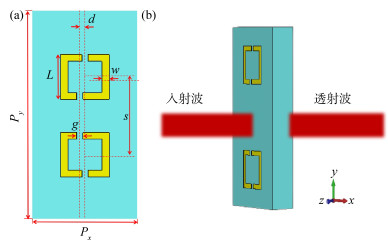 图 1 单开口双环超表面传感器注:Px为x方向周期,Py为y方向周期;d为不对称度;L为谐振环边长;s为2个开口环的中心间距;w为金属线宽;g为开口间隙。
(a)超表面单元结构示意;(b)电场入射方向Fig. 1 single-split double-ring metasurface sensor(a) schematic diagram of the metasurface unit structure; (b) electric field incidence direction 下载:
全尺寸图片
2. 太赫兹超表面透射特性及谐振机理分析
采用电磁仿真软件对超表面结构进行仿真模拟研究。不同d下超表面的透射谱如图 2所示。图 2(a)展示了初始结构(d = 0)的透射光谱特性。通过打破结构对称性(d ≠ 0),如图 2(b)所示,在1.561和1.796 THz处分别观察到尖锐的谐振谷和类EIT谐振峰。
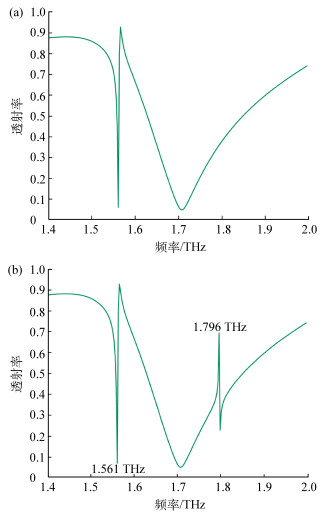 图 2 不同不对称度下超表面的透射谱(a)d = 0;(b)d = 2 μmFig. 2 transmission spectra of the metasurface under different asymmetry degrees(a) d = 0; (b) d = 2 μm下载:
全尺寸图片
为深入理解谐振模式的物理机制,进一步仿真分析了特征频率点的电磁场分布特性,如图 3所示。在谐振谷1.561 THz处,电子主要聚集于开口环左半部分,形成同向电流分布,激发电偶极振荡模式(electric dipole,ED)[27];在类EIT谐振峰低频侧1.707 THz处,观察到反向电流分布,其电场分布呈现超辐射特性,对应于明模式[28];在谐振峰高频侧1.798 THz处,同向电流分布激发电四极振荡模式(electric quadrupole,EQ)[29],其电场分布呈现亚辐射特性,对应于暗模式[30]。特别地,在1.796 THz处,ED与EQ模式发生耦合,形成类EIT谐振,由于辐射损耗较小,为实现高S传感提供了有利条件。
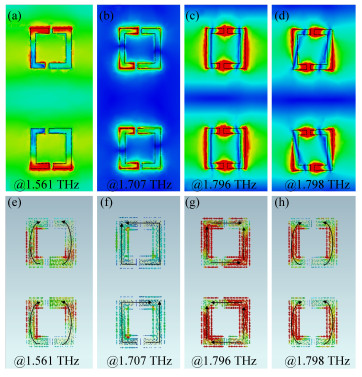 图 3 特征频率点的电磁场分布特性(a~d)不同频点处电场分布;(e~h)不同频点处表面电流分布Fig. 3 electromagnetic field distribution characteristics at characteristic frequency points(a~d) electric field distribution at different frequency points; (e~h) surface current distribution at different frequency points下载:
全尺寸图片
通过打破超表面结构的对称性,成功激发了新的类EIT谐振模式。图 4(a)展示了d对类EIT谐振特性的影响规律。当d = 0(黑色曲线)时,光谱中仅观察到偶极谐振模式,未出现类EIT谐振;当d ≠ 0(彩色曲线)时,结构对称性被打破,光谱中同时出现偶极谐振和类EIT谐振2个特征峰。定量分析表明,随着d的增加,偶极谐振模式保持稳定,而类EIT谐振模式的Q逐渐降低,谐振强度则显著增强。表 1总结了不同d下类EIT谐振模式的Q和谐振强度变化规律,相应的关系曲线如图 4(b)所示。基于Q和谐振强度的综合优化分析,最终确定最佳d = 4 μm。
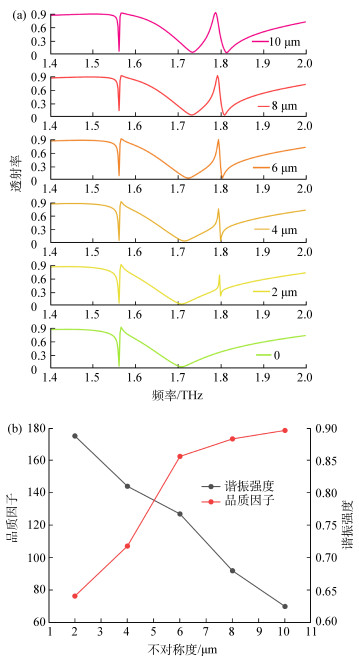 图 4 不对称度对透射谱、品质因子(Q)及谐振强度的影响(a)不对称度对双开口双环结构透射谱的影响;(b)不对称度对类EIT谐振峰Q和谐振强度的影响Fig. 4 influence of asymmetry degree on transmission spectrum, quality factor (Q), and resonance intensity(a) influence of asymmetry degree on the transmission spectrum of the double-split double-ring structure; (b) effect of asymmetry degree on Q factor and resonance intensity of the EIT-like resonance peak下载:
全尺寸图片
表 1 不对称度(d)对类EIT谐振峰Q和谐振强度的影响Table 1 effects of asymmetry (d) on Q factor and resonance intensity of EIT-like resonance peak
d/μm 频率/THz Q 谐振强度 2 1.796 175 0.641 4 1.794 144 0.718 6 1.794 127 0.856 8 1.791 92 0.883 10 1.786 70 0.896 注:Q表示品质因子。 3. 参数优化与性能分析
为了实现超高Q的电偶极子效应和类EIT效应,本文优化了非对称双开口金属对环超材料的结构参数。分别对2个开口环的s和w进行多变量的仿真分析。在仿真过程中,当以上2个参数中的一个发生改变时,结构的其他参数保持不变,其中: Px = 90 μm,Py = 190 μm; L = 40 μm; w = 5 μm; 2个开口环的s = 100 μm; g = 4 μm; d = 4 μm; PI衬底厚度为35 μm,金层厚度为200 nm。非对称双开口金属对环结构超表面透射谱如图 5所示。由图 5(a)可知,随着2个开口环的s逐渐增大,电偶极谐振谷逐渐蓝移,谐振宽度变窄。类EIT谐振左侧低频谐振点处明模谐振的宽度逐渐增加并发生红移,高频谐振点处的暗模谐振的宽度逐渐减小也发生红移,类EIT峰也逐渐红移,宽度逐渐变宽。当s = 100 μm时,类EIT透射峰的振幅最大。这是因为在类EIT透射峰处,电场主要集中在2个开口环的开口和两侧,由低频谐振点和高频谐振点的2个明-暗谐振耦合产生。而当2个开口环的s逐渐增大时,高-低频谐振点的耦合强度逐渐减小,使得在低频谐振点处产生的明模谐振强度逐渐增强,电场强度也逐渐增强,而高频谐振点处产生的暗模谐振强度逐渐减弱,电场强度也逐渐减弱,从而导致低频段的谐振谷谐振宽度逐渐增大,发生红移,高频段的谐振谷的谐振宽度逐渐减小,同样发生红移,类EIT透射峰谐振宽度增加,发生红移。随着w逐渐增大,低频处电偶极谐振谷和高频处类EIT谐振峰的谐振宽度逐渐减小,类EIT峰发生红移(图 5(b))。这是因为当金属结构与入射波发生耦合后,谐振的电场分布主要集中在金属结构上。当w发生改变时,电场区域增加,耦合更强,因此两谐振的谐振宽度逐渐减小,变得更为尖锐。
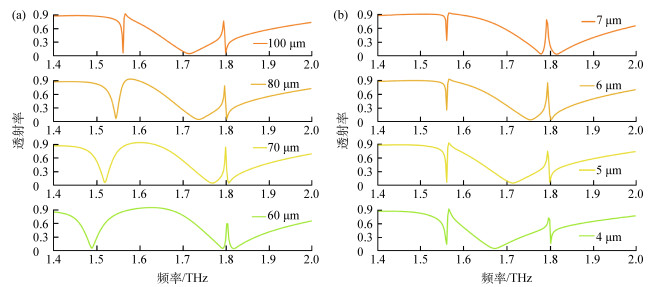 图 5 非对称双开口金属对环结构超表面透射光谱与结构参数的关系(a)双开口环不同中心间距的影响;(b)不同金属线宽的影响Fig. 5 relationship between the transmission spectrum of the asymmetric double-split metallic double-ring metasurface and structural parameters(a) influence of different center-to-center spacings (s) of the double split rings; (b) influence of different metallic line widths (w)下载:
全尺寸图片
Q是评估谐振性能的关键参数之一。为优化传感器性能,研究了结构参数对谐振特性的影响规律。开口环s和w对Q的调控规律如图 6所示。结果表明,当s从60 μm增加至100 μm时,电偶极谐振的Q从325显著提升至408,而类EIT谐振的Q则从301降低至275。类似地,随着w从4 μm增加至7 μm,电偶极谐振的Q呈现单调上升趋势,在w = 7 μm时达到最大值523;类EIT谐振的Q在w = 6 μm时取得最大值244,随后小幅下降至223(w = 7 μm),变化幅度较小。
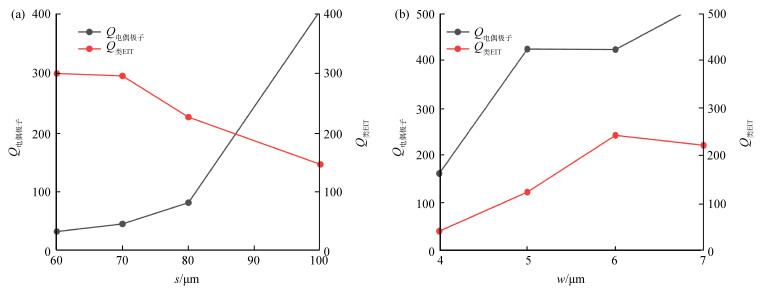 图 6 不同结构参数对传感器Q的影响(a)2个开口环的s对Q的影响;(b)w对Q的影响Fig. 6 influence of different structural parameters on the sensor's Q factor(a) influence of the s of the two split rings on the Q factor; (b) influence of the w on the Q factor下载:
全尺寸图片
基于上述分析,确定最优结构参数为: Px = 90 μm,Py = 190 μm;L = 40 μm;开口环s = 100 μm;w = 7 μm;g = 4 μm;d = 4 μm;PI衬底厚度35 μm,金层厚度200 nm。优化后的超表面透射光谱如图 7所示,其中f1 = 1.561 THz处电偶极谐振的Q为385,谐振相对强度为0.40;f2 = 1.794 THz处类EIT谐振的Q为297,谐振相对强度为0.85。
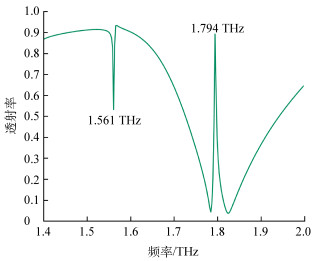 图 7 优化结构超表面的透射谱Fig. 7 transmission spectrum of the optimized structural metasurface下载:
全尺寸图片
结合后续溶液传感实验测量要求,理论计算超表面的S。在超表面上覆盖50 μm厚的分析物,通过改变分析物的折射率(n)可计算2处谐振的频移范围。超表面传感器对不同n分析物的响应特性及S计算结果如图 8所示。通过对比n=1.8、1.9、2.0、2.1和2.2时分析物作用下谐振峰的频移特性,其中电偶极谐振峰和类EIT谐振峰均表现出明显的依赖性频移,随着n的增加,均向低频方向移动。
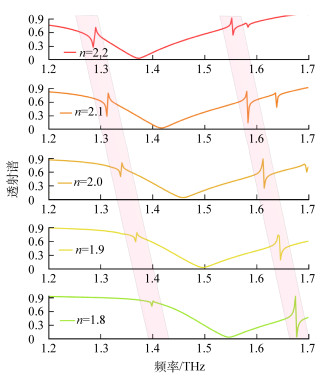 图 8 超表面传感器对不同折射率分析物的透射谱Fig. 8 transmission spectra of the metasurface sensor for analytes with different refractive indices下载:
全尺寸图片
为了准确计算2处谐振的折射率灵敏度,作出2处谐振频率与分析物n关系如图 9所示。图 9(a)通过线性拟合得到的电偶极谐振S=281 GHz/RIU。图 9(b)通过线性拟合得到类EIT谐振S=305 GHz/RIU,展现出更高的S。
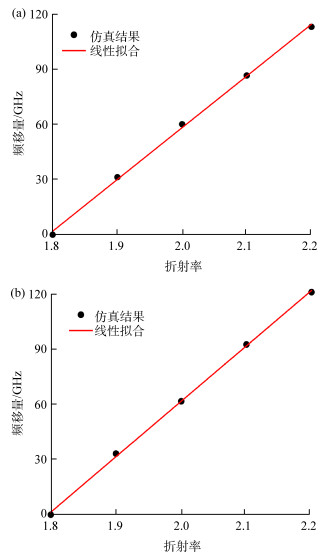 图 9 2处谐振频率与分析物折射率关系(a)f1;(b)f2Fig. 9 relationship between the two resonance frequencies and the analyte refractive index(a)f1; (b)f2下载:
全尺寸图片
基于不同结构的超表面传感器性能的比较如表 2所示,包括开口环和金属条结构组合结构[16]、双开口谐振环和金属短线组合结构[17]、双开口环结构[20]和双椭圆结构[21]。值得注意的是,本研究所提出的超表面传感器的性能与最佳纪录相当。
表 2 本文工作与其他工作的成果对比Table 2 comparison of results between this work and other works4. 结论
本文理论设计了一种非对称双开口金属谐振对环超表面传感器,创新性地通过结构非对称性实现了双谐振模式的独立调控与协同优化。通过分析谐振峰处的电场和表面电流分布,揭示了双谐振的物理机制,f1处的谐振峰由偶极谐振激发,f2处的谐振峰由类EIT谐振激发。进一步通过优化结构参数,显著提升了传感器的性能。实验结果表明,优化后的传感器在f1处偶极谐振的传感S = 281 GHz/RIU,Q = 385;在f2处类EIT谐振的传感S = 305 GHz/RIU,Q = 279。与现有研究相比,本研究通过非对称结构实现了双谐振模式的高效激发与独立调控,同时在单一传感器中同时实现了高S(S > 280 GHz/RIU)和高Q(Q > 270),为高性能双模式超表面传感器的设计提供了理论依据和技术参考。
-
图 1 单开口双环超表面传感器
注:Px为x方向周期,Py为y方向周期;d为不对称度;L为谐振环边长;s为2个开口环的中心间距;w为金属线宽;g为开口间隙。
(a)超表面单元结构示意;(b)电场入射方向Fig. 1 single-split double-ring metasurface sensor
(a) schematic diagram of the metasurface unit structure; (b) electric field incidence direction
下载:
全尺寸图片
图 2 不同不对称度下超表面的透射谱
(a)d = 0;(b)d = 2 μm
Fig. 2 transmission spectra of the metasurface under different asymmetry degrees
(a) d = 0; (b) d = 2 μm
下载:
全尺寸图片
图 3 特征频率点的电磁场分布特性
(a~d)不同频点处电场分布;(e~h)不同频点处表面电流分布
Fig. 3 electromagnetic field distribution characteristics at characteristic frequency points
(a~d) electric field distribution at different frequency points; (e~h) surface current distribution at different frequency points
下载:
全尺寸图片
图 4 不对称度对透射谱、品质因子(Q)及谐振强度的影响
(a)不对称度对双开口双环结构透射谱的影响;(b)不对称度对类EIT谐振峰Q和谐振强度的影响
Fig. 4 influence of asymmetry degree on transmission spectrum, quality factor (Q), and resonance intensity
(a) influence of asymmetry degree on the transmission spectrum of the double-split double-ring structure; (b) effect of asymmetry degree on Q factor and resonance intensity of the EIT-like resonance peak
下载:
全尺寸图片
图 5 非对称双开口金属对环结构超表面透射光谱与结构参数的关系
(a)双开口环不同中心间距的影响;(b)不同金属线宽的影响
Fig. 5 relationship between the transmission spectrum of the asymmetric double-split metallic double-ring metasurface and structural parameters
(a) influence of different center-to-center spacings (s) of the double split rings; (b) influence of different metallic line widths (w)
下载:
全尺寸图片
图 6 不同结构参数对传感器Q的影响
(a)2个开口环的s对Q的影响;(b)w对Q的影响
Fig. 6 influence of different structural parameters on the sensor's Q factor
(a) influence of the s of the two split rings on the Q factor; (b) influence of the w on the Q factor
下载:
全尺寸图片
图 7 优化结构超表面的透射谱
Fig. 7 transmission spectrum of the optimized structural metasurface
下载:
全尺寸图片
图 8 超表面传感器对不同折射率分析物的透射谱
Fig. 8 transmission spectra of the metasurface sensor for analytes with different refractive indices
下载:
全尺寸图片
图 9 2处谐振频率与分析物折射率关系
(a)f1;(b)f2
Fig. 9 relationship between the two resonance frequencies and the analyte refractive index
(a)f1; (b)f2
下载:
全尺寸图片
表 1 不对称度(d)对类EIT谐振峰Q和谐振强度的影响
Table 1 effects of asymmetry (d) on Q factor and resonance intensity of EIT-like resonance peak
d/μm 频率/THz Q 谐振强度 2 1.796 175 0.641 4 1.794 144 0.718 6 1.794 127 0.856 8 1.791 92 0.883 10 1.786 70 0.896 注:Q表示品质因子。 表 2 本文工作与其他工作的成果对比
Table 2 comparison of results between this work and other works
-
[1] SONG Q, HAN P Y, ZHANG X C, et al. Temperature dependent terahertz spectroscopy of allopurinol[J]. Journal of Infrared, Millimeter, and Terahertz Waves, 2009, 30(5): 461-467. DOI: 10.1007/s10762-009-9477-7. [2] JANG J, PARK J, SHIN J H. Terahertz spectral analysis: an in-depth exploration of spectroscopy approaches for ultrafast dynamics[J]. Current Applied Physics, 2024, 59: 197-207. DOI: 10.1016/j.cap.2023.11.015. [3] ZHAO G Z. Terahertz time-domain spectroscopy and its applications[J]. Journal of Electronic Science and Technology, 2014, 12(2): 146-149. DOI: 10.1016/j.dit.2013.03.009. [4] KAWASE K, OGAWA Y, WATANABE Y, et al. Non-destructive terahertz imaging of illicit drugs using spectral fingerprints[J]. Optics Express, 2003, 11(20): 2549-2554. DOI: 10.1364/OE.11.002549. [5] RAINSFORD T, MICKAN S P, ABBOTT D. T-ray sensing applications: review of global developments[J]. Smart Structures, Devices, and Systems Ⅱ, 2005, 5649: 826-838. DOI: 10.1117/12.607746. [6] ZIMDARS D, VALDMANIS A J, WHITE S J, et al. Technology and applications of terahertz imaging non-destructive examination: inspection of space shuttle sprayed on foam insulation[C]// WOOLARD D L, LOEROP W R, ROSKER M J. AIP Conference Proceedings. Melville, NY: AIP Publishing, 2005: 570. [7] ROH Y, KIM T, LEE G, et al. Advances in terahertz biosensors toward photon-molecule interplay[J]. Trends in Analytical Chemistry, 2024, 175: 117715. DOI: 10.1016/j.trac.2024.117715. [8] YU Q, JIANG L, ZHANG L, et al. Research progress of THz spectroscopy of amino acids[J]. Infrared Technology, 2018, 40(3): 220-226. [9] OURIR A, GALLAS B, BECERRA L, et al. Electromagnetically induced transparency in symmetric planar metamaterial at THz wavelengths[J]. Photonics, 2015, 2(1): 308-316. DOI: 10.3390/photonics2010308. [10] BANERJEE S, PAL B P, CHOWDHURY D R. Resonance phenomena in electromagnetic metamaterials for the terahertz domain: a review[J]. Journal of Electromagnetic Waves and Applications, 2020, 34(12): 1314-1337. DOI: 10.1080/09205071.2020.1713227. [11] HAN S, CONG L Q, GAO F, et al. Observation of Fano resonance and classical analog of electromagnetically induced transparency in toroidal metamaterials[J]. Annalen der Physik, 2016, 528(5): 352-357. DOI: 10.1002/andp.201600016. [12] DAYAL G, CHIN X Y, SOCI C, et al. High-Q whispering-gallery-mode-based plasmonic Fano resonances in coupled metallic metasurfaces at near infrared frequencies[J]. Advanced Optical Materials, 2016, 4(8): 1295-1301. DOI: 10.1002/adom.201600356. [13] ANNIKA T, CLEMENT H, ANDRE S, et al. Nonlinear absorption in interacting Rydberg electromagnetically-induced-transparency spectra on two-photon resonance[J]. Physical Review A, 2021, 103(6): 1-11. DOI: 10.1103/PhysRevA.103.063710. [14] SUZUKI T, KONDOH S. Negative refractive index metasurface in the 2.0-THz band[J]. Optical Materials Express, 2018, 8(7): 1916-1925. DOI: 10.1364/OME.8.001916. [15] GUO X Z, HOLGER M, MITCHELL K, et al. Metasurface holograms reaching 80% efficiency[J]. Nature Nanotechnology, 2015, 10(4): 308-312. DOI: 10.1038/nnano.2015.2. [16] ELEFTHERIADES G V, BALMAIN K G. Negative-refraction metamaterials: fundamental principles and applications[J]. Materials Today, 2005, 8(9): 49. DOI: 10.1002/0471744751. [17] ZHOU X, SHU J, HAO J, et al. L-valine solution sensing based on Fano resonance of terahertz metasurface sensor[J]. Optics Communications, 2025, 574: 131166. DOI: 10.1016/j.optcom.2024.131166. [18] SHU J Y, ZHOU X L, HAO J X, et al. Terahertz sensing of L-valine and L-phenylalanine solutions [J]. Sensors, 2024, 24(12): 3798-3798. DOI: 10.3390/s24123798. [19] 潘武, 闫彦君, 沈大俊. 基于类电磁诱导透明的太赫兹超材料传感器性能分析[J]. 红外技术, 2018, 40(7): 707-711. PAN W, YAN Y Q, SHEN D J. Performance analysis of terahertz metamaterial sensor based on electromagnetically induced transparency[J]. Infrared Technology, 2018, 40(7): 707-711. [20] SAMY A S, HAMEED M F O, ELKARAMANY E M A, et al. Highly sensitive terahertz metamaterial sensor[J]. IEEE Sensors Journal, 2019, 19(18): 7993-7999. DOI: 10.1109/JSEN.2019.2918214. [21] 霍红, 延凤平, 王伟, 等. 基于超材料的太赫兹高灵敏度传感器的设计[J]. 中国激光, 2020, 47(8): 322-331. DOI: 10.3788/CJL202047.0814004. HUO H, YAN F P, WANG W, et al. Design of a terahertz high-sensitivity sensor based on metamaterials[J]. Chinese Journal of Lasers, 2020, 47(8): 322-331. doi: 10.3788/CJL202047.0814004 [22] 王晨, 王爽. 一种基于半圆形开口谐振环结构的太赫兹环偶极子超表面设计[J]. 应用物理, 2022, 12(6): 343-350. DOI: 10.12677/APP.2022.126040. WANG C, WANG S. Design of a terahertz toroidal dipole metasurface based on a semicircular split-ring resonator structure[J]. Applied Physics, 2022, 12(6): 343-350. doi: 10.12677/APP.2022.126040 [23] 马长伟, 马文英, 谭毅, 等. 高Q值THz类EIT超材料及传感特性研究[J]. 光电工程, 2018, 45(11): 83-90. DOI: 10.1208610ee.2018.180298. MA C W, MA W Y, TAN Y, et al. Study on high-Q factor THz EIT-like metamaterials and sensing characteristics[J]. Opto-Electronic Engineering, 2018, 45(11): 83-90. doi: 10.12086/oee.2018.180298 [24] 裘燕青, 王钢棋, 郎婷婷. 基于双开口环结构的太赫兹超材料生物传感器[J]. 光学学报, 2023, 43(4): 0428002. DOI: 10.3788/AOS221489. QIU Y Q, WANG G Q, LANG T T. Terahertz metamaterial biosensor based on double split-ring resonator structure[J]. Acta Optica Sinica, 2023, 43(4): 0428002. doi: 10.3788/AOS221489 [25] 刘伟, 梁兰菊, 闫昕, 等. 电磁诱导透明的太赫兹传感器特性分析[J]. 激光杂志, 2020, 41(5): 53-56. DOI: 10.14016/j.cnki.jgzz.2020.05.053. LIU W, LIANG L J, YAN X, et al. Analysis of terahertz sensor characteristics based on electromagnetically induced transparency[J]. Laser Journal, 2020, 41(5): 53-56. doi: 10.14016/j.cnki.jgzz.2020.05.053 [26] 曾庆鹏, 胡放荣, 周远, 等. 基于双椭圆结构的高Q值太赫兹超材料传感器[J]. 光学学报, 2021, 41(14): 191-197. DOI: 10.3788/AOS202141.1428001. ZENG Q P, HU F R, ZHOU Y, et al. High-Q factor terahertz metamaterial sensor based on double elliptical structure[J]. Acta Optica Sinica, 2021, 41(14): 191-197. doi: 10.3788/AOS202141.1428001 [27] FARIAS B, FURTADO C. An analog of magnetic oscillations for neutral atoms with induced electric dipole[J]. International Journal of Modern Physics B, 2018, 32(16): 1850206. DOI: 10.1142/S0217979218502065. [28] 陈颖, 张敏, 丁志欣, 等. 基于全介质超表面的微流体折射率传感器[J]. 中国激光, 2022, 49(6): 0613001. DOI: 10.3788/CJL202249.0613001. CHEN Y, ZHANG M, DING Z X, et al. Microfluidic refractive index sensor based on all-dielectric metasurfaces[J]. Chinese Journal of Lasers, 2022, 49(6): 0613001. doi: 10.3788/CJL202249.0613001 [29] GAO Y X, GE J Y, SUN S F, et al. Dark modes governed by translational-symmetry-protected bound states in the continuum in symmetric dimer lattices[J]. Results in Physics, 2022, 43: 1-7. DOI: 10.1016/j.rinp.2022.106078.
