

Nullnorms on bounded Trellis
-
摘要: 零模作为一类混合型聚合算子,在理论及实际应用中具有重要的研究价值,尤其是序结构上的零模已成为当前的研究热点。首先,介绍了有界Trellis上零模的概念和基本性质;其次,提出了有界Trellis上零模的一个新的构造方法;最后,给出了有界Trellis上零模的相关实例。Abstract: The nullnorms as a class of hybrid aggregation operators, holds significant research value both in theory and practical applications, especially the nullnorms on ordered structures which has become a current research hotspot. Firstly, introduces the concept and basic properties of the nullnorms on a bounded Trellis. Secondly, it proposes a new construction method for the nullnorms on a bounded Trellis. Finally, it provides relevant examples of the nullnorms on a bounded Trellis.
-
Keywords:
- Psoset /
- bounded Trellis /
- nullnorm
-
0. 引言
信息聚合是将不同来源的信息聚合成一个具有代表性数值的过程,描述该过程的数学模型称为聚合算子。近年来,随着信息技术与人工智能的快速发展,信息聚合在理论研究与实际应用中的重要性日益凸显。零模作为一类重要的聚合算子,由Calvo等首次提出,Karaçal等[1]将零模的概念从单位区间推广到有界格,并基于有界格上三角模和三角余模的存在性给出了一些构造方法。目前,有界格上零模的研究已经取得了丰富的成果[2-3]。
传递性是偏序集的重要特征之一,但是在许多理论研究和实际问题中非传递关系广泛存在。例如: 在随机变量比较的研究中,传递性的缺失,导致了循环传递性的建立[4-5];在物种竞争结构中循环的存在性支持了生物多样性[6]。此外,在博弈论、图论以及非传递性蕴含逻辑的研究中,非传递关系亦广泛存在。因此,非传递关系吸引了众多学者的研究,1970年Fried提出不具有传递性的Psosets结构[7]。随后,针对这一结构开展了诸多研究,例如非结合格[8]、Trellis[9]等。
Trellis作为格的一般化,最近,很多学者将有界格上的聚合算子推广到Trellis上,并进行了相关性质的研究。Zedam和De Baets[9]将三角模的概念从有界格推广到有界Trellis;Kong和Zhao[10]随后研究了有界Trellis上的一致模。零模作为三角模和三角余模的推广,在模糊逻辑、模糊集理论、专家系统和神经网络等[11-15]领域已得到广泛应用。因此,有界Trellis上零模的研究具有重要的理论与应用价值。本文构造了有界Trellis上的2类零模,并给出相应的实例。
1. 预备知识
定义1.1[9] 设X是一个非空集合,$ ⊴ $是X上的一个二元关系,若其满足自反性和反对称性,则称$ ⊴ $是X上的一个Pseudo序。具有Pseudo序关系的集合X称为Psoset,记作$ P=\left(X, ⊴\right) $。
定义1.2[9] 存在最小元和最大元(最小元用0表示,最大元用1表示)的Psoset被称为有界Psoset。记作$ P=\left(X, ⊴, \mathrm{0, 1}\right) $。
定义1.3[9] 设$ P=\left(X, ⊴\right) $是一个Psoset,且对于任意的元$ x, y\in X $都存在$ x\wedge y $ (或$ x\vee y $),则称$ P $为$ \wedge - $semi$ - $Trellis($ \vee - $semi$ - $Trellis)。若$ P $既是$ \wedge - $semi$ - $Trellis又是$ \vee - $semi$ - $Trellis,则称为Trellis,记作$ T=\left(X, ⊴, \wedge , \vee \right) $。
定义1.4[9] 设$ T=\left(X, ⊴, \wedge , \vee , \mathrm{0, 1}\right) $是有界Trellis,如果a和b是不可比较的,用$ a\Vert b $来表示。与a不可比较的元的集合记为$ {I}_{a}=\{x\in X\left|\right.x\Vert a\} $。
定义1.5[9] 设$ T=\left(X, ⊴, \wedge , \vee , \mathrm{0, 1}\right) $是有界Trellis,且$ a, b\in X, a⊴b $,则有如下定义:$ [a, b]=\{x\in X|a⊴x⊴b\} $,$ (a, b]=\{x\in X|a⊲x⊴b\} $,$ [a, b)=\{x\in X|a⊴x⊲b\} $,$ (a, b)=\{x\in X|a⊲x⊲b\} $。
定义1.6[9] 设$ P=\left(X, ⊴\right) $是一个Psoset,X中的元$ a $被称为:
(1) 右传递元,对任意$ x, y\in X $,若$ a⊴x⊴y $,则$ a⊴y $;
(2) 左传递元,对任意$ x, y\in X $,若$ x⊴y⊴a $,则$ x⊴a $;
(3) 中间传递元,对任意$ x, y\in X $,若$ x⊴a⊴y $,则$ x⊴y $;
(4) 传递元,既是左传递元、右传递元又是中间传递元。
本文记$ {X}^\text{rtr}、{X}^\text{ltr}、{X}^\text{mtr}和{X}^\text{tr} $分别表示$ X $中所有右传递元、左传递元、中间传递元和传递元的集合。
定义1.7[16] 设$ T=\left(X, ⊴, \wedge , \vee \right) $ $ 是一个 $Trellis,则:
(1) 若对于任意的三元组$ (x, y, z)\in {X}^{3} $,满足$ (x\wedge y)\wedge z=x\wedge (y\wedge z) $ $ \left(或\right(x\vee y)\vee z $ $ =x\vee (y\vee z)) $,则称该三元组是$ \wedge - $结合的(或$ \vee - $结合的);
(2) 若对于包含元$ a $的任意三元组都是$ \wedge - $结合的(或$ \vee - $结合的),则称元$ a $是$ \wedge - $结合的(或$ \vee - $结合的);
(3) 若元$ a $既是$ \wedge - $结合的,又是$ \vee - $结合的,则称其为结合的。
本文记$ {X}^{\wedge -\text{ass}}、{X}^{\vee -\text{ass}}和{X}^\text{ass} $分别表示$ X $中所有$ \wedge -结合元、\vee -结合元和 $结合元的集合。
定义1.8[9] 设$ T=\left(X, ⊴, \wedge , \vee , \mathrm{0, 1}\right) $是一个有界Trellis,X上的二元运算F具有:
(1) 交换性,若对任意$ x, y\in X $,有$ F\left(x, y\right)=F\left(y, x\right) $;
(2) 结合性,若对任意$ x, y, z\in X $,有$ F\left(x, F\left(y, z\right)\right)=F\left(F\left(x, y\right), z\right) $;
(3) 左单调性,若对任意$ {x}_{1}, {x}_{2}, y\in X $,$ {x}_{1}⊴{x}_{2} $有$ F\left({x}_{1}, y\right)⊴F\left({x}_{2}, y\right) $;
(4) 右单调性,若对任意$ {x}_{1}, {x}_{2}, y\in X $,$ {x}_{1}⊴{x}_{2} $有$ F\left(y, {x}_{1}\right)⊴F\left(y, {x}_{2}\right) $;
(5) 单调性,若对任意$ {x}_{1}, {x}_{2}, {y}_{1}, {y}_{2}\in X $,$ {x}_{1}⊴{x}_{2}, $ $ \hspace{0.33em}{y}_{1}⊴{y}_{2} $有$ F\left({x}_{1}, {y}_{1}\right)⊴F\left({x}_{2}, {y}_{2}\right) $。
定义1.9[10] 设$ \left(X, ⊴, \mathrm{0, 1}\right) $是一个有界Psoset,称X上的一个二元运算$ T:{X}^{2}\to X(S:{X}^{2}\to X) $为一个三角模(三角余模),若满足交换性、结合性、单调性,有单位元1(单位元0),使得对任意$ x\in X $,有$ T(x, 1)=1\left(S\right(x, 0)=0) $成立。
命题1.1[16] 设$ T=\left(X, ⊴, \wedge , \vee \right) $是一个Trellis且$ a\in X $,则:
(1) 如果$ a\in {X}^\text{rtr} $,则:
(a) 对任意$ x\in X, a\lesssim x $蕴含$ a⊴x; $
(b) 对任意$ x, y\in X, a⊴x $蕴含$ a\vee y⊴x\vee y $。
(2) 如果$ a\in {X}^\text{ltr} $,则:
(a) 对任意$ x\in X, a\lesssim x $蕴含$ x⊴a $;
(b) 对任意$ x, y\in X, x⊴a $蕴含$ x\wedge y⊴a\wedge y $。
(3) 如果$ a\in {X}^{\Lambda -\text{ass}} $则对任意$ x, y\in X, x⊴y $蕴含$ a\wedge x⊴a\wedge y $。
2. 主要结果
定义2.1[17] 设$ T=\left(X, ⊴, \wedge , \vee , \mathrm{0, 1}\right) $是有界Trellis,称X上的一个二元运算$ V:{X}^{2}\to X $为零模,若$ V $ $ 满足交换性、单调性、结合性 $,当$ x⊴a $时,$ V(x, 0)=x $;当$ a⊴x $时,$ V(x, 1)=x $。
可以很容易地得到$ V(x, a)=a对所有的x\in X $都成立。因此,$ a $是$ V $的零元。
命题2.1[17] 设$ T=\left(X, ⊴, \wedge , \vee , \mathrm{0, 1}\right) $是有界Trellis,$ V $是$ T $上零元为$ a $的零模,则:
(1) $ {\left.V\right|}_{{\left[0\right., a]}^{2}}:{\left[0\right., a]}^{2}\to [0, a] $是$ \left[0\right., a] $上的三角余模;
(2) $ {\left.V\right|}_{{[a, 1]}^{2}}:{[a, 1]}^{2}\to [a, 1] $是$ [a, 1] $上的三角模;
(3) $ V(x, y)=a $,对所有的$ (x, y)\in [0, a]\times [a, 1]\bigcup [a, 1]\times [0, a]; $
(4) $ a⊴V(x, y) $,对所有的$ (x, y)\in {[a, 1]}^{2}\bigcup [a, 1]\times $ $ {I}_{a}\bigcup {I}_{a}\times [a, 1]; $
(5) $ V(x, y)⊴a $,对所有的$ (x, y)\in {\left[0\right., a]}^{2}\bigcup $ $ \left[0\right., a]\times {I}_{a}\bigcup {I}_{a}\times [0, a]; $
(6) $ V(x, y)⊴y $,对所有的$ (x, y)\in X\times [a, 1]; $
(7) $ V(x, y)⊴x $,对所有的$ (x, y)\in [a, 1]\times X; $
(8) $ x⊴V(x, y) $,对所有的$ (x, y)\in [0, a]\times X; $
(9) $ y⊴V(x, y) $,对所有的$ (x, y)\in X\times [0, a]; $
(10) $ x\vee y⊴V(x, y) $,对所有的$ (x, y)\in {[a, 1]}^{2}; $
(11) $ V(x, y)⊴x\vee y $,对所有的$ (x, y)\in {[a, 1]}^{2}; $
(12) $ (x\wedge a)\vee (y\wedge a)⊴V(x, y) $,对所有的$ (x, y)\in [0, a]\times {I}_{a}\bigcup {I}_{a}\times [0, a]\bigcup {I}_{a}\times {I}_{a}; $
(13) $ V(x, y)⊴(x\vee a)\wedge (y\vee a) $,对所有的$ (x, y)\in [a, 1]\times {I}_{a}\bigcup {I}_{a}\times [a, 1]\bigcup {I}_{a}\times {I}_{a} $。
定理2.1 设$ T=\left(X, ⊴, \wedge , \vee , \mathrm{0, 1}\right) $是一个有界Trellis,且$ a\in X\backslash \left\{\mathrm{0, 1}\right\}, S $为$ \left[0\right., a] $上的三角余模,若$ a\in {X}^{\wedge -\text{ass}} $,则二元运算$ V:{X}^{2}\to X $:
$$ V(x, y)=\left\{\begin{array}{ll}S(x\wedge a, y\wedge a), & (x, y)\in \left(\right[0, a)\bigcup {I}_{a}{)}^{2}, \\ x\wedge y, & \begin{array}{l}(x, y)\in \left\{1\right\}\times (a, 1]\bigcup \\ (a, 1]\times \left\{1\right\}, \end{array}\\ a, & 其他, \end{array}\right. $$ 是$ X $上零元为a的零模。
证明 交换性容易验证,当$ x⊴a $时,$ V(x, 0)=x $;当$ a⊴x $时,$ V(x, 1)=x $。
关于单调性,只需证明对任意的$ x, y, z, t\in X $,当$ x⊴y, z⊴t $时,有$ V(x, z)⊴V(y, t) $成立。若y=t=1,则保序性显然,只需考虑如下情况:
(1) $ x, y\in [0, a)\bigcup {I}_{a} $。
(a) $ z, t\in [0, a)\bigcup {I}_{a} $,由$ a\in {X}^{\wedge -\text{ass}} $和S保序知
$ V(x, z)=S(x\wedge a, z\wedge a)⊴S(y\wedge a, t\wedge a)=V(y, t); $
(b) $ z\in [0, a)\bigcup {I}_{a} $,$ t\in [a, 1] $,
$ V(x, z)=S(x\wedge a, z\wedge a)⊴a=V(y, t); $
(c) $ z, t\in [a, 1] $,$ V(x, z)=a=V(y, t); $
(2) $ x\in [0, a)\bigcup {I}_{a} $,$ y\in [a, 1) $。
(a) $ z\in [0, a)\bigcup {I}_{a} $,$ t\in [a, 1) $,
$ V(x, z)=S(x\wedge a, z\wedge a)⊴a=V(y, t); $
(b) $ z\in [0, a)\bigcup {I}_{a} $,$ t=1 $,
$ V(x, z)=S(x\wedge a, z\wedge a)⊴a⊴y=V(y, 1); $
(c) $ z, t\in [a, 1) $,$ V(x, z)=a=V(y, t); $
(d) $ z\in [a, 1] $,$ t=1 $,$ V(x, z)=a⊴y=V(y, 1)。 $
(3) $ x\in [0, a)\bigcup {I}_{a} $,$ y=1 $。
$ z, t\in [a, 1) $,$ V(x, z)=a⊴t=V(1, t)。 $
(4) $ x, y\in [a, 1) $。
(a) $ z, t\in [a, 1) $,$ V(x, z)=a=V(y, t); $
(b) $ z\in [a, 1), t=1 $,$ V(x, z)=a⊴y=V(y, 1); $
(c) $ z=t=1 $,$ V(x, 1)=x⊴y=U(y, 1)。 $
下证结合性,只要证明对任意$ x, y, z\in X $,有$ V(x, V(y, z\left)\right)=V\left(V\right(x, y), z) $成立。若$ a\in \left\{x, y, z\right\} $,则$ V(x, V(y, z\left)\right)=V\left(V\right(x, y), z)=a $。若$ a\notin \left\{x, y, z\right\}, $进行如下分情况讨论。
(1) $ x, y, z\in [0, a)\bigcup {I}_{a} $。
$$ \begin{gathered} V(x, V(y, z))=V(x, S(y \wedge a, z \wedge a))= \\ S(x \wedge a, S(y \wedge a, z \wedge a)), \end{gathered} $$ $$\begin{gathered} V(V(x, y), z)=V(S(x \wedge a, y \wedge a), z)= \\ S(S(x \wedge a, y \wedge a), z \wedge a) 。 \end{gathered} $$ 由S的结合性,知$ V(x, V(y, z\left)\right)=V\left(V\right(x, y), z)。 $
(2) $ x\in [a, 1) $,$ y=z=1 $。
$$ V(x, V(\mathrm{1, 1}\left)\right)=V(x, 1)=x, $$ $$ V\left(V\right(x, 1), 1)=V(x, 1)=x。 $$ (3) $ x=y=z=1 $。
$$ V(x, V(y, z\left)\right)=1=V\left(V\right(x, y), z)。 $$ 对其他情况有
$$ V(x, V(y, z\left)\right)=V\left(V\right(x, y), z)=a $$ 成立。综上所述,V是X上零元为a的零模。
定理2.2 设$ P=\left(X, ⊴, \wedge , \vee , \mathrm{0, 1}\right) $是一个有界Trellis,且$ a\in X\backslash \left\{\mathrm{0, 1}\right\}, T $为$ [a, 1] $上的三角模,若$ a\in {X}^{\vee -\text{ass}} $,则二元运算$ V:{X}^{2}\to X $:
$$ V(x, y)=\left\{\begin{array}{ll}T(x\vee a, y\vee a), & (x, y)\in \left(\right(a, 1]\bigcup {I}_{a}{)}^{2}, \\ x\vee y, & \begin{array}{l}(x, y)\in \left\{0\right\}\times [0, a)\bigcup \\ \left[0\right., a)\times \{0\}, \end{array}\\ a, & 其他, \end{array}\right. $$ 是X上零元为a的零模。
若有界Trellis为有界格,则可得由Funda Karaçal等构造的有界格上的零模$ {V}_{a}^{\left(S\right)}(x, y) $和$ {V}_{a}^{\left(T\right)}(x, y) $,参见文献[1]。
推论2.1[1] $ L=\left(L, \le , \wedge , \vee , \mathrm{0, 1}\right) $是一个有界格,$ a\in L\backslash \left\{\mathrm{0, 1}\right\} $,$ S $是$ \left[0\right., a] $上的三角余模,$ T $是$ [a, 1] $上的三角模,其中$ {D}_{a}=\left\{\right(x, y\left)\right|(x, y)\in [0, a)\times (a, 1]\bigcup (a, 1]\times [0, a) \} $,则$ {V}_{a}^{\left(S\right)}, {V}_{a}^{\left(T\right)}:{L}^{2}\to L $定义为

例2.1 考虑图 1所示的有界Trellis $ X $,$ a\in {X}^{\wedge -\text{ass}} $,取$ S(x, y)=x\vee y $为$ \left[0\right., a] $上的三角余模,则由定理2.1可得$ {V}_{S} $是$ X $上的零模,见表 1。
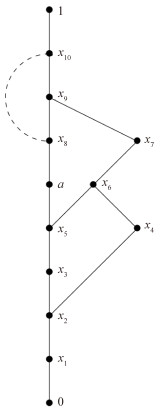 图 1 有界Trellis XFig. 1 bounded Trellis X
 下载:
全尺寸图片
表 1 有界Trellis $ X $上的零模$ {V}_{S}(x, y) $Table 1 nullnorms $ {V}_{S}(x, y) $ on bounded Trellis $ X $
VS 0 x1 x2 x3 x5 a x4 x6 x7 x8 x9 x10 1 0 0 x1 x2 x3 x5 a x2 x5 x5 a a a a x1 x1 x1 x2 x3 x5 a x2 x5 x5 a a a a x2 x2 x2 x2 x3 x5 a x2 x5 x5 a a a a x3 x3 x3 x3 x3 x5 a x3 x5 x5 a a a a x5 x5 x5 x5 x5 x5 a x5 x5 x5 a a a a a a a a a a a a a a a a a a x4 x2 x2 x2 x3 x5 a x2 x5 x5 a a a a x6 x5 x5 x5 x5 x5 a x5 x5 x5 a a a a x7 x5 x5 x5 x5 x5 a x5 x5 x5 a a a a x8 a a a a a a a a a a a a x8 x9 a a a a a a a a a a a a x9 x10 a a a a a a a a a a a a x10 1 a a a a a a a a a x8 x9 x10 1 例2.2 考虑图 2所示的有界Trellis $ X $,$ a\in {X}^{\vee -\text{ass}} $,取$ T(x, y)=x\wedge y $为$ [a, 1] $上的三角模,则由定理2.2可得$ {V}_{T} $是$ X $上的零模,见表 2。
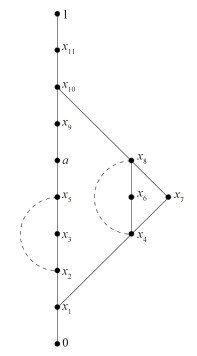 图 2 有界TrellisFig. 2 bounded Trellis下载:
全尺寸图片
表 2 有界Trellis $ X $上的零模$ {V}_{T}(x, y) $Table 2 nullnorms $ {V}_{T}(x, y) $ on bounded Trellis $ X $
VT 0 x1 x2 x3 x5 a x4 x6 x7 x8 x9 x10 x11 1 0 0 x1 x2 x3 x5 a a a a a a a a a x1 x1 a a a a a a a a a a a a a x2 x2 a a a a a a a a a a a a a x3 x3 a a a a a a a a a a a a a x5 x5 a a a a a a a a a a a a a a a a a a a a a a a a a a a a x4 a a a a a a x10 x10 x10 x10 x9 x10 x10 x10 x6 a a a a a a x10 x10 x10 x10 x9 x10 x10 x10 x7 a a a a a a x10 x10 x10 x10 x9 x10 x10 x10 x8 a a a a a a x10 x10 x10 x10 x9 x10 x10 x10 x9 a a a a a a x9 x9 x9 x9 x9 x9 x9 x9 x10 a a a a a a x10 x10 x10 x10 x9 x10 x10 x10 x11 a a a a a a x10 x10 x10 x10 x9 x10 x11 x11 1 a a a a a a x10 x10 x10 x10 x9 x10 x11 1 3. 结束语
作为一类混合型聚合算子,零模不论在理论还是应用方面,均具有重要的研究意义。目前,有界Trellis上零模的研究引起学者广泛关注。本文构造了一类有界Trellis上的零模,结果表明有界Trellis上存在新的不同的零模,进一步丰富和发展了有界Trellis上的零模理论。
-
图 1 有界Trellis X
Fig. 1 bounded Trellis X
下载:
全尺寸图片
图 2 有界Trellis
Fig. 2 bounded Trellis
下载:
全尺寸图片
表 1 有界Trellis $ X $上的零模$ {V}_{S}(x, y) $
Table 1 nullnorms $ {V}_{S}(x, y) $ on bounded Trellis $ X $
VS 0 x1 x2 x3 x5 a x4 x6 x7 x8 x9 x10 1 0 0 x1 x2 x3 x5 a x2 x5 x5 a a a a x1 x1 x1 x2 x3 x5 a x2 x5 x5 a a a a x2 x2 x2 x2 x3 x5 a x2 x5 x5 a a a a x3 x3 x3 x3 x3 x5 a x3 x5 x5 a a a a x5 x5 x5 x5 x5 x5 a x5 x5 x5 a a a a a a a a a a a a a a a a a a x4 x2 x2 x2 x3 x5 a x2 x5 x5 a a a a x6 x5 x5 x5 x5 x5 a x5 x5 x5 a a a a x7 x5 x5 x5 x5 x5 a x5 x5 x5 a a a a x8 a a a a a a a a a a a a x8 x9 a a a a a a a a a a a a x9 x10 a a a a a a a a a a a a x10 1 a a a a a a a a a x8 x9 x10 1 表 2 有界Trellis $ X $上的零模$ {V}_{T}(x, y) $
Table 2 nullnorms $ {V}_{T}(x, y) $ on bounded Trellis $ X $
VT 0 x1 x2 x3 x5 a x4 x6 x7 x8 x9 x10 x11 1 0 0 x1 x2 x3 x5 a a a a a a a a a x1 x1 a a a a a a a a a a a a a x2 x2 a a a a a a a a a a a a a x3 x3 a a a a a a a a a a a a a x5 x5 a a a a a a a a a a a a a a a a a a a a a a a a a a a a x4 a a a a a a x10 x10 x10 x10 x9 x10 x10 x10 x6 a a a a a a x10 x10 x10 x10 x9 x10 x10 x10 x7 a a a a a a x10 x10 x10 x10 x9 x10 x10 x10 x8 a a a a a a x10 x10 x10 x10 x9 x10 x10 x10 x9 a a a a a a x9 x9 x9 x9 x9 x9 x9 x9 x10 a a a a a a x10 x10 x10 x10 x9 x10 x10 x10 x11 a a a a a a x10 x10 x10 x10 x9 x10 x11 x11 1 a a a a a a x10 x10 x10 x10 x9 x10 x11 1 -
[1] KARAÇAL F, İNCE M A, MESIAR R. Nullnorms on bounded lattice[J]. Information Sciences, 2015, 325: 227-236. DOI: 10.1016/j.ins.2015.06.052. [2] DRYGAŚ P. A characterization of idempotent nullnorms[J]. Fuzzy Sets and Systems, 2004, 145: 455-461. DOI: 10.1016/S0165-0114(03)00259-8. [3] QIN F, ZHAO B. The distributive equations for idempotent uninorms and nullnorms[J]. Fuzzy Sets and Systems, 2005, 155: 446-458. DOI: 10.1016/j.fss.2005.04.010. [4] DE BAETS B, DE MEYER H, DE SCHUYMER B, et al. Cyclic evaluation of transitivity of reciprocal relations [J]. Social Choice and Welfare, 2006, 26: 217-238. DOI: 10.1007/s00355-006-0093-3. [5] DE BAETS, DE LOOF K, DE MEYER H. A frequentist view on cycle-transitivity of reciprocal relations [J]. Fuzzy Sets and Systems, 2015, 281: 198-218. DOI: 10.1016/j.fss.2015.06.020. [6] KERR B, RILEY M A, FELDMAN M W, et al. Local dispersal promotes biodiversity in a real-life game of rock-paper-scissors [J]. Nature, 2002, 418: 171-174. DOI: 10.1038/nature00823. [7] FRIED E. Tournaments and non-associative lattices[J]. Annales Universitatis Scientiarium Budapestinensis de Rolando Eötvös Nominatae, Sectio Mathematica, 1970, 13: 151-164. [8] SKALA H. Trellis theory[M]. Providence: American Mathematical Society, 1972. [9] ZEDAM L, DE BAETS B. Triangular norms on bounded trellises[J]. Fuzzy Sets and Systems, 2023, 462: 108468. DOI:10.1016/J. FSS.2023.01.003. [10] KONG Y, ZHAO B. Uninorms on bounded trellises[J]. Fuzzy Sets and Systems, 2024, 481: 108898. DOI:10.1016/J. FSS.2024.108898. [11] ALSINA M, FRANK B, SCHWEIZER H. Associative functions. Triangular norms and copulas[M]. Hackensack: World Scientific, 2006. [12] DUBOIS D, PRADE H. A review of fuzzy set aggregation connectives [J]. Information Sciences, 1985, 36: 85-121. DOI: 10.1016/0020-0255(85)90027-1. [13] DUBOIS D, PRADE H. Fundamentals of fuzzy sets [M]. Boston: Kluwer Academic Publishers, 2000. [14] GRABISCH M, MARICHAL J L, MESIAR R, et al. Aggregation functions [M]. Cambridge: Cambridge University Press, 2009. [15] MESIAR R, PAP E. Different interpretations of triangular norms and related operations [J]. Fuzzy Sets and Systems, 1998, 96: 183-189. DOI: 10.1016/s0165-0114(96)00290-4. [16] BACZYŃSKI M, JAYARAM B. Fuzzy implications[M]. Berlin: Springer, 2008. [17] XIU Z Y, XU Z. Nullnorms on bounded trellises[EB/OL]. [2025-04-02]. https://arxiv.org/abs/2408.09321.
