

Construction of uninorms on bounded Trellis
-
摘要: 作为一类混合型聚合算子,一致模具有重要的研究意义,特别是序结构上的一致模是目前的研究热点。本文主要研究有界Trellis上一致模的构造问题,给出了一种新的构造方法,并举例阐明与已有方法的差异。Abstract: As a class of mixed aggregation operators, uninorms hold significant research importance. In particular, uninorms on ordered structures are currently a research hotspot. This paper focuses on the construction of uninorms on bounded Trellis, proposing a new method for their construction. Additionally, it provides examples to illustrate the differences between this new method and existing approaches.
-
Keywords:
- Psoset /
- bounded Trellis /
- uninorm
-
0. 引言
信息聚合是将不同来源的信息聚合成一个具有代表性数值的过程,描述该过程的数学模型称为聚合算子。近些年,随着科技的发展,信息聚合变得尤为重要。一致模是一类重要的聚合算子,由Yager和Rybalov[1]于1996年引入,随后Fodor等[2]展开深入研究。作为三角模和三角余模的推广,一致模被广泛应用于统计决策、专家系统、模糊逻辑、图像处理和近似推理[3-7]等领域。随着研究的深入,Karaçal和Mesiar[8]于2015年定义了有界格上的一致模,证明了任意有界格上一致模的存在性,并提供2种构造有界格上一致模的方法;2016年,çaylı等[9]讨论了新的一类有界格上的一致模,证明了有界格上幂等一致模的存在性,并得到了任意有界格上最大和最小的幂等一致模。此后,许多研究者致力于研究有界格上一致模的相关问题[10-16]。
传递性是偏序关系具有的属性之一,事实上,在数学和其他领域中非传递关系普遍存在而且具有重要的作用,如相邻关系、正交关系等。Psoset是一类具有自反性和反对称性,但不具备传递性的序结构。1971年,Skala[17]引入了Trellis。随后,许多学者研究了Trellis的一些重要性质[18-21]。2023年,Zedam和De Baets[22]在有界Trellis上定义了三角模,开始了有界Trellis上聚合算子的研究;2024年,Kong和Zhao[23]进一步研究了有界Trellis上的一致模,并给出了一类构造方法。在此基础上,本文将继续研究有界Trellis上一致模的不同构造,并通过具体实例阐明构造方法的不同之处。
1. 预备知识
定义1.1[22] 设$X$ 是一个非空集合,$\unlhd$ 是$X$ 上的一个二元关系,若其满足自反性和反对称性,则称$\unlhd$ 是$X$ 上的一个Pseudo序。具有Pseudo序关系的集合$X$称为Psoset,记作$\mathbb{P}=(X, \unlhd)$。
定义1.2[22] 存在最小元和最大元(最小元用0表示,最大元用1表示)的Psoset(即对任意$x \in X, 0 \unlhd x \unlhd 1$)被称为有界Psoset。记作$\mathbb{P}=(X, \unlhd, 0, 1)$。
定义1.3[22] 设$\mathbb{P}=(X, \unlhd)$ 是一个Psoset,且对任意$x, y \in X$ 都存在$x \wedge y($ 或$x \vee y)$,则称$\mathbb{P}$ 为$\wedge$-semi-Trellis($\vee$-semi-Trellis)。若$\mathbb{P}$ 既是$\wedge$-semi-Trellis又是$\vee$-semi-Trellis,则称为Trellis,记作$\mathrm{T}=(X, \unlhd, \wedge, \vee)$。
定义1.4[22] 设$\mathbb{T}=(X, \unlhd, \wedge, \vee, 0, 1)$ 是有界Trellis,若$a$ 和$b$ 是不可比较的,用$a \| b$ 来表示,与$a$不可比较元的集合记为$I_{a}=\{x \in X \mid x \| a\}$。
定义1.5[22] 设$\mathbb{T}=(X, \unlhd, \wedge, \vee, 0, 1)$ 是有界Trellis,且$a, b \in X, a \unlhd b$,则有如下定义:$[a, b]= \{x \in X \mid a \unlhd x \unlhd b\}, (a, b]=\{x \in X \mid a \triangleleft x \unlhd b\}, [a, b)= \{x \in X \mid a \unlhd x \triangleleft b\}, (a, b)=\{x \in X \mid a \triangleleft x \triangleleft b\}$。
定义1.6[22] 设$\mathbb{P}=(X, \unlhd)$ 是一个Psoset,$X$ 中的元$a$ 被称为如下4类传递元。
(1)右传递元:对任意$x, y \in X$,若$a \unlhd x \unlhd y$,则$a \unlhd y$。
(2)左传递元:对任意$x, y \in X$,若$x \unlhd y \unlhd a$,则$x \unlhd a$。
(3)中间传递元:对任意$x, y \in X$,若$x \unlhd a \unlhd y$,则$x \unlhd y$。
(4)传递元:既是左传递元、右传递元又是中间传递元。
本文记$X^{r t r}、X^{l r r}、X^{m t r}、X^{t r}$ 分别表示$X$ 中所有右传递元、左传递元、中间传递元、传递元的集合。
定义1.7[22] 设$\mathbb{T}=(X, \unlhd, \wedge, \vee, 0, 1)$ 是一个有界Trellis,$X$ 上的二元运算$F$ 具有以下特性。
(1)交换性:若对任意$x, y \in X$,有$F(x, y)=F(y, x)$。
(2)结合性:若对任意$x, y, z \in X$,有$F(x, F(y, z))=F(F(x, y), z)$。
(3)左单调性:若对任意$x_{1}, x_{2}, y \in X, x_{1} \unlhd x_{2}$ 有$F\left(x_{1}, y\right) \unlhd F\left(x_{2}, y\right)$。
(4)右单调性:若对任意$x_{1}, x_{2}, y \in X, x_{1} \unlhd x_{2}$ 有$F\left(y, x_{1}\right) \unlhd F\left(y, x_{2}\right)$。
(5)单调性:若对任意$x_{1}, x_{2}, y_{1}, y_{2} \in X$,$x_{1} \unlhd x_{2}, y_{1} \unlhd y_{2}$ 有$F\left(x_{1}, y_{1}\right) \unlhd F\left(x_{2}, y_{2}\right)$。
定义1.8[23] 设$\mathbb{T}=(X, \unlhd, \wedge)$ 是一个$\wedge$-semi-Trel-lis,称$X$ 上的一个二元运算$F: X^{2} \rightarrow X$ 为子模,若对任意$x, y \in X$,满足交换性、结合性、单调性,且$F(x, y) \unlhd x \wedge y$ 成立。
定义1.9[23] 设$\mathbb{T}=(X, \unlhd, \mathrm{~V})$ 是一个V -semi-Trel-lis,称$X$ 上的一个二元运算$F: X^{2} \rightarrow X$ 为余子模,若对任意$x, y \in X$,满足交换性、结合性、单调性,且$x \vee y \unlhd F(x, y)$ 成立。
定义1.10[23] 设$\mathbb{T}=(X, \unlhd, \wedge, \vee, 0, 1)$ 是一个有界Trellis,称$X$ 上的一个二元运算$U: X^{2} \rightarrow X$ 为一致模,若$U$ 满足交换性、结合性、单调性,且存在单位元$e$。
定理1.1[23] 设$\mathbb{T}=(X, \unlhd, \wedge, \vee, 0, 1)$ 是一个满足(CC1)的有界Trellis,$e \in\left(X^{m t r} \cap X^{l t r}\right) \backslash\{0, 1\}$,$T: [0, e]^{2} \rightarrow[0, e]$ 是一个三角模,$c l: X^{2} \rightarrow X$ 是一个闭包算子,$F: c l(X)^{2} \rightarrow c l(X)$ 是一个余子模,若$c l(X) \subseteq X^{l r}$,则二元运算$U: X^{2} \rightarrow X$ 被定义为
$$ U(x, y)= \begin{cases}T(x, y), & (x, y) \in[0, e]^{2}, \\ y, & x \in[0, e], y \notin[0, e], \\ x, & y \in[0, e], x \notin[0, e], \\ F(c l(x), c l(y)), & \text { 其他}, \end{cases} $$ 则U是X上单位元为e的一致模。
2. 主要结果
定理2.1 设$\mathbb{T}=(X, \unlhd, \wedge, \vee, 0, 1)$ 是有界Trellis,$e \in X^{m t r} \backslash\{0, 1\}, I_{e} \subseteq X^{t r}$,若$T$ 为$[0, e)^{2}$ 上的子模且满足$T(x, y) \subseteq X^{r r r}, \forall x, y \in[0, e)$,则二元运算$U_{t}: X^{2} \rightarrow X$ 为
$$ U_t(x, y)= \begin{cases}T(x, y), & (x, y) \in[0, e)^2, \\ (x \vee y) \vee e, & (x, y) \in I_e \times I_e \cup[0, e) \times \\ \; &(e, 1] \cup(e, 1] \times[0, e),\\ y, & (x, y) \in[0, e) \times I_e \cup\{e\} \times X, \\ x, & (x, y) \in I_e \times[0, e) \cup X \times\{e\},\\ 1, &\text { 其他 },\end{cases} $$ 是X上单位元为e的一致模。
证明 交换性显然成立,$e$ 是$U_{t}$ 的单位元,下面只需证单调性和结合性即可。
关于单调性,只需证明对任意的$x, y, z, t \in X$,当$x \unlhd z, y \unlhd t$ 时,有$U_{t}(x, y) \unlhd U_{t}(z, t)$ 成立。下面分情况讨论。
2.1 对于$x \in[0, e)$时的情形
(1)$y \in[0, e)$。
①$z \in[0, e)$ 时,若$t \in[0, e)$,则
$$ U_{t}(x, y)=T(x, y) \unlhd T(z, t)=U_{t}(z, t) 。 $$ 若$t=e$,则
$$ U_{t}(x, y)=T(x, y) \unlhd x \unlhd z=U_{t}(z, t) 。 $$ 因为$T \subseteq X^{r r r}$,所以$U_{t}(x, y) \unlhd U_{t}(z, t)$。若$t \in(e, 1]$,则$U_{t}(x, y)=T(x, y) \unlhd e \unlhd t=(z \vee t) \vee e=U_{t}(z, t)$。因为$e \in X^{m t r} \backslash\{0, 1\}$,所以$U_{t}(x, y) \unlhd U_{t}(z, t)$。若$t \in I_{e}$,则
$$ U_{t}(x, y)=T(x, y) \unlhd y \unlhd t=U_{t}(z, t) 。 $$ 因为$T \subseteq X^{r t r}$,所以$U_{t}(x, y) \unlhd U_{t}(z, t)$。
② $z=e$ 时,对所有的$t$ 均有
$$ U_{t}(x, y)=T(x, y) \unlhd y \unlhd t=U_{t}(z, t) 。 $$ 因为$T \subseteq X^{r t r}$,所以$U_{t}(x, y) \unlhd U_{t}(z, t)$。
③ $z \in(e, 1]$ 时,若$t \in[0, e)$,则有
$$ U_{t}(x, y)=T(x, y) \unlhd x \unlhd z=(z \vee t) \vee e=U_{t}(z, t)。 $$ 因为$T \subseteq X^{r t r}$,所以$U_{t}(x, y) \unlhd U_{t}(z, t)$。若$t=e$,则有
$$ U_{t}(x, y)=T(x, y) \unlhd x \unlhd z=U_{t}(z, t)。 $$ 因为$T \subseteq X^{r t r}$,所以$U_{t}(x, y) \unlhd U_{t}(z, t)$。若$t \in(e, 1]$或$t \in I_{e}$,则有
$$ U_{t}(x, y)=T(x, y) \unlhd 1=U_{t}(z, t) 。 $$ ④ $z \in I_{e}$ 时,若$t \in[0, e)$ 或$t=e$,则有
$$ U_{t}(x, y)=T(x, y) \unlhd x \unlhd z=U_{t}(z, t) 。 $$ 因为$T \subseteq X^{r t r}$,所以$U_{t}(x, y) \unlhd U_{t}(z, t)$。若$t \in(e, 1]$,则有
$$ U_{t}(x, y)=T(x, y) \unlhd 1=U_{t}(z, t) 。 $$ 若$t \in I_{e}$,则有
$$ U_{t}(x, y)=T(x, y) \unlhd e \unlhd(z \vee t) \vee e=U_{t}(z, t) 。 $$ 因为$e \in X^{m t r} \backslash\{0, 1\}$,所以$U_{t}(x, y) \unlhd U_{t}(z, t)$。
(2)$y=e$。
① $z \in[0, e)$ 时,若$t=e$,则
$$ U_{t}(x, y)=x \unlhd z=U_{t}(z, t) \text { 。 } $$ 若$t \in(e, 1]$,则
$$ U_{t}(x, y)=x \unlhd e \unlhd(z \vee t) \vee e=U_{t}(z, t) \text { 。 } $$ 因为$e \in X^{m t r} \backslash\{0, 1\}$,所以$U_{t}(x, y) \unlhd U_{t}(z, t)$。
②$z=e$ 时,若$t=e$,则有
$$ U_{t}(x, y)=x \unlhd e=U_{t}(z, t) \text { 。 } $$ 若$t \in(e, 1]$ 时,
$$ U_{t}(x, y)=x \unlhd e \unlhd t=U_{t}(z, t) \text { 。 } $$ 因为$e \in X^{m t r} \backslash\{0, 1\}$,所以$U_{t}(x, y) \unlhd U_{t}(z, t)$。
③ $z \in(e, 1]$ 或$z \in I_{e}$ 时,若$t=e$,则
$$ U_{t}(x, y)=x \unlhd z=U_{t}(z, t) \text { 。 } $$ 若$t \in(e, 1]$,则
$$ U_{t}(x, y)=x \unlhd 1=U_{t}(z, t) \text { 。 } $$ (3)$y \in(e, 1]$。
① $z \in[0, e)$ 时,若$t \in(e, 1]$,则
$$ U_{t}(x, y)=(x \vee y) \vee e=y \unlhd t=(z \vee t) \vee e=U_{t}(z, t)。 $$ ② $z=e$ 时,若$t \in(e, 1]$,则
$$ U_{t}(x, y)=(x \vee y) \vee e=y \unlhd t=U_{t}(z, t)。 $$ ③ $z \in(e, 1]$ 或$z \in I_{e}$ 时,若$t \in(e, 1]$,则有
$$ U_{t}(x, y)=(x \vee y) \vee e=y \unlhd 1=U_{t}(z, t)。 $$ (4)$y \in I_{e} $。
① $z \in[0, e)$ 时,若$t \in(e, 1]$,则有
$$ U_{t}(x, y)=y \unlhd t=(z \vee t) \vee e=U_{t}(z, t)。 $$ 若$t \in I_{e}$,则有
$$ U_{t}(x, y)=y \unlhd t=U_{t}(z, t) \text { 。 } $$ ② $z=e$ 时,若$t \in(e, 1]$ 或$t \in I_{e}$,则有
$$ U_{t}(x, y)=y \unlhd t=U_{t}(z, t) \text { 。 } $$ ③$z \in(e, 1]$ 时,若$t \in(e, 1]$ 或$t \in I_{e}$,则有
$$ U_{t}(x, y)=y \unlhd 1=U_{t}(z, t) \text { 。 } $$ ④ $z \in I_{e}$ 时,若$t \in(e, 1]$,则
$$ U_{t}(x, y)=y \unlhd 1=U_{t}(z, t) \text { 。 } $$ 若$t \in I_{e}$,则有
$$ U_{t}(x, y)=y \unlhd t \unlhd(z \vee t) \vee e=U_{t}(z, t) \text { 。 } $$ 因为$I_{e} \subseteq X^{t r}$,所以$U_{t}(x, y) \unlhd U_{t}(z, t)$。
2.2 对于$x=e$时的情形
(1)$y \in[0, e)$。
① $z=e$ 时,对所有的$t$ 均有
$$ U_{t}(x, y)=y \unlhd t=U_{t}(z, t) \text { 。 } $$ ② $z \in(e, 1]$ 时,若$t \in[0, e)$,则有
$$ U_{t}(x, y)=y \unlhd e \unlhd z=(z \vee t) \vee e=U_{t}(z, t) 。 $$ 因为$e \in X^{m t r} \backslash\{0, 1\}$,所以$U_{t}(x, y) \unlhd U_{t}(z, t)$。若$t \in(e, 1]$ 或$t \in I_{e}$,则有
$$ U_{t}(x, y)=y \unlhd 1=U_{t}(z, t)。 $$ 因为$e \in X^{m t r} \backslash\{0, 1\}$,所以$U_{t}(x, y) \unlhd U_{t}(z, t)$。若$t \in(e, 1]$ 或$t \in I_{e}$,则有
$$ U_{t}(x, y)=y \unlhd 1=U_{t}(z, t)。 $$ (2)$y=e$。
① $z=e$ 时,若$t=e$,则有
$$ U_{t}(x, y)=e=U_{t}(z, t)。 $$ 若$t \in(e, 1]$,则
$$ U_{t}(x, y)=e \unlhd t=U_{t}(z, t)。 $$ ② $z \in(e, 1]$ 时,若$t=e$,则有
$$ U_{t}(x, y)=e \unlhd z=U_{t}(z, t) \text { 。 } $$ 若$t \in(e, 1]$,则有
$$ U_{t}(x, y)=e \unlhd 1=U_{t}(z, t) \text { 。 } $$ (3)$y \in(e, 1]$。
① $z=e$ 时,若$t \in(e, 1]$,则有
$$ U_{t}(x, y)=y \unlhd t=U_{t}(z, t)。 $$ ② $z \in(e, 1]$ 时,若$t \in(e, 1]$,则有
$$ U_{t}(x, y)=y \unlhd 1=U_{t}(z, t)。 $$ (4)$y \in I_{e}$。
① $z=e$ 时,若$t \in(e, 1]$ 或$t \in I_{e}$,则有
$$ U_{t}(x, y)=y \unlhd t=U_{t}(z, t)。 $$ ② $z \in(e, 1]$ 时,若$t \in(e, 1]$ 或$t \in I_{e}$,则有
$$ U_{t}(x, y)=y \unlhd 1=U_{t}(z, t)。 $$ 2.3 对于$x \in(e, 1]$时的情形
(1)$y \in[0, e)$。当$z \in(e, 1]$ 时,若$t \in[0, e)$,则有
$$ U_{t}(x, y)=(x \vee y) \vee e=x \unlhd z=(z \vee t) \vee e=U_{t}(z, t)。 $$ 若$t=e$ 时,则有
$$ U_{t}(x, y)=(x \vee y) \vee e=x \unlhd z=U_{t}(z, t) 。 $$ 若$t \in(e, 1]$ 或$t \in I_{e}$,则有
$$ U_{t}(x, y)=(x \vee y) \vee e=x \unlhd 1=U_{t}(z, t)。 $$ (2)$y=e$。当$z \in(e, 1]$ 时,若$t=e$,则有
$$ U_{t}(x, y)=x \unlhd z=U_{t}(z, t) 。 $$ 若$t \in(e, 1]$,则有
$$ U_{t}(x, y)=x \unlhd 1=U_{t}(z, t)。 $$ (3)$y \in(e, 1]$。当$z \in(e, 1]$ 时,若$t \in(e, 1]$,则有
$$ U_{t}(x, y)=1=U_{t}(z, t)。 $$ (4)$y \in I_{e}$。当$z \in(e, 1]$ 时,若$t \in(e, 1]$ 或$t \in I_{e}$,则有
$$ U_{t}(x, y)=1=U_{t}(z, t)。 $$ 2.4 对于$x \in I_e$时的情形
(1)$y \in[0, e)$。
① 当$z \in(e, 1]$ 时,若$t \in[0, e)$,则
$$ U_{t}(x, y)=x \unlhd z=(z \vee t) \vee e=U_{t}(z, t)。 $$ 若$t=e$,则有
$$ U_{t}(x, y)=x \unlhd z=U_{t}(z, t) \text { 。 } $$ 若$t \in(e, 1]$ 或$t \in I_{e}$,则
$$ U_{t}(x, y)=x \unlhd 1=U_{t}(z, t) 。 $$ 若$t \in(e, 1]$ 或$t \in I_{e}$,则
$$ U_{t}(x, y)=x \unlhd 1=U_{t}(z, t) 。 $$ ② 当$z \in I_{e}$ 时,若$t \in[0, e)$ 或$t=e$,则
$$ U_{t}(x, y)=x \unlhd z=U_{t}(z, t) 。 $$ 若$t \in(e, 1]$,则
$$ U_{t}(x, y)=x \unlhd 1=U_{t}(z, t) \text { 。 } $$ 若$t \in I_{e}$,则
$$ U_{t}(x, y)=x \unlhd z \unlhd(z \vee t) \vee e=U_{t}(z, t)。 $$ 因为$I_{e} \subseteq X^{t r}$,所以$U_{t}(x, y) \unlhd U_{t}(z, t)$。
(2)$y=e$。当$z \in(e, 1]$ 或$z \in I_{e}$ 时,若$t=e$,则
$$ U_{t}(x, y)=x \unlhd z=U_{t}(z, t) 。 $$ 若$t \in(e, 1]$,则
$$ U_{t}(x, y)=x \unlhd 1=U_{t}(z, t) 。 $$ (3)$y \in(e, 1]$。当$z \in(e, 1]$ 或$z \in I_{e}$ 时,若$t \in(e, 1]$,则
$$ U_{t}(x, y)=1=U_{t}(z, t)。 $$ (4)$y \in I_{e}$。
① 当$z \in(e, 1]$ 时,若$t \in(e, 1]$ 或$t \in I_{e}$,则有
$$ U_{t}(x, y)=(x \vee y) \vee e \unlhd 1=U_{t}(z, t)。 $$ ② 当$z \in I_{e}$ 时,若$t \in(e, 1]$,则有
$$ U_{t}(x, y)=(x \vee y) \vee e \unlhd 1=U_{t}(z, t)。 $$ 若$t \in I_{e}$,则有
$$ U_{t}(x, y)=(x \vee y) \vee e \unlhd(z \vee t) \vee e=U_{t}(z, t)。 $$ 因为$I_{e} \subseteq X^{t r}$,所以$U_{t}(x, y) \unlhd U_{t}(z, t)$。
下证结合性,需证明对任意的$x, y, z \in X$,有$U_{t}\left(x, U_{t}(y, z)\right)=U_{t}\left(U_{t}(x, y), z\right)$ 成立。
2.5 根据文献[10]中定理2.23,只需考虑如下情况
(1)$x \in[0, e)$。
① $y \in[0, e)$ 时,若$z=e$,有
$$ \begin{gathered} U_{t}\left(x, U_{t}(y, z)\right)=U_{t}(x, y)=T(x, y)= \\ U_{t}(T(x, y), z)=U_{t}\left(U_{t}(x, y), z\right)。 \end{gathered} $$ ② $y=e$ 时,若$z \in[0, e)$,有
$$ \begin{gathered} U_{t}\left(x, U_{t}(y, z)\right)=U_{t}(x, z)=T(x, z)=\\ U_{t}(x, z)=U_{t}\left(U_{t}(x, y), z\right) 。 \end{gathered} $$ 若$z=e$,有
$$ \begin{gathered} U_{t}\left(x, U_{t}(y, z)\right)=U_{t}(x, e)=x= \\ U_{t}(x, z)=U_{t}\left(U_{t}(x, y), z\right)。 \end{gathered} $$ 若$z \in(e, 1]$,有
$$ \begin{gathered} U_{t}\left(x, U_{t}(y, z)\right)=U_{t}(x, z)=(x \vee z) \vee e= \\ U_{t}(x, z)=U_{t}\left(U_{t}(x, y), z\right)。 \end{gathered} $$ 若$z \in I_{e}$,有
$$ U_{t}\left(x, U_{t}(y, z)\right)=U_{t}(x, z)=U_{t}\left(U_{t}(x, y), z\right) \text { 。 } $$ (1.3)$y \in(e, 1]$ 时,若$z=e$,则
$$ \begin{gathered} U_{t}\left(x, U_{t}(y, z)\right)=U_{t}(x, y)=(x \vee y) \vee e=y= \\ U_{t}(y, z)=U_{t}((x \vee y) \vee e, z)=U_{t}\left(U_{t}(x, y), z\right)。 \end{gathered} $$ (2)$x=e_{0}$
① $y \in[0, e)$ 时,若$z \in[0, e)$,则
$$ \begin{gathered} U_{t}\left(x, U_{t}(y, z)\right)=U_{t}(x, T(y, z))= \\ T(y, z)=U_{t}(y, z)=U_{t}\left(U_{t}(x, y), z\right)。 \end{gathered} $$ 若$z=e$,则
$$ \begin{gathered} U_{t}\left(x, U_{t}(y, z)\right)=U_{t}(x, y)=y= \\ U_{t}(y, z)=U_{t}\left(U_{t}(x, y), z\right)。 \end{gathered} $$ 若$z \in(e, 1]$,则
$$ \begin{gathered} U_{t}\left(x, U_{t}(y, z)\right)=U_{t}(x, (y \vee z) \vee e)=U_{t}(x, z)= \\ z=(y \vee z) \vee e=U_{t}(y, z)=U_{t}\left(U_{t}(x, y), z\right)。 \end{gathered} $$ 若$z \in I_{e}$,则
$$ \begin{gathered} U_{t}\left(x, U_{t}(y, z)\right)=U_{t}(x, z)=z= \\ U_{t}(y, z)=U_{t}\left(U_{t}(x, y), z\right)。 \end{gathered} $$ ② $y=e$ 时,若$z \in[0, e)$,则
$$ \begin{gathered} U_{t}\left(x, U_{t}(y, z)\right)=U_{t}(x, z)=z= \\ U_{t}(y, z)=U_{t}\left(U_{t}(x, y), z\right)。 \end{gathered} $$ 若$z=e$,则
$$ \begin{gathered} U_{t}\left(x, U_{t}(y, z)\right)=U_{t}(x, e)=x=e= \\ U_{t}(e, e)=U_{t}\left(U_{t}(x, y), z\right)。 \end{gathered} $$ 若$z \in(e, 1]$ 或$z \in I_{e}$,则
$$ \begin{gathered} U_{t}\left(x, U_{t}(y, z)\right)=U_{t}(x, z)=z= \\ U_{t}(y, z)=U_{t}\left(U_{t}(x, y), z\right)。 \end{gathered} $$ ③ $y \in(e, 1]$ 时,若$z \in[0, e)$,则
$$ \begin{gathered} U_{t}\left(x, U_{t}(y, z)\right)=U_{t}(x, (y \vee z) \vee e)=U_{t}(x, y)= \\ y=(y \vee z) \vee e=U_{t}(y, z)=U_{t}\left(U_{t}(x, y), z\right) 。 \end{gathered} $$ 若$z=e$,则
$$ \begin{gathered} U_{t}\left(x, U_{t}(y, z)\right)=U_{t}(x, y)=y= \\ U_{t}(y, z)=U_{t}\left(U_{t}(x, y), z\right)。 \end{gathered} $$ 若$z \in(e, 1]$ 或$z \in I_{e}$,则
$$ \begin{gathered} U_{t}\left(x, U_{t}(y, z)\right)=U_{t}(x, 1)=1= \\ U_{t}(y, z)=U_{t}\left(U_{t}(x, y), z\right)。 \end{gathered} $$ ④ $y \in I_{e}$ 时,若$z \in[0, e)$ 或$z=e$,则
$$ \begin{gathered} U_{t}\left(x, U_{t}(y, z)\right)=U_{t}(x, y)=y= \\ U_{t}(y, z)=U_{t}\left(U_{t}(x, y), z\right)。 \end{gathered} $$ 若$z \in(e, 1]$,则
$$ \begin{gathered} U_{t}\left(x, U_{t}(y, z)\right)=U_{t}(x, 1)=1= \\ U_{t}(y, z)=U_{t}\left(U_{t}(x, y), z\right)。 \end{gathered} $$ 若$z \in I_{e}$,则
$$ \begin{gathered} U_{t}\left(x, U_{t}(y, z)\right)=U_{t}(x, (y \vee z) \vee e)= \\ (y \vee z) \vee e=U_{t}(y, z)=U_{t}\left(U_{t}(x, y), z\right)。 \end{gathered} $$ (3)$x \in(e, 1]$。
① $y \in[0, e)$ 时,若$z=e$,则
$$ \begin{gathered} U_{t}\left(x, U_{t}(y, z)\right)=U_{t}(x, y)=(x \vee y) \vee e= \\ x=U_{t}(x, z)=U_{t}\left(U_{t}(x, y), z\right)。 \end{gathered} $$ ② $y=e$ 时,若$z \in[0, e)$,则
$$ \begin{gathered} U_{t}\left(x, U_{t}(y, z)\right)=U_{t}(x, z)=(x \vee z) \vee e= \\ U_{t}(x, z)=U_{t}\left(U_{t}(x, y), z\right)。 \end{gathered} $$ 若$z \in[e, 1]$ 或$z \in I_{e}$,则
$$ U_{t}\left(x, U_{t}(y, z)\right)=U_{t}(x, z)=U_{t}\left(U_{t}(x, y), z\right) 。 $$ ③$y \in(e, 1]$ 时,若$z=e$,则
$$ \begin{gathered} U_{t}\left(x, U_{t}(y, z)\right)=U_{t}(x, y)=1= \\ U_{t}(1, z)=U_{t}\left(U_{t}(x, y), z\right)。 \end{gathered} $$ (4)$x \in I_{e}$。
① $y \in[0, e)$ 时,若$z=e$,则
$$ \begin{gathered} U_{t}\left(x, U_{t}(y, z)\right)=U_{t}(x, y)=x= \\ U_{t}(x, z)=U_{t}\left(U_{t}(x, y), z\right)。 \end{gathered} $$ ② $y=e$ 时,对所有的$z$,有
$$ U_{t}\left(x, U_{t}(y, z)\right)=U_{t}(x, z)=U_{t}\left(U_{t}(x, y), z\right)。 $$ ③ $y \in(e, 1]$ 时,若$z=e$,则有
$$ \begin{gathered} U_{t}\left(x, U_{t}(y, z)\right)=U_{t}(x, y)=1= \\ U_{t}(1, z)=U_{t}\left(U_{t}(x, y), z\right)。 \end{gathered} $$ 综上所述,$U_{t}(x, y)$ 是一致模。
注2.1 在定理2.1中,一致模$U_{t}: X^{2} \rightarrow X$ 也可以定义为
$$ U_{t}(x, y)= \begin{cases}\begin{array}{ll}T(x, y), & (x, y) \in[0, e)^{2}, \\ (x \vee y) \vee e, & (x, y) \in I_{e} \times I_{e}, \\ y, & (x, y) \in[0, e) \times I_{e} \cup\{e\} \times \\ & \quad\quad\quad X \cup(e, 1] \times[0, e), \\ x, & (x, y) \in I_{e} \times[0, e) \cup X \times \\ & \quad\quad\quad \{e\} \cup[0, e) \times(e, 1],\\ 1, & \text { 其他。 } \end{array} \end{cases} $$ 定理2.2 设$\mathbb{T}=(X, \unlhd, \wedge, \vee, 0, 1)$ 是有界Trellis,$e \in X^{m t r} \backslash\{0, 1\}, I_{e} \subseteq X^{t r}$,若$S$ 为$(e, 1]^{2}$ 上的余子模且满足$S(x, y) \subseteq X^{l t r}, \forall x, y \in(e, 1]$,则二元运算$U_{s}: X^{2} \rightarrow X$,
$$ U_{s}(x, y)= \begin{cases}S(x, y), & (x, y) \in(e, 1]^{2}, \\ (x \wedge y) \wedge e, & (x, y) \in I_{e} \times I_{e} \cup[0, e) \times \\ & \quad\quad\quad (e, 1] \cup(e, 1] \times[0, e),\\ y, & (x, y) \in(e, 1] \times I_{e} \cup\{e\} \times X, \\ x, & (x, y) \in I_{e} \times(e, 1] \cup X \times\{e\}, \\ 0, & \text { 其他}, \\ \end{cases} $$ 是X上单位元为e的一致模。
证明 由定理2.1易证。
注2.2 在定理2.2中,一致模$U_{s}: X^{2} \rightarrow X$也可以定义为
$$ \begin{aligned} & \quad\quad\quad\quad\quad\quad\quad\text { Us }(x, y)= \\ & \begin{cases}S(x, y), & (x, y) \in(e, 1]^{2} \\ (x \wedge y) \wedge e, & (x, y) \in I_{e} \times I_{e}, \\ y, & (x, y) \in(e, 1] \times I_{e} \cup\{e\} \times \\ & \quad\quad\quad X \cup(e, 1] \times[0, e), \\ x, & (x, y) \in I_{e} \times(e, 1] \cup X \times \\ & \quad\quad\quad \{e\} \cup[0, e) \times(e, 1], \\ 0, & \text { 其他。 }\end{cases} \end{aligned} $$ 例2.1 考虑图 1所示的有界Trellis $X, e \in X^{m t r} \backslash \{0, 1\}$,表 1中定义了$[0, e)$ 上的子模$T(x, y)$,由定理2.1可得一类新的一致模$U_{t}(x, y)$,见表 2。
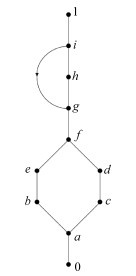 图 1 一类有界Trellis X
 下载:
全尺寸图片
表 1 [0, e)上的子模T(x, y)
T 0 a b 0 0 0 0 a 0 0 0 b 0 0 b 表 2 有界Trellis X上的一致模Ut(x, y)Ut 0 a b e c d f g h i 1 0 0 0 0 0 c d f g h i 1 a 0 0 0 a c d f g h i 1 b 0 0 b b c d f g h i 1 e 0 a b e c d f g h i 1 c c c c c f f 1 1 1 1 1 d d d d d f f 1 1 1 1 1 f f f f f 1 1 1 1 1 1 1 g g g g g 1 1 1 1 1 1 1 h h h h h 1 1 1 1 1 1 1 i i i i i 1 1 1 1 1 1 1 1 1 1 1 1 1 1 1 1 1 1 1 注2.3 定理2.1中定义的一致模$U_{t}(x, y)$ 与定理1.1中定义的一致模$U(x, y)$ 不同,如下例所示。
例2.2 考虑图 2中的有界Trellis $X$,定义闭包算子$c l$ 如下:
$$ \begin{gathered} c l(i)=i, i \in\{0, e, f, d, g, c, a, h, 1\} ; \\ c l(l)=d, c l(b)=a。 \end{gathered} $$ 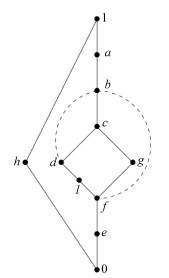 图 2 另一类有界Trellis X下载:
全尺寸图片
由定理2.1和1.1,在表 3和4分别定义一致模$和一致模U,显然不同。
表 3 有界Trellis X上的一致模Ut(x, y)Ut 0 e f l d g c b a h 1 0 0 0 f l d g c b a h 1 e 0 e f l d g c b a h 1 f f f 1 1 1 1 1 1 1 1 1 l l l 1 1 1 1 1 1 1 1 1 d d d 1 1 1 1 1 1 1 1 1 g g g 1 1 1 1 1 1 1 1 1 c c c 1 1 1 1 1 1 1 1 1 b b b 1 1 1 1 1 1 1 1 1 a a a 1 1 1 1 1 1 1 1 1 h h h 1 1 1 1 1 1 1 1 1 1 1 1 1 1 1 1 1 1 1 1 1 表 4 有界Trellis X上一致模U(x, y)U 0 e f l d g c b a h 1 0 0 0 f l d g c b a h 1 e 0 e f l d g c b a h 1 f f f f l d g c a a 1 1 l l l l d d c c a a 1 1 d d d d d d c c a a 1 1 g g g g c c g c a a 1 1 c c c c c c c c a a 1 1 b b b a a a a a a a 1 1 a a a a a a a a a a 1 1 h h h 1 1 1 1 1 1 1 h 1 1 1 1 1 1 1 1 1 1 1 1 1 3. 结束语
一致模不论在理论还是应用方面,均具有重要的研究意义。本文构造了有界Trellis上的一类一致模,研究结果表明有界Trellis上存在新的不同的一致模,进一步丰富和发展了有界Trellis上的一致模理论。
-
图 1 一类有界Trellis X
下载:
全尺寸图片
图 2 另一类有界Trellis X
下载:
全尺寸图片
表 1 [0, e)上的子模T(x, y)
T 0 a b 0 0 0 0 a 0 0 0 b 0 0 b 表 2 有界Trellis X上的一致模Ut(x, y)
Ut 0 a b e c d f g h i 1 0 0 0 0 0 c d f g h i 1 a 0 0 0 a c d f g h i 1 b 0 0 b b c d f g h i 1 e 0 a b e c d f g h i 1 c c c c c f f 1 1 1 1 1 d d d d d f f 1 1 1 1 1 f f f f f 1 1 1 1 1 1 1 g g g g g 1 1 1 1 1 1 1 h h h h h 1 1 1 1 1 1 1 i i i i i 1 1 1 1 1 1 1 1 1 1 1 1 1 1 1 1 1 1 1 表 3 有界Trellis X上的一致模Ut(x, y)
Ut 0 e f l d g c b a h 1 0 0 0 f l d g c b a h 1 e 0 e f l d g c b a h 1 f f f 1 1 1 1 1 1 1 1 1 l l l 1 1 1 1 1 1 1 1 1 d d d 1 1 1 1 1 1 1 1 1 g g g 1 1 1 1 1 1 1 1 1 c c c 1 1 1 1 1 1 1 1 1 b b b 1 1 1 1 1 1 1 1 1 a a a 1 1 1 1 1 1 1 1 1 h h h 1 1 1 1 1 1 1 1 1 1 1 1 1 1 1 1 1 1 1 1 1 表 4 有界Trellis X上一致模U(x, y)
U 0 e f l d g c b a h 1 0 0 0 f l d g c b a h 1 e 0 e f l d g c b a h 1 f f f f l d g c a a 1 1 l l l l d d c c a a 1 1 d d d d d d c c a a 1 1 g g g g c c g c a a 1 1 c c c c c c c c a a 1 1 b b b a a a a a a a 1 1 a a a a a a a a a a 1 1 h h h 1 1 1 1 1 1 1 h 1 1 1 1 1 1 1 1 1 1 1 1 1 -
[1] YAGER R R, RYBALOV A. Uninorms aggregation operators[J]. Fuzzy Sets and Systems, 1996, 80(1): 111-120. doi: 10.1016/0165-0114(95)00133-6 [2] FODOR J, YAGER R R, RYBALOV A. Structure of uninorms[J]. International Journal of Uncertainty Fuzziness and Knowledge-Based Systems, 1997, 5(4): 411-427. doi: 10.1142/S0218488597000312 [3] BACZYŃSKI M, JAYARAM B. Fuzzy implications[M]. Berlin Heidelberg: Springer, 2008. [4] DUBOIS D, PRADE H. A review of fuzzy set aggregation connectives[J]. Information Sciences, 1985, 36(1/2): 85-121. [5] DUBOIS D, PRADE H. Fundamentals of fuzzy sets[M]. New York: Kluwer Academic Publishers, 2000. [6] BAETS B D, FODOR J. Melle's combining function in MYCIN is a representable uninorm: an alternative proof[J]. Fuzzy Sets and Systems, 1999, 104(1): 133-136. doi: 10.1016/S0165-0114(98)00265-6 [7] YAGER R R. Defending against strategic manipulation in uninorm-based multi-agent decision making[J]. European Journal of Operational Research, 2002, 141(1): 217-232. doi: 10.1016/S0377-2217(01)00267-3 [8] KARAÇAL F, MESIAR R. Uninorms on bounded lattices[J]. Fuzzy Sets and Systems, 2015, 261: 33-43. doi: 10.1016/j.fss.2014.05.001 [9] ÇAYLı G D, KARAÇAL F, MESIAR R. On a new class of uninorms on bounded lattices[J]. Information Sciences, 2016, 367/368: 221-231. doi: 10.1016/j.ins.2016.05.036 [10] ÇAYLı G D. A characterization of uninorms on bounded lattices by means of triangular norms and triangular conorms[J]. International Journal of General Systems, 2018, 47(8): 772-793. doi: 10.1080/03081079.2018.1513929 [11] ÇAYLı G D, KARAÇAL F. Construction of uninorms on bounded lattices[J]. Kybernetika, 2017, 53(3): 394-417. [12] ÇAYLı G D. On a new class of t-norms and t-conorms on bounded lattices[J]. Fuzzy Sets and Systems, 2018, 332: 129-143. doi: 10.1016/j.fss.2017.07.015 [13] DAN Y, HU B Q, QIAO J. New construction of t-norms and t-conorms on bounded lattices[J]. Fuzzy Sets and Systems, 2020, 395: 40-70. doi: 10.1016/j.fss.2019.05.017 [14] PENG H, WANG X P. Constructing uninorms on bounded lattices by using additive generators[J]. International Journal of Approximate Reasoning, 2021, 136: 1-13. doi: 10.1016/j.ijar.2021.05.006 [15] SUN X R, LIU H W. Further characterization of uninorms on bounded lattices[J]. Fuzzy Sets and Systems, 2022, 427: 96-108. doi: 10.1016/j.fss.2021.01.006 [16] ZHANG H P, WU M, WANG Z, et al. A characterization of the classes Umin and Umax of uninorms on a bounded lattice[J]. Fuzzy Sets and Systems, 2021, 423: 107-121. doi: 10.1016/j.fss.2020.10.016 [17] SKALA H. Trellis theory[J]. Algebra Universalis, 1971(1): 218-233. [18] GLADSTIEN K. A characterization of complete trellises of finite length[J]. Algebra Universalis, 1973, 3: 341-344. doi: 10.1007/BF02945138 [19] FRIED E, GRÄTZER G. Some examples of weakly associative lattices[J]. In Colloquium Mathematics, 1973, 27(2): 215-221. doi: 10.4064/cm-27-2-215-221 [20] FRIED E. Tournaments and non-associative lattices[J]. Annual University Science Budapest, 1970, 13: 151-164. [21] RAI S B, RAO P. Modular, weakly distributive and Normal trellises[J]. Journal of Physics(Conference Series), 2021, 1850(1): 012090. [22] ZEDAM L, DE BAETS B. Triangular norms on bounded trellises[J]. Fuzzy Sets and Systems, 2023, 462: 108468. doi: 10.1016/j.fss.2023.01.003 [23] KONG Y, ZHAO B. Uninorms on bounded trellises[J]. Fuzzy Sets and Systems, 2024, 481: 108898. doi: 10.1016/j.fss.2024.108898
