
Research progress in plant sugar transporter SWEETs
-
摘要: 植物碳水化合物在“源流库”不同组织器官中的合成、代谢及转运对有机体维持正常生命活动至关重要。其中,以蔗糖、葡萄糖和果糖为代表的糖类短距离或长距离运输在源到库的“流”中占有关键作用,在此过程中,碳水化合物的转运与分配需要多种细胞糖转运体的协同参与。糖外排转运蛋白(SWEETs)能够调节植物营养的分配、利用,决定组织器官的生长与发育,维持或调节细胞糖响应浓度,调节寄主-病原体相互作用等生物与非生物胁迫。本综述介绍了SWEETs基因家族基本结构特征、生理功能和胁迫应答等方面的研究进展,对植物细胞生理功能的理解和生物育种等研究具有重要意义。Abstract: The synthesis, metabolism and transport of plant carbohydrates in different tissues and organs of"source-sink-flow"are essential for the normal life activities of organism. Among them, the short-distance or long-distance transport of sugars, such as sucrose, glucose and fructose, play a key role in the"flow"from source to sink, the transport and distribution of carbohydrates require the synergistic involvement of multiple cellular sugar transporters. Sugars will eventually be exported transporters(SWEETs)exhibit diverse functions, participating in regulating important physiological processes such as nutrient allocation, utilization, tissue organ growth, and development, as well as responding to biotic and abiotic stress by maintaining or regulating cellular sugar levels. This review summarizes the research progress in the basic structural characteristics, physiological functions, and stress responses of the SWEETs gene family, which holds significant implications for understanding plant cellular physiology and research areas like biotic breeding.
-
Keywords:
- sugar transporters /
- SWEETs /
- growth and development /
- biotic stress /
- abiotic stress
-
0. 引言
植物在生命过程中能够产生各种化合物和代谢物,通过转运在特定的组织、细胞中积累。已有研究表明植物中存在高度复杂的转运机制[1]:碳在叶片组织(主要是叶肉细胞)的叶绿体中由二氧化碳固定为碳水化合物;库组织(如根、花和种子)的能量需求主要是以蔗糖的形式从叶片中输出[2];植物碳水化合物的分配,需要通过多种糖转运蛋白的协同调节(图 1)[3]。这一过程在植物体内至关重要,近些年来对于糖类长距离运输的研究越来越多,糖外排转运蛋白(sugar will eventually be exported transporters,SWEETs)是新发现的可以促进糖类沿浓度梯度运输的一类糖转运蛋白。为了更好地理解碳水化合物的分配及其遗传控制,提高作物产量和抗逆性,对SWEETs家族的研究进展进行系统总结和阐述是非常有必要的。外质体韧皮部的装载/卸载涉及的糖转运体包括蔗糖转运蛋白(sucrose transporters,SUTs)、单糖转运蛋白(monosaccharide transporters,MSTs)和SWEETs[4]。SUTs和MSTs的转运过程需要能量来完成跨膜转运,由于拓扑结构的相似性,MSTs和SUTs被归为主要协同转运蛋白超家族(major facilitator superfamily,MFS),二者主要促进糖流入细胞质,这些MFS转运体大多作为同向转运体,利用质子动力在质膜上转运糖[2]。有趣的是,SWEETs是一种单向转运体,与MFS转运蛋白没有同源性,SWEETs不依赖于质子耦合机制完成转运[5]。对不同物种SWEETs的全基因组鉴定和进一步地深入功能分析表明,SWEETs蛋白在调节植物生理过程和提高抗逆性方面发挥着重要作用[6]。因此,对这些基因进行改造和深入探究可能是提高作物产量的有效策略,从而增强源和库的物质分配,并开发和优化抗病作物品种。此外,宿主和病原体都能吸收蔗糖,而SWEETs在宿主或病原体体内介导的糖代谢机制目前仍存在很多未知。本综述重点介绍SWEETs在进化过程中的结构特征、碳水化合物转运中的重要性和挑战,及其在调节植物的生物和非生物胁迫耐受性方面可能发挥的作用,以帮助研究者了解植物生长过程中碳水化合物代谢的复杂动态变化过程。
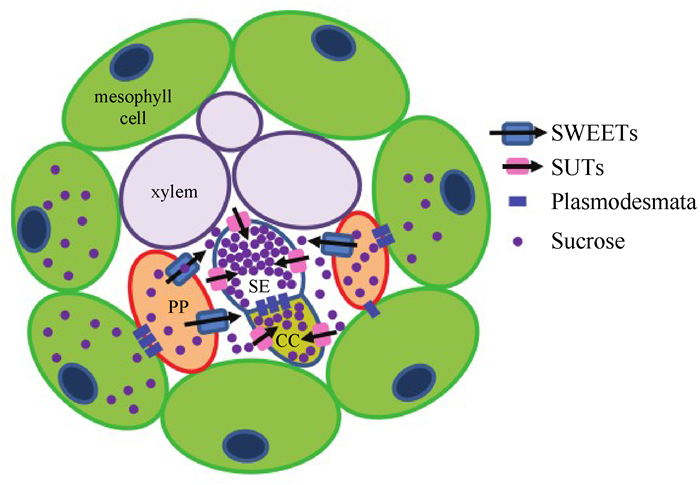 图 1 蔗糖在叶脉维管系统中的运输模型注:SWEETs为糖外排转运蛋白;SUTs为蔗糖转运蛋白;SE为筛分子;PP为韧皮部薄壁组织;CC为伴侣细胞。
 下载:
全尺寸图片
1. SWEETs家族的结构特征及进化
1.1 结构特征
2010年,Chen等[5]基于荧光共振能量转移(fluorescence resonance energy transfer,FRET)技术在拟南芥(Arabidopsis thaliana)中鉴定出一种新型糖转运蛋白,命名为SWEETs,该转运蛋白可以根据浓度促进葡萄糖、果糖和蔗糖等糖的双向跨膜转运。SWEETs参与多种生物学过程的调控,这与其特殊的蛋白质三维结构相关。真核和原核生物SWEETs蛋白分别有7和3个跨膜结构域,原核生物SWEETs被称为SemiSWEETs[7],有趣的是,真核生物SWEETs是由细菌的2个3次跨膜结构域(TM1-3和TM5-7)以及1个不保守的TM4构成,使SWEETs形成“3-1-3”结构。因此,真核SWEETs可能是通过复制和融合从原核生物SemiSWEETs进化而来 [8-9]。
SWEETs和SemiSWEETs的晶体结构为研究转运机制提供了重要见解,包括底物结合位点的位置和对转运活性至关重要的残基。水稻(Oryza sativa)OsSWEET2b在其晶体结构中被捕获为紧密排列的同源三聚体 [10]。在酵母和HEK293T等外源体系中通过截短和互补实验,验证了SWEETs可能形成同源或异源多聚体来转运糖类[11]。AtSWEET13晶体结构在2017年被解析,显示10个氨基酸残基在底物的识别和结合中起重要作用,分别是Trp58、Asn76、Asn54、Ser142、Met145、Leu23、Asn176、Ser20、Asn196和Trp180,其中Asn54、Met145、Leu23和Asn176是底物选择性位点,其在SWEETs家族中是比较保守的。所以这些位点可能对于SWEETs转运底物的选择及构象的改变是非常关键的[12]。真核生物SWEETs的另一个特征是其胞内C末端能够被磷酸化修饰。此外,胞内C末端可以作为蛋白质结合的部分在信号传递中发挥作用[13],但具体的分子机制仍不清楚。
1.2 进化及底物选择性
SWEETs家族在不同物种之间差异很大。如在1项对3 249个7-TMH SWEETs和3-TMH SemiSWEETs进行的研究中[14],这些蛋白在绿色植物、细菌、卵菌、后生动物和绿藻中的比例分别为44.4%、24.6%、12.9%、12.7%和1.2%,而在古生菌、真菌、原生生物和其他藻类中发现的比例 < 1.0%。在系统发育上,拟南芥SWEETs分为4个分支(分支I、Ⅱ、Ⅲ、Ⅳ)亚家族[5, 15-16]:分支I亚家族有AtSWEET1、AtSWEET2和AtSWEET3共3个成员;分支Ⅱ亚家族有AtSWEET4、AtSWEET5、AtSWEET6、AtSWEET7和AtSWEET8共5个成员;分支Ⅲ亚家族有AtSWEET9、AtSWEET10、AtSWEET11、AtSWEET12、AtSWEET13、AtSWEET14和AtSWEET15共7个成员;分支Ⅳ亚家族有AtSWEET16和AtSWEET17共2个成员。不同亚家族对糖选择性偏好不同:分支Ⅱ亚家族在进化上接近藻类,被认为是较古老的亚家族;分支Ⅲ亚家族SWEETs直到维管植物形成后才出现,并在此之后进化出多个成员[5, 15]。Sosso等[17]表明这些糖转运蛋白能够促进糖从源器官(如叶)到库器官(如种子和花)的长距离运输。
SWEETs在动物、植物和原核生物中均很常见。相对于原核生物和动物,SWEETs在植物体内似乎起到更复杂的生物学功能。秀丽隐杆线虫(Caenorhabditis elegans)的CeSWEET1和人(Homo sapiens)的同源蛋白HsSWEET1被证明是葡萄糖转运蛋白,拟南芥和水稻的SWEETs被鉴定为葡萄糖转运蛋白或者蔗糖转运蛋白,相对于小鼠(Mus musculus)和人类中只有1个SWEETs基因,植物体内SWEETs成员众多[18-19],其在拟南芥、水稻、葡萄(Vitis vinifera)和大豆(Glycine max)中分别证实了17、21、6和52个SWEETs基因,本文绘制的拟南芥SWEETs蛋白的系统发育树如图 2所示。SWEETs家族成员可以转运蔗糖、葡萄糖和果糖等底物,具有转运底物选择性[6]。同一物种SWEETs家族成员在不同组织中的表达也不同:AtSWEET9定位于拟南芥花蜜蜜腺调控花蜜的分泌[20];AtSWEET13主要在花药发育后期表达,定位于药室内壁,调控花粉活力[21];AtSWEET11和AtSWEET12在种子形成阶段表达,调控种子灌浆[22]。
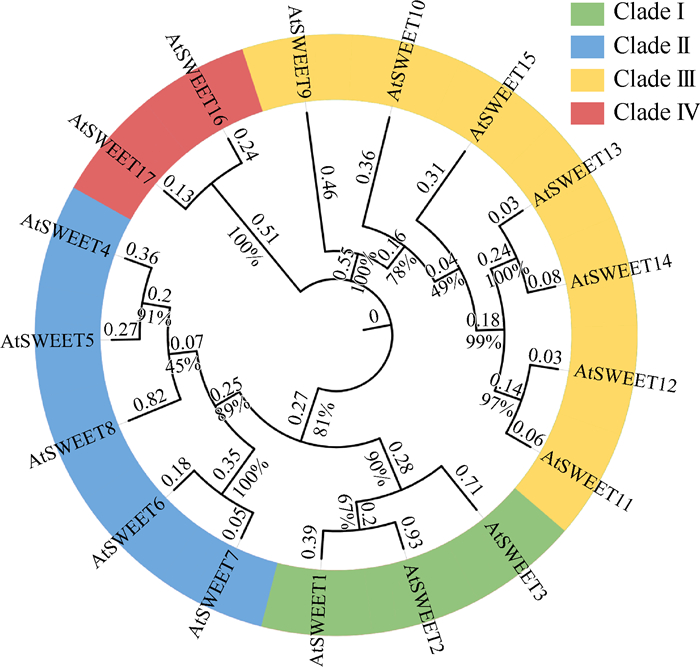 图 2 拟南芥SWEETs蛋白的系统发育树下载:
全尺寸图片
2. SWEETs调控植物生长发育
2.1 参与种子和果实发育
光合产物从叶肉细胞到韧皮部薄壁细胞的运输主要通过胞间连丝[23-25]。在利用质外体韧皮部装载机制的物种中,如玉米(Zea mays)、马铃薯(Solanum tuberosum)和拟南芥等,韧皮部薄壁细胞的蔗糖通过SWEETs从细胞质输出到质外体[22, 26-27],然后,蔗糖被其转运体从质外体吸收,并装载到筛元件-伴胞复合体,再转运到库组织[28-29]。此外,SWEETs和SUTs在种子等库器官中发挥着卸糖的作用[30-31]。在拟南芥中,AtSWEET11、AtSWEET12和AtSWEET15这3个蔗糖转运蛋白参与糖从种皮到胚中的转运,将AtSWEET11、AtSWEET12和AtSWEET15基因突变后,突变体表现出严重的种子缺陷,引起种子表面形成褶皱的表型[5]。在发育中的番茄(Solanum lycopersicum)幼果中,SlSWEET15的活性在种子中强度最高,与野生型种子相比,SlSWEET15基因突变体植物的种子质量降低了90%,SlSWEET15具有蔗糖转运活性,因此在番茄果实的形成中,调控糖分的输送,进而影响果实的形成[32]。
2.2 参与根系生长发育
糖可以调节根的生长[33],在拟南芥的17个SWEETs成员中,AtSWEET2、AtSWEET16和AtSWEET17位于根部液泡膜上[34-36]。AtSWEET16基因主要在木质部薄壁细胞表达,定位于根部细胞液泡膜[35];AtSWEET16在干旱胁迫下影响植物侧根的形成[37]。同属分支IV亚家族的成员AtSWEET17亚细胞定位和AtSWEET16一样,定位于根的液泡膜,由AtSWEET17基因启动子驱动的β-D-葡萄糖苷酸酶(β-glucuronidase,GUS)基因主要在根尖和根的成熟区表达[38]。在拟南芥叶肉原生质体的双分子荧光互补实验中,证明AtSWEET16和AtSWEET17可以在液泡膜上形成异源二聚体[9], 即二者可能在植物根的形态建成上共同发挥作用。Chen等[13]认为AtSWEET11能够发生磷酸化,这种修饰增强了AtSWEET11的蔗糖运输活性,从而促进蔗糖向根的运输,进而改善干旱胁迫下根的生长。Loo等[39]开发了2个生长系统,确定了微生物群和代谢物沿拟南芥根纵轴的空间分布,证实根微生物群、代谢产物和SWEETs单转运蛋白沿根轴排列。
2.3 在叶片中的生理功能
核糖核酸(ribonucleic acid,RNA)干扰AtSWEET4基因后导致植株较小,葡萄糖和果糖含量降低,叶片叶绿素含量降低导致叶片黄化表型[40]。AtSWEET15基因最开始作为衰老基因SAG29被发现,随着叶片的衰老,SAG29基因在叶片中的表达逐渐升高[41]。但是AtSWEET15基因在叶片的衰老过程具体发挥的作用,目前还没有明确的报道。
2.4 在花粉发育中的功能
花粉的可育性对于农业生产有重大意义,AtSWEET8、AtSWEET13对植物的花粉发育至关重要[42]:将AtSWEET8(rpg1)基因突变后,花粉的活性丧失[43];AtSWEET8 和AtSWEET13基因双突变体中花粉的可育性降低,导致角果中产生的种子数量减少。在进化关系中,AtSWEET13与AtSWEET14的同源性较高[44]。拟南芥AtSWEET13和AtSWEET14基因突变后,双突变体的花粉活力丧失,在AtSWEET13和AtSWEET14基因双突变体中可以由AtSWEET13或AtSWEET14基因的启动子驱动AtSWEET13或AtSWEET14表达而回补。表明AtSWEET13、AtSWEET14在花粉的发育中起重要作用[45]。
半乳糖激酶在花粉萌发过程中发挥重要作用,AtSWEET5在花粉萌发的早期阶段发挥作用,在成熟花粉中高度表达,沿浓度梯度将半乳糖转运穿过花粉膜[46]。AtSWEET9介导蔗糖的转运,参与花蜜的分泌。在野生型植物中,淀粉在开花前积累在蜜腺薄壁组织的质体中,在突变体中蜜腺薄壁组织的所有细胞中都有淀粉沉积,AtSWEET9可能作为蜜腺糖分泌的关键转运蛋白,负责细胞内糖的流出[20]。在开花的表型方面,AtSWEET10基因过表达植株具有早花表型[47],然而AtSWEET10基因突变体没有明显的开花表型,AtSWEET10在调控开花中的作用还需进一步研究。
3. SWEETs应对生物胁迫
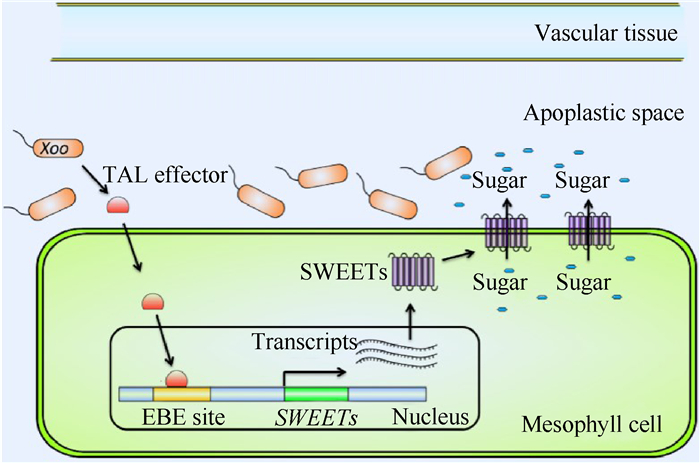
植物病原菌需要寄主细胞提供糖来支持其生长和增殖,细菌和真菌病原体能够特异性激活SWEETs基因家族的表达,从而促进感染部位细胞中的糖分泌以达到繁殖的目的[5, 48]。许多细菌性病原菌(如水稻黄单胞杆菌(Xanthomonas oryzae pv.oryzae (Xoo)))会攻击寄主(如水稻和棉花(Gossypium hirsutum)),通过第3型分泌系统分泌, 被称为转录激活因子类效应因子(transcription activator like effectors,TALE)蛋白的效应分子[49-51],TALE通过与SWEETs基因启动子中的效应结合元件(effector-binding element,EBE)位点结合,从而激活同源SWEETs基因的表达[5, 49]。这一结果揭示了在植物与病原体的共同进化过程中,这些蔗糖转运体可能扮演着至关重要的角色(图 3)[52]。
在SWEETs被鉴定为糖转运体之前,单子叶植物水稻中XA13/Os8N3/OsSWEET11基因启动子突变能够赋予植株对特定细菌水稻黄单胞杆菌菌株所引发的白叶枯病特异性抗性[53-54]。水稻黄单胞杆菌分泌的TALE可以与OsSWEET11基因启动子上的EBE结合,从而激活OsSWEET11基因的表达。OsSWEET11蛋白将糖转运到胞外基质以供病原菌繁殖生长[5, 55]。敲除该菌株中激活OsSWEET11基因启动子的TALE或敲除OsSWEET11基因启动子中的EBE,都能增强植株对该菌株的抗性[54]。但OsSWEET11基因启动子结合元件缺失的植株,只能抵抗释放特定TALE的菌株,无法抵抗释放其他TALE的菌株[5, 49]。类似地,XA25/OsSWEET13基因的隐性等位基因也表现出对特定水稻黄单胞杆菌菌株的抗性,其显性与隐性等位基因编码蛋白有8个氨基酸残基的差异[56]。此外,Os11N3/OsSWEET14基因也可以被释放TALE的菌株通过相似的方式激活,敲除或抑制OsSWEET14基因表达都能使植株对该菌株表现出抗性[49]。值得注意的是,目前已知的水稻SWEETs分支Ⅲ亚家族成员OsSWEET11、OsSWEET11b、OsSWEET12、OsSWEET13、OsSWEET14和OsSWEET15基因都能够被人工合成的TALE激活表达[16, 57-58];目前尚未发现能够释放TALE激活OsSWEET12、OsSWEET15与OsSWEET11b基因的水稻黄单胞杆菌菌株。
在双子叶植物中,细菌利用SWEETs作为糖转运蛋白,更易使宿主感染。如:在木薯(Manihot esculenta crantz)中,细菌地毯草黄单胞菌(Xanthomonas axonopodis)释放的TALE可以特异性激活MeSWEET10a基因,从而提高植株的易感性,诱发木薯细菌性萎蔫病[59];在棉花中,细菌柑橘黄单胞菌(Xanthomonas citri)释放的TALE可以特异性激活GhSWEET10d基因,增加植株的易感性,诱发棉花角斑病[50];在拟南芥中,细菌丁香假单胞菌(Pseudomonas syringae)菌株DC3000也能通过TALE上调AtSWEET4、AtSWEET5、AtSWEET7、AtSWEET8、AtSWEET10、AtSWEET12和AtSWEET15基因的信使RNA(messenger RNA, mRNA)水平,不能将分支Ⅲ亚家族的效应蛋白注射到宿主中, 并且致病性受损的DC3000Ⅲ型分泌突变体(ΔhrcU)不能诱导7种AtSWEETs基因中的3种,表明 SWEETs mRNA丰度以Ⅲ型依赖性方式调节[5]。
SWEETs不仅在植物与细菌相互作用中扮演重要角色,还会被原生生物和真菌所利用。在拟南芥中,原生生物芸薹根肿菌(Plasmodiophora brassicae)通过特异性调控AtSWEET11和AtSWEET12基因的表达,与宿主植株建立了长期的寄生关系。Walerowski等[60]对AtSWEET11和AtSWEET12基因双突变体的研究表明,其感染部位的糖运输减少,抑制了病害的发展;Gebauer等[61]表明这些双缺失突变体还表现出对真菌芸薹炭疽菌(Colletotrichum higginsianum)的抗性,这种抗性依赖于水杨酸途径。在水稻中,OsSWEET14基因的表达能够调控植株对真菌立枯丝核菌(Rhizoctonia solani)的抗性,有助于防止水稻纹枯病的发生。过表达OsSWEET14基因会引起糖的非特异性转运,从而提高水稻对水稻纹枯病的抗性,但同时也会降低水稻的产量[62]。玉米被真菌玉米黑粉菌(Ustilago maydis)侵染的幼苗与成熟叶片中,ZmSWEET4a、ZmSWEET4b和ZmSWEET11a基因的表达会上调[63]。甘薯(Ipomoea batatas)IbSWEET10基因调节了植株对真菌尖孢镰刀菌(Fusarium oxysporum)的抗性;过表达IbSWEET10基因会导致植株的蔗糖水平下降,从而提高抗病能力;抑制IbSWEET10基因的表达会使植株的蔗糖水平上升,降低抗病能力[14]。葡萄感染真菌灰葡萄孢(Botrytis cinerea)后,VvSWEET4基因的表达显著上调,导致植株病情恶化[40, 64];拟南芥受到真菌畸雌腐霉(Pythium irregulare)感染时,定位在根细胞液泡膜上的AtSWEET2基因的表达会显著上调,通过将葡萄糖转运进入液泡的方式限制糖外排。AtSWEEET2基因缺失突变体对畸雌腐霉的抗性显著降低[36]。此外,真菌菊科高氏白粉菌(Golovinomyces cichoracearum)可以诱导AtSWEET4、AtSWEET12、AtSWEET15和AtSWEET17基因的表达[5]。在磷酸饥饿胁迫下,真菌哈茨木霉(Trichoderma harzianum)感染会导致根系中:AtSWEET11和AtSWEET12基因的表达量下降,抑制蔗糖的流出;而AtSWEET2基因的表达量上升,促进液泡吸收蔗糖[65]。蒺藜苜蓿(Medicago truncatula)SWEETs在植株与共生菌的相互作用中也发挥了作用。定位于丛枝外膜,即丛枝菌根在植物根皮层细胞中形成树状结构丛枝,周围被特化的宿主膜包裹,称为丛枝外膜。其上的植物转运蛋白能够介导养分从真菌转移到根中,MtSWEET1b基因在糖定向转运过程中发挥重要作用,协助维持健康的共生关系,但在维持丛枝菌根共生关系中的作用具有冗余性[66]。
综上所述,SWEETs家族在植物与病原体共同进化的过程中扮演了不同的角色。面对不同的病原体,有时会促进病害发展,也可能会抑制病害发展或成为共生关系的关键成员,多样的功能显示了其在植物逆境应对和生长发育中的重要性。
4. SWEETs参与非生物胁迫
植物经常受到干旱、盐和极端温度等各种非生物胁迫,这些胁迫会对植物的生长发育产生不利影响,导致农业生产遭受重大损失,从而威胁全球粮食安全。转录水平分析表明[67-68],SWEETs作为糖转运体与植物对逆境胁迫的响应密切相关,在植物的抗逆性中起着重要作用。
4.1 干旱
拟南芥通过增强叶片和根中SWEET11、SWEET12、SWEET13和SWEET15基因的转录水平来促进韧皮部中糖的装载,增加在植物干旱缺水时糖从叶到根的转移,从而促进根的发育[11, 69]。如在干旱胁迫下,AtSWEET11和AtSWEET12基因表达增强,促进蔗糖向根部运输,诱导根系生长,提高植物的根冠比和干旱抗性[13, 69]。液泡膜定位的AtSWEET17调节果糖诱导的根系生长和结构,对植物耐干旱胁迫十分重要[37]。拟南芥植物中过表达AtSWEET4和AtSWEET16基因会改变糖代谢,增强耐旱性[35, 40]。
水稻OsSWEET13和OsSWEET15基因通过调节蔗糖的转运和含量,参与对干旱的响应[70];玉米ZmSWEET1b基因具有正向调节气孔开放的作用,可能对水分利用效率产生影响[71],ZmSWEET15a基因在干旱胁迫下的表达量会增加[72];苹果(Malus pumila)MpSWEET17基因也在提高抗旱性方面发挥着重要作用[73]。
4.2 盐胁迫
在盐胁迫条件下,提高了拟南芥中AtSWEET1、AtSWEET2、AtSWEET4、AtSWEET14和AtSWEET15基因的表达量,也诱导了水稻OsSWEET1b、OsSWEET7c和OsSWEET15基因的表达[74]。
盐胁迫诱导产生的果糖激酶样蛋白2(fructokinase-like proteins2,FLN2)蛋白通过降低AtSWEET11和AtSWEET14基因的表达量,影响糖代谢以增强植物的耐盐性[75]。值得注意的是,过表达AtSWEET15和AtSWEET16基因使植株对高盐环境高度敏感,而AtSWEET15和AtSWEET16基因突变体则表现出较高的耐盐性,且根系活性显著增加[35, 41]。此外,在高盐处理下,玉米的ZmSWEET15a基因和水稻的OsSWEET13、OsSWEET15基因的表达量也显著增加,表明这些基因参与了盐胁迫对蔗糖转运的调节[70, 72]。
4.3 温度胁迫
拟南芥中SWEETs基因在植物低温抗性中扮演着至关重要的角色:经过低温处理后,AtSWEET11和AtSWEET12基因双突变体能够积累更多的葡萄糖、果糖和蔗糖,表现出比野生型更高的耐寒性[76];而过表达AtSWEET4基因能促进叶片中糖类物质的积累,从而提高植株的抗寒性[77];AtSWEET15基因在低温条件下表达水平显著增加[78];低温会显著抑制拟南芥中AtSWEET16基因和茶树(Camellia sinensis)CsSWEET16基因的表达,过表达AtSWEET16基因的拟南芥植株表现出糖代谢的改变,同时其萌发率和抗寒性均得到提高[35];过表达AtSWEET17基因的植株液泡中会积累大量果糖,以应对低温胁迫[38]。
茶树CsSWEET1基因在低温条件下呈现明显增加的表达水平,而CsSWEET2和CsSWEET3基因的表达则遭到显著抑制[79]。CsSWEET1a、CsSWEET2以及CsSWEET17基因在低温胁迫下的异源过表达,显著提升了转基因拟南芥的耐寒性[80]。高粱(Sorghum bicolor)叶片组织中SbSWEET11、SbSWEET12和SbSWEET17基因在低温环境下表达显著增加,而SbSWEET1基因则在高温条件下表达量上升[81]。
在拟南芥中,高温能够诱导AtSWEET1、AtSWEET4、AtSWEET13和AtSWEET15基因的表达,同时抑制AtSWEET2、AtSWEET10和AtSWEET17基因的表达。并且在水稻中,高温胁迫会促进OsSWEET14和OsSWEET16基因的表达,同时抑制OsSWEET3b、OsSWEET4和OsSWEET5基因的表达[75]。然而,尚需进一步深入研究功能基因,以验证SWEETs蛋白在植物热应激中的确切作用。
这些研究表明,SWEETs蛋白通过调控糖的运输和分配,在不利环境条件下促进植物的生长、发育和提高产量[82]。
5. 结束语
近几年,SWEETs糖转运蛋白家族的研究取得了显著进展。然而,关于其分子结构与功能的关系,基因和蛋白质调控,以及将基础研究转化为提高作物产量的关键问题仍然存在许多疑问。在分子水平上,SemiSWEET似乎具有较窄的转运孔道,而SWEETs由于跨膜螺旋4(transmembrane helices 4,TMH4)的存在具有较宽的孔道,这表明在确定底物的大小存在差异。因此,这种相互作用在所有构象状态下是否一致尚不清楚,以及TMH4是否参与调控转运活性。通过分子动力学模拟辅助的更多晶体学研究,不仅可以提高对转运途径的理解,还可以提高对不同物种的进化和生理作用的理解。值得注意的是,尽管广泛报道SWEETs可以运输糖类物质,但至少有2个来自拟南芥的成员,AtSWEET13和AtSWEET14已被证实可以转运赤霉素。SWEETs家族并不是唯一被报道可以转运不同底物的家族。所以需要探索SWEETs是否也能识别多种类型的底物,以及这种多样性是如何演化。此外,常用的FRET传感器只能检测葡萄糖和蔗糖。因此,需要开发具有更高的亲和力和针对其他糖类的新FRET传感器。SWEETs的C末端可以通过磷酸化进行调节,但受到哪些激酶的调控仍然未知,因此深入了解这些修饰如何影响转运活性,磷酸化修饰是否可以改变SWEETs的动力学,并引起这些修饰的条件是什么等,也是值得探索的。
-
图 1 蔗糖在叶脉维管系统中的运输模型
注:SWEETs为糖外排转运蛋白;SUTs为蔗糖转运蛋白;SE为筛分子;PP为韧皮部薄壁组织;CC为伴侣细胞。
下载:
全尺寸图片
图 2 拟南芥SWEETs蛋白的系统发育树
下载:
全尺寸图片
-
[1] BRAUN D M. Phloem loading and unloading of sucrose: what a long, strange trip from source to sink[J]. Annual Review of Plant Biology, 2022, 73: 553-584. doi: 10.1146/annurev-arplant-070721-083240 [2] SALVI P, AGARRWAL R, KAJAL, et al. Sugar transporters and their molecular tradeoffs during abiotic stress responses in plants[J]. Physiologia Plantarum, 2022, 174(2): e13652. doi: 10.1111/ppl.13652 [3] SLEWINSKI T L, BRAUN D M. Current perspectives on the regulation of whole-plant carbohydrate partitioning[J]. Plant Science, 2010, 178(4): 341-349. doi: 10.1016/j.plantsci.2010.01.010 [4] JULIUS B T, LEACH K A, TRAN T M, et al. Sugar transporters in plants: new insights and discoveries[J]. Plant and Cell Physiology, 2017, 58(9): 1442-1460. doi: 10.1093/pcp/pcx090 [5] CHEN L Q, HOU B H, LALONDE S, et al. Sugar transporters for intercellular exchange and nutrition of pathogens[J]. Nature, 2010, 468(7323): 527-532. doi: 10.1038/nature09606 [6] JI J, YANG L, FANG Z, et al. Plant SWEET family of sugar transporters: structure, evolution and biological functions[J]. Biomolecules, 2022, 12(2): 205. doi: 10.3390/biom12020205 [7] FENG L, FROMMER W B. Structure and function of SemiSWEET and SWEET sugar transporters[J]. Trends in Biochemical Sciences, 2015, 40(8): 480-486. doi: 10.1016/j.tibs.2015.05.005 [8] ANJALI A, FATIMA U, MANU M S, et al. Structure and regulation of SWEET transporters in plants: an update[J]. Plant Physiology and Biochemistry, 2020, 156: 1-6. doi: 10.1016/j.plaphy.2020.08.043 [9] AUBRY E, HOFFMANN B, VILAINE F, et al. A vacuolar hexose transport is required for xylem development in the inflorescence stem[J]. Plant Physiology, 2022, 188(2): 1229-1247. doi: 10.1093/plphys/kiab551 [10] TAO Y, CHEUNG L S, LI S, et al. Structure of a eukaryotic SWEET transporter in a homotrimeric complex[J]. Nature, 2015, 527(7577): 259-263. doi: 10.1038/nature15391 [11] XUAN Y H, HU Y B, CHEN L Q, et al. Functional role of oligomerization for bacterial and plant SWEET sugar transporter family[J]. Proceedings of the National Academy of Sciences of the United States of America, 2013, 110(39): 3685-3694. [12] HAN L, ZHU Y P, LIU M, et al. Molecular mechanism of substrate recognition and transport by the AtSWEET13 sugar transporter[J]. Proceedings of the National Academy of Sciences of the United States of America, 2017, 114(38): 10089-10094. [13] CHEN Q, HU T, LI X, et al. Phosphorylation of SWEET sucrose transporters regulates plant root: shoot ratio under drought[J]. Nature Plants, 2022, 8(1): 68-77. [14] LI Y, WANG Y, ZHANG H, et al. The plasma membrane-localized sucrose transporter IbSWEET10 contributes to the resistance of sweet potato to Fusarium oxysporum[J]. Frontiers in Plant Science, 2017, 8: 197. [15] YUAN M, WANG S. Rice MtN3/saliva/SWEET family genes and their homologs in cellular organisms[J]. Molecular Plant, 2013, 6(3): 665-674. doi: 10.1093/mp/sst035 [16] WU L B, EOM J S, ISODA R, et al. OsSWEET11b, a potential sixth leaf blight susceptibility gene involved in sugar transport-dependent male fertility[J]. New Phytologist, 2022, 234(3): 975-989. doi: 10.1111/nph.18054 [17] SOSSO D, LUO D, LI Q B, et al. Seed filling in domesticated maize and rice depends on SWEET-mediated hexose transport[J]. Nature Genetics, 2015, 47(12): 1489-1493. doi: 10.1038/ng.3422 [18] PATIL G, VALLIYODAN B, DESHMUKH R, et al. Soybean (Glycine max) SWEET gene family: insights through comparative genomics, transcriptome profiling and whole genome re-sequence analysis[J]. BMC Genomics, 2015, 16(1): 520. doi: 10.1186/s12864-015-1730-y [19] FENG C Y, HAN J X, HAN X X, et al. Genome-wide identification, phylogeny, and expression analysis of the SWEET gene family in tomato[J]. Gene, 2015, 573(2): 261-272. doi: 10.1016/j.gene.2015.07.055 [20] LIN I W, SOSSO D, CHEN L Q, et al. Nectar secretion requires sucrose phosphate synthases and the sugar transporter SWEET9[J]. Nature, 2014, 508(7497): 546-549. doi: 10.1038/nature13082 [21] ISODA R, PALMAI Z, YOSHINARI A, et al. SWEET13 transport of sucrose, but not gibberellin, restores male fertility in Arabidopsis SWEET13;14[J]. Proceedings of the National Academy of Sciences of the United States of America, 2022, 119(42): e2207558119. [22] CHEN L Q, QU X Q, HOU B H, et al. Sucrose efflux mediated by SWEET proteins as a key step for phloem transport[J]. Science, 2012, 335(6065): 207-211. doi: 10.1126/science.1213351 [23] LIESCHE J, SCHULZ A. In vivo quantification of cell coupling in plants with different phloem-loading strategies[J]. Plant Physiology, 2012, 159(1): 355-365. doi: 10.1104/pp.112.195115 [24] SCHULZ A. Diffusion or bulk flow: how plasmodesmata facilitate pre-phloem transport of assimilates[J]. Journal of Plant Research, 2015, 128(1): 49-61. doi: 10.1007/s10265-014-0676-5 [25] MIRAS M, POTTIER M, SCHLADT T M, et al. Plasmodesmata and their role in assimilate translocation[J]. The Journal of Plant Physiology, 2022, 270: 153633. doi: 10.1016/j.jplph.2022.153633 [26] BEZRUTCZYK M, HARTWIG T, HORSCHMAN M, et al. Impaired phloem loading in ZmSWEET13a, b, c sucrose transporter triple knock-out mutants in Zea mays [J]. New Phytologist, 2018, 218(2): 594-603. doi: 10.1111/nph.15021 [27] ABELENDA J A, BERGONZI S, OORTWIJN M, et al. Source-sink regulation is mediated by interaction of an FT homolog with a SWEET protein in potato[J]. Current Biology, 2019, 29(7): 1178-1186. doi: 10.1016/j.cub.2019.02.018 [28] GOTTWALD J R, KRYSAN P J, YOUNG J C, et al. Genetic evidence for the in planta role of phloem-specific plasma membrane sucrose transporters[J]. Proceedings of the National Academy of Sciences of the United States of America, 2000, 97(25): 13979-13984. [29] SLEWINSKI T L, MEELEY R, BRAUN D M. Sucrose transporter1 functions in phloem loading in maize leaves[J]. Journal of Experimental Botany, 2009, 60(3): 881-892. doi: 10.1093/jxb/ern335 [30] YANG J, LUO D, YANG B, et al. SWEET11 and 15 as key players in seed filling in rice[J]. New Phytologist, 2018, 218(2): 604-615. doi: 10.1111/nph.15004 [31] WANG G, WU Y, MA L, et al. Phloem loading in rice leaves depends strongly on the apoplastic pathway[J]. Journal of Experimental Botany, 2021, 72(10): 3723-3738. doi: 10.1093/jxb/erab085 [32] KO H Y, HO L H, NEUHAUS H E, et al. Transporter SlSWEET15 unloads sucrose from phloem and seed coat for fruit and seed development in tomato[J]. Plant Physiology, 2021, 187(4): 2230-2245. doi: 10.1093/plphys/kiab290 [33] TAKAHASHI F, SATO-NARA K, KOBAYASHI K, et al. Sugar-induced adventitious roots in Arabidopsis seedlings[J]. Journal of Plant Research, 2003, 116(2): 83-91. doi: 10.1007/s10265-002-0074-2 [34] CHARDON F, BEDU M, CALENGE F, et al. Leaf fructose content is controlled by the vacuolar transporter SWEET17 in Arabidopsis[J]. Current Biology, 2013, 23(8): 697-702. doi: 10.1016/j.cub.2013.03.021 [35] KLEMENS P A, PATZKE K, DEITMER J, et al. Overexpression of the vacuolar sugar carrier AtSWEET16 modifies germination, growth, and stress tolerance in Arabidopsis[J]. Plant Physiology, 2013, 163(3): 1338-1352. doi: 10.1104/pp.113.224972 [36] CHEN H Y, HU J H, YU Y C, et al. The Arabidopsis vacuolar sugar transporter SWEET2 limits carbon sequestration from roots and restricts Pythium infection[J]. The Plant Journal, 2015, 83(6): 1046-1058. doi: 10.1111/tpj.12948 [37] VALIFARD M, LE HIR R, MULLER J, et al. Vacuolar fructose transporter SWEET17 is critical for root development and drought tolerance[J]. Plant Physiology, 2021, 187(4): 2716-2730. doi: 10.1093/plphys/kiab436 [38] GUO W J, NAGY R, CHEN H Y, et al. SWEET17, a facilitative transporter, mediates fructose transport across the tonoplast of Arabidopsis roots and leaves[J]. Plant Physiology, 2014, 164(2): 777-789. doi: 10.1104/pp.113.232751 [39] LOO E P, DURÁN P, PANG T Y, et al. Sugar transporters spatially organize microbiota colonization along the longitudinal root axis of Arabidopsis[J]. Cell Host Microbe, 2024, 32(4): 543-556. doi: 10.1016/j.chom.2024.02.014 [40] LIU X, ZHANG Y, YANG C, et al. AtSWEET4, a hexose facilitator, mediates sugar transport to axial sinks and affects plant development[J]. Scientific Reports, 2016, 6: 24563. doi: 10.1038/srep24563 [41] SEO P J, PARK J M, KANG S K, et al. An Arabidopsis senescence-associated protein SAG29 regulates cell viability under high salinity[J]. Planta, 2011, 233(1): 189-200. doi: 10.1007/s00425-010-1293-8 [42] SUN M X, HUANG X Y, YANG J, et al. Arabidopsis RPG1 is important for primexine deposition and functions redundantly with RPG2 for plant fertility at the late reproductive stage[J]. Plant Reproduction, 2013, 26(2): 83-91. doi: 10.1007/s00497-012-0208-1 [43] ZHANG C, REN M Y, HAN W J, et al. Slow development allows redundant genes to restore the fertility of rpg1, a TGMS line in Arabidopsis[J]. The Plant Journal, 2022, 109(6): 1375-1385. doi: 10.1111/tpj.15635 [44] KANNO Y, OIKAWA T, CHIBA Y, et al. AtSWEET13 and AtSWEET14 regulate gibberellin-mediated physiological processes[J]. Nature Communications, 2016, 7: 13245. doi: 10.1038/ncomms13245 [45] WANG J, XUE X, ZENG H, et al. Sucrose rather than GA transported by AtSWEET13 and AtSWEET14 supports pollen fitness at late anther development stages[J]. New Phytologist, 2022, 236(2): 525-537. doi: 10.1111/nph.18368 [46] WANG J, YU Y C, LI Y, et al. Hexose transporter SWEET5 confers galactose sensitivity to Arabidopsis pollen germination via a galactokinase[J]. Plant Physiology, 2022, 189(1): 388-401. doi: 10.1093/plphys/kiac068 [47] ANDRES F, KINOSHITA A, KALLURI N, et al. The sugar transporter SWEET10 acts downstream of flowering locus T during floral transition of Arabidopsis thaliana[J]. BMC Plant Biology, 2020, 20(1): 53. doi: 10.1186/s12870-020-2266-0 [48] GUPTA P K, BALYAN H S, GAUTAM T. SWEET genes and TAL effectors for disease resistance in plants: present status and future prospects[J]. Molecular Plant Pathology, 2021, 22(8): 1014-1026. doi: 10.1111/mpp.13075 [49] ANTONY G, ZHOU J, HUANG S, et al. Rice XA13 recessive resistance to bacterial blight is defeated by induction of the disease susceptibility gene Os-11N3[J]. Plant Cell, 2010, 22(11): 3864-3876. doi: 10.1105/tpc.110.078964 [50] COX K L, MENG F, WILKINS K E, et al. TAL effector driven induction of a SWEET gene confers susceptibility to bacterial blight of cotton[J]. Nature Communications, 2017, 8: 15588. doi: 10.1038/ncomms15588 [51] ZHOU J, PENG Z, LONG J, et al. Gene targeting by the TAL effector PthXo2 reveals cryptic resistance gene for bacterial blight of rice[J]. The Plant Journal, 2015, 82(4): 632-643. doi: 10.1111/tpj.12838 [52] SINGH J, DAS S, JAGADIS G K, et al. Physiological implications of SWEETs in plants and their potential applications in improving source-sink relationships for enhanced yield[J]. Plant Biotechnology, 2023, 21(8): 1528-1541. doi: 10.1111/pbi.13982 [53] CHU Z, YUAN M, YAO J, et al. Promoter mutations of an essential gene for pollen development result in disease resistance in rice[J]. Genes & Development, 2006, 20(10): 1250-1255. [54] YANG B, SUGIO A, WHITE F F. Os8N3 is a host disease-susceptibility gene for bacterial blight of rice[J]. Proceedings of the National Academy of Sciences of the United States of America, 2006, 103(27): 10503-10508. [55] ROMER P, RECHT S, STRAUSS T, et al. Promoter elements of rice susceptibility genes are bound and activated by specific TAL effectors from the bacterial blight pathogen, Xanthomonas oryzae pv. oryzae[J]. New Phytologist, 2010, 187(4): 1048-1057. doi: 10.1111/j.1469-8137.2010.03217.x [56] LIU Q, YUAN M, ZHOU Y, et al. A paralog of the MtN3/saliva family recessively confers race-specific resistance to Xanthomonas oryzae in rice[J]. Plant Cell and Environment, 2011, 34(11): 1958-1969. doi: 10.1111/j.1365-3040.2011.02391.x [57] LI T, HUANG S, ZHOU J, et al. Designer TAL effectors induce disease susceptibility and resistance to Xanthomonas oryzae pv. oryzae in rice[J]. Molecular Plant, 2013, 6(3): 781-789. doi: 10.1093/mp/sst034 [58] STREUBEL J, PESCE C, HUTIN M, et al. Five phylogenetically close rice SWEET genes confer TAL effector-mediated susceptibility to Xanthomonas oryzae pv. oryzae[J]. New Phytologist, 2013, 200(3): 808-819. doi: 10.1111/nph.12411 [59] COHN M, BART R S, SHYBUT M, et al. Xanthomonas axonopodis virulence is promoted by a transcription activator-like effector-mediated induction of a SWEET sugar transporter in cassava[J]. Molecular Plant-Microbe Interactions, 2014, 27(11): 1186-1198. doi: 10.1094/MPMI-06-14-0161-R [60] WALEROWSKI P, GUNDEL A, YAHAYA N, et al. Clubroot disease stimulates early steps of phloem differentiation and recruits SWEET sucrose transporters within developing galls[J]. Plant Cell, 2018, 30(12): 3058-3073. doi: 10.1105/tpc.18.00283 [61] GEBAUER P, KORN M, ENGELSDORF T, et al. Sugar accumulation in leaves of Arabidopsis SWEET11/SWEET12 double mutants enhances priming of the salicylic acid-mediated defense response[J]. Frontiers in Plant Science, 2017, 8: 1378. doi: 10.3389/fpls.2017.01378 [62] KIM P, XUE C Y, SONG H D, et al. Tissue-specific activation of DOF11 promotes rice resistance to sheath blight disease and increases grain weight via activation of SWEET14[J]. Plant Biotechnology Journal, 2021, 19(3): 409-411. doi: 10.1111/pbi.13489 [63] SOSSO D, VAN DER LINDE K, BEZRUTCZYK M, et al. Sugar partitioning between Ustilago maydis and its Host Zea mays L during infection[J]. Plant Physiology, 2019, 179(4): 1373-1385. doi: 10.1104/pp.18.01435 [64] CHONG J, PIRON M C, MEYER S, et al. The SWEET family of sugar transporters in grapevine: VvSWEET4 is involved in the interaction with Botrytis cinerea[J]. Journal of Experimental Botany, 2014, 65(22): 6589-6601. doi: 10.1093/jxb/eru375 [65] ROUINA H, TSENG Y H, NATARAJA K N, et al. Arabidopsis restricts sugar loss to a colonizing Trichoderma harzianum strain by downregulating SWEET11 and -12 and upregulation of SUC1 and SWEET2 in the roots[J]. Microorganisms, 2021, 9(6): 1246. doi: 10.3390/microorganisms9061246 [66] AN J, ZENG T, JI C, et al. A Medicago truncatula SWEET transporter implicated in arbuscule maintenance during arbuscular mycorrhizal symbiosis[J]. New Phytologist, 2019, 224(1): 396-408. doi: 10.1111/nph.15975 [67] ZHU J K. Abiotic stress signaling and responses in plants[J]. Cell, 2016, 167(2): 313-324. doi: 10.1016/j.cell.2016.08.029 [68] SAMI F, YUSUF M, FAIZAN M, et al. Role of sugars under abiotic stress[J]. Plant Physiology and Biochemistry, 2016, 109: 54-61. doi: 10.1016/j.plaphy.2016.09.005 [69] DURAND M, PORCHERON B, HENNION N, et al. Water deficit enhances C export to the roots in Arabidopsis thaliana plants with contribution of sucrose transporters in both shoot and roots[J]. Plant Physiology, 2016, 170(3): 1460-1479. doi: 10.1104/pp.15.01926 [70] MATHAN J, SINGH A, RANJAN A. Sucrose transport in response to drought and salt stress involves ABA-mediated induction of OsSWEET13 and OsSWEET15 in rice[J]. Physiologia Plantarum, 2021, 171(4): 620-637. doi: 10.1111/ppl.13210 [71] WANG H, YAN S, XIN H, et al. A subsidiary cell-localized glucose transporter promotes stomatal conductance and photosynthesis[J]. Plant Cell, 2019, 31(6): 1328-1343. doi: 10.1105/tpc.18.00736 [72] LIU M, LIU T, LU J, et al. Characterization and functional analysis of ZmSWEET15a in maize[J]. DNA and Cell Biology, 2022, 41(6): 564-574. doi: 10.1089/dna.2021.1144 [73] LU J, SUN M H, MA Q J, et al. MdSWEET17, a sugar transporter in apple, enhances drought tolerance in tomato[J]. Journal of Integrative Agriculture, 2019, 18(9): 2041-2051. doi: 10.1016/S2095-3119(19)62695-X [74] GAUTAM T, DUTTA M, JAISWAL V, et al. Emerging roles of SWEET sugar transporters in plant development and abiotic stress responses[J]. Cells, 2022, 11(8): 1303. doi: 10.3390/cells11081303 [75] CHEN G, HU J, DONG L L, et al. The tolerance of salinity in rice requires the presence of a functional copy of FLN2[J]. Biomolecules, 2019, 10(1): 17. doi: 10.3390/biom10010017 [76] LE HIR R, SPINNER L, KLEMENS P A, et al. Disruption of the sugar transporters AtSWEET11 and AtSWEET12 affects vascular development and freezing tolerance in Arabidopsis[J]. Molecular Plant, 2015, 8(11): 1687-1690. doi: 10.1016/j.molp.2015.08.007 [77] CHENG K J, SELVAM B, CHEN L Q, et al. Distinct substrate transport mechanism identified in homologous sugar transporters[J]. Journal of Physical Chemistry B, 2019, 123(40): 8411-8418. doi: 10.1021/acs.jpcb.9b08257 [78] QUIRINO B F, NORMANLY J, AMASINO R M. Diverse range of gene activity during Arabidopsis thaliana leaf senescence includes pathogen-independent induction of defense-related genes[J]. Plant Molecular Biology, 1999, 40(2): 267-278. doi: 10.1023/A:1006199932265 [79] YUE C, CAO H L, WANG L, et al. Effects of cold acclimation on sugar metabolism and sugar-related gene expression in tea plant during the winter season[J]. Plant Molecular Biology, 2015, 88(6): 591-608. doi: 10.1007/s11103-015-0345-7 [80] YAO L, DING C, HAO X, et al. CsSWEET1a and CsSWEET17 mediate growth and freezing tolerance by promoting sugar transport across the plasma membrane[J]. Plant & Cell Physiology, 2020, 61(9): 1669-1682. [81] MIZUNO H, KASUGA S, KAWAHIGASHI H. The sorghum SWEET gene family: stem sucrose accumulation as revealed through transcriptome profiling[J]. Biotechnology for Biofuels, 2016, 9: 127. doi: 10.1186/s13068-016-0546-6 [82] SADDHE A A, MANUKA R, PENNA S. Plant sugars: homeostasis and transport under abiotic stress in plants[J]. Physiologia Plantarum, 2021, 171(4): 739-755. doi: 10.1111/ppl.13283