

Irregular scattering of triple electrons in chaotic lithium atom
-
摘要: 本文采用经典方法分析了混沌锂原子中三电子的不规则散射(IS)现象。三电子的不规则散射区是由2个无量纲参数来体现得非常窄的窗口。在三角形构型的锂原子体系中, 不规则散射区域中的三重电子存活概率将以正则化时间为函数而呈现衰减规律。结果表明: 三重电子衰变的存活概率遵循代数定律P(τ)~τ-α, 衰减指数αTE=2.02;双电子衰变的存活概率也遵循代数定律, 其衰减指数αDE=0.78, 并可以用外电子与原子核形成的长寿命开普勒轨道来解释。而三重电子衰减定律的解释是一个具有挑战性的问题, 研究结果显示, 不规则散射区三电子的典型长寿命轨迹是由2个突出的开普勒轨道组成的。此外, 通过对三电子系统的T构形研究, 揭示了代数衰变律的构型无关性。这种配置记忆损失可能与不规则散射区域三电子的共振有关。Abstract: In the present study, we analyze the irregular scattering(IS)of triple electrons in chaotic lithium atom by using classical method. The IS region of triple electrons is characterized by a very narrow window of two dimensionless parameters. The survival probability of the triple electrons in the IS region for the triangle configuration would decay as a function of a regularization time. It was demonstrated that the survival probability of triple electrons(TESP)decays follow an algebraic law P(τ)~τ-α with a decay exponent αTE = 2.02. In addition, the survival probability of double electrons (DESP)decays follow an algebraic law either, the DESP decay exponent αDE = 0.78. The decay law for the DESP could be interpreted by a long-lived Kepler orbit formed by outer electron with the atomic kernel. Whereas the explain of the decay law for the TESP is a challenging problem. It was revealed that the typical long-lived trajectory of the triple-electrons in the IS region is composed by two prominent Kepler orbits. Further, a configurations-independent property of the algebraic decay law was studied via the T-shape of triple-electron system. This configuration memory loss may be related to the resonance of triple electrons in the IS region.
-
Keywords:
- irregular scattering /
- decay law /
- chaos /
- lithium atom
-
0. Introduction
Over more than two decades, there have been an increased interest in irregular scattering(IS)among researchers working on the quantum and classical chaotic systems[1-2]. IS implies the existence of Ericson fluctuations of levels that correspond to the quantum scattering matrix(S-matrix)in the quantum systems. In the classical systemic paradigms, IS can induce the fully hyperbolic dynamics and fractal phase structure. This quantum effect showed that a classical repeller will stay in the IS region for a delay time, and the survival probability of a chaotic repeller would decay over time via an algebraic law corresponding to the hyperbolic nature of the system dynamics[3]. This implies that the trajectories of chaotic repellers will remain trapped within a close vicinity of the hierarchical structure in phase space over time. The survival probability can be described using the following equation
$$ P(\tau) \sim \tau^{-\alpha} . $$ (1) This algebraic decay law was first observed by the Channon group[4]. Soon after, the algebraic laws in Hamiltonian systems were investigated[5]. The effects of hyperbolic and nonhyperbolic dynamics in the neighborhood of a resonant island on the stickiness of conservative systems was also studied[6]. On the atomic scale, the IS of double electrons in the electron-Hydrogen scattering system has been investigated using semiclassical S-matrix theory[7]. In addition, a fractal structure with a various degree of self-similarity was clearly demonstrated in IS, indicating that double electrons resonances were below the threshold. Previous studies have recently observed the role of IS in a double-electron chaotic helium atom[8], and the double electrons survival probability(DESP)exhibited an algebraic decay law as the form of equation(1).
Despite a significant progress mentioned above, the literature focusing on IS and on related algebraic decay law of the multi-electron systems is still very limited. More, the IS in the triple-electron systems has not yet been investigated. The triple-electron Li atom is effective for studying the physics of multi-electron correlation, and it is also an ideal Hamiltonian system for a research on multi-electron fragmentation processes near the fragmentational threshold. The present study focuses on the two key configurations of triple-electron Li atom near the triple-electron ionization threshold[9]. As shown in figure 1, the first is the symmetric Wannier configuration, which is an equilateral triangle with the nucleus in the center and the electrons at the corners. The second is a T-shape configuration with two electrons colinear and the third is vertical to the colinear line. The two transient threshold configurations mainly depend on the spatial distribution of the electrons, and this was investigated using classical theory[9], quantum simulations[10], and confirmed in the experimental observations[11].
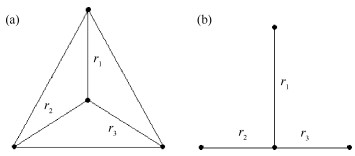 Fig. 1 Two configurations of the triple-electron Li HamiltonianNote: ri is the distances between the triple electrons and the nucleus, i=1, 2, 3.
(a)a triangle configuration; (b)a T-shape configuration 下载:
全尺寸图片
We also investigated IS of the triple-electron Li atom and found that the temporal decay of the triple electrons survival probability obeyed an algebraic law. The decay exponent of the triple-electron system is compared with the double-electron decay. In conclusion, the mechanism of the triple electrons decay and the algebraic law are discussed.
1. Results and discussions
1.1 The regulization Hamiltionian of the Li atom
The classical Hamiltonian of the Li atom with its nucleus and three electrons on one plane are expressed as
$$ h=\sum_{i=1}^3 \frac{p_i^2}{2}-\sum_{i=1}^3 \frac{Z}{r_i}+\sum_{i, j=1, i>j}^3 \frac{1}{\left|r_i-r_j\right|}, $$ (2) where ri is the distances between the triple electrons (labeled as 1, 2 and 3 as shown in figure 1)and the nucleus, i=1, 2, 3;pi is the corresponding conjugate momenta, i=1, 2, 3;Z is the nucleus charge.
However, the Hamiltonian in equation(2)is not convenient for further analysis due to the singularity at ri → 0. Also, the radius must be nonnegative, and this condition is not guaranteed by the Hamilton of equation(2). To avoid these problems, a new variable is introduced to regularize the Hamiltonian in equation(2)
$$ r_i=Q_i^2, p_i=\frac{P_i}{2 Q_i}, i=1, 2, 3 . $$ (3) Here Pi(note the captial letter)is the conjugate momentum of Qi. The singularity of the equations of motion of Qi = 0 is removed by forming a new Haimltonian(h-E)of zero value multiplied by an arbitrary function f of the coordinates Qi. The new Hamiltonian reads
$$ H \equiv(h-E) f \text {. } $$ (4) This canonical transformation is referred as regularization[12]. The arbitrary functions of the coordinates then introduces a new timescale, such that
$$ \mathrm{d} t=f \mathrm{~d} \tau, f=\frac{\left(Q_1 Q_2 Q_3\right)^2}{\left(Q_1 Q_2\right)^2+\left(Q_1 Q_3\right)^2+\left(Q_2 Q_3\right)^2} $$ (5) Using this new canonical transformation, the singularity-free triangle configuration for the Hamiltonian(as shown in figure 1)reads[9]
$$ \begin{aligned} & H_{\text {tri }}=\frac{P_1^2 Q_2^2 Q_3^2+P_2^2 Q_1^2 Q_3^2+P_3^2 Q_1^2 Q_2^2}{8\left(\left(Q_1 Q_2\right)^2+\left(Q_1 Q_3\right)^2+\left(Q_2 Q_3\right)^2\right)}-Z+ \\ & \left(\frac{1}{\sqrt{\left(Q_1^2+\frac{Q_2^2}{2}\right)^2+\frac{3 Q_2^2}{4}}}+\frac{1}{\sqrt{\left(Q_2^2+\frac{Q_3^2}{2}\right)^2+\frac{3 Q_3^2}{4}}}+\right. \\ & \left.\frac{1}{\sqrt{\left(Q_1^2+\frac{Q_3^2}{2}\right)^2+\frac{3 Q_3^3}{4}}}-E\right). \\ & \frac{\left(Q_1 Q_2 Q_3\right)^2}{\left(Q_1 Q_2\right)^2+\left(Q_1 Q_3\right)^2+\left(Q_2 Q_3\right)^2} \text {. } \end{aligned} $$ (6) Given the initial conditions, the dynamics of equation(6)can be obtained from the following equations of motion
$$ \frac{\mathrm{d} Q_i}{\mathrm{~d} \tau}=\frac{\partial H_{\text {tri }}}{\partial P_i}, \frac{\mathrm{d} P_i}{\mathrm{~d} \tau}=-\frac{\partial H_{\text {tri }}}{\partial Q_i}, i=1, 2, 3 . $$ (7) The Hamiltonian of the T-shaped configuration is provided in the supporting information.
1.2 The initial conditions
We use the half collision model[13] to represent the triple photoionization process and the highly triple-electron excited states from the Li ground state. The primary electron(1s electron)absorbs an photon near the nucleus[14], and due to the electronic correlation, the energy is redistributed among the three electrons, leading to triple photoionization over the threshold of the total energy of E > 0 and triple highly triple excited states of E < 0.
As for the initial conditions, we set the primary electron to absorb a photon near the nucleus($ r_1=\gamma_\omega^{-1 / 4}$, γω is the energy of the photon by atomic unit γω = E + I, where I is the ionization threshold, and E is excess energy of the system or by another word, the total energy of the system). Then we can approximate the second and third electrons as hydrogen ions with effective charges of Zi, where i = 2, 3. This approximation is chosen to reproduce the ionization potentials Ii, where i = 2, 3. For the second 1s electron, Z2 = 2.358(I2 = 2.78 au), and for the third 2s electron, Z3 = 1.259(I3 = 0.198 au). We number the pho-to-electron(generally which is 1s electron)as 1, the other 1s electron as 2 and the 2s electron as 3. Electron 2 and 3 satisfy the following equations
$$ p_i^2 / 2-Z_i / r_i=-I_i, i=2, 3 . $$ (8) For the canonical coordinates(Qi, Pi), this equation can be written as
$$ P_i^2 / 8-Z_i+I_i Q_i^2=0, i=2, 3 . $$ (9) Thus the Qi, Pi, = 2, 3 can be expressed by a variable parameter ηi, i = 2, 3, such as $ Q_i=\sqrt{Z_i / I_i} \cos \left(\eta_i\right), P_i=\sqrt{8 Z_i} \sin \left(\eta_i\right)$, and i = 2, 3. The Li triple-ionization threshold energy is I = 7.478 au[12]. For a given excess energy E, E will be positive for the triple photoionization above the energy threshold and will be negative for the triple highly excited states below the energy threshold, Then P1 is determined by total energy conservation of equation(6), so we can obtain different initial conditions by changing the parameter ηi, i = 2, 3, which are only two parameters to get the final state of the Hamiltonian equation(6)by motion of equation(7). For the triple-electron system, we fixed the configuration such that each electron is confined to one dimension motion, and three electrons need six coordinates(Qi, Pi, and i = 1, 2, 3)to describe their motions via equation (7). Using above skill for the choices of initial conditions, we can simplify the problem of multi-electrons systems, in addition, we would drastically decrease the hard computational time for the triple-electron system. Similarly, the initial conditions can be applied to the T-shape configuration.
1.3 Irregular scattering in the triple-electron system
For E < 0, IS of the triple electrons occur due to triple-electron resonances, which is analogous to IS in the double-electron chaotic system(see supporting information in part Ⅰ, and figure 5(b))[7, 15]. To locate the IS region of the triple electrons in chaotic lithium atom, two parameters of η2, η3 were scanned from $ \left(-\frac{\pi}{2}, \frac{\pi}{2}\right)$. figure 2(a)shows the final energy of the triple electrons(which are labeled as e1, e2, e3 corresponding to electron 1, 2, 3, respectively)of triangle configuration after 1 000 au. evolving time as a function of different initial conditions given by fixing η3 = − 0.736, and scanning η2 $ \subset$ (− 1.4, 1.4).(The IS region for the T-shape configuration is shown in figure 7(b) of the supporting information). Here, the x-axis represents η2, the y-axis is the final energies of the three electrons(ei, i =1, 2, 3). figure 2(a)shows the double-electron chaotic scattering, which is the most part of the region. In this part, only one electron's final energy changes smoothly, and this do not exchange energy with other two electrons. In contrast, the two remaining electrons will exchange the energy simultaneously. For example, in the region η2 $ \subset$ (− 1.4, 1.0), the e1 energy(black line)is positive and changes smoothly from 30 to 0 au, whereas e2 (red)and e3(green)oscillate from positive to negative and exchange energy simultaneously. When η2 in the region highlighted by a dashed black circle (− 0.976 3, − 0.973 6), the energy of e1 does not change smoothly. Contrarily, e1 exchanges energy with e2 and e3, and the triple electrons exchange energy simultaneously. All of them fluctuate together. The Ericsson region fluctuations like triple-electron IS is detailed in figure 2(b). The three electrons are strongly correlated with the Coulomb repulsion exchange energy in this IS region.
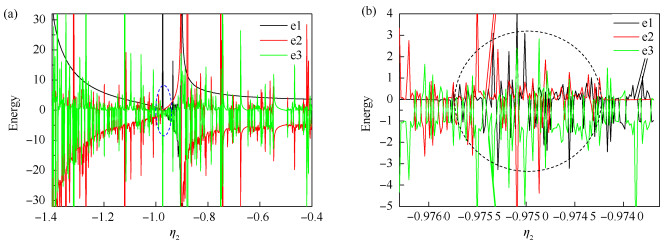 Fig. 2 Irregular scattering of triple electrons in lithium atom via the final energy diagram of electron(a)The final energy of triple different electrons in the triangle configuration after 1 000 au ionization time as a function of different initial conditions given by η3=−0.736 and η2 $ \subset$ (− 1.4, − 0.4), the excess energy of system E=−1 au; (b)Enlargement of the region η2 $ \subset$ (− 0.976 3, − 0.973 6) which shown triple electrons Ericson fluctuation like irregular scattering(IS)marked by the dotted circle in(a)下载:
全尺寸图片
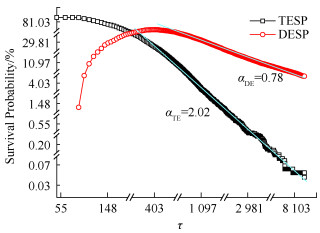 Fig. 3 Survival probability of triple electrons in the IS region of the equilateral triangle configuration as a function of time下载:
全尺寸图片
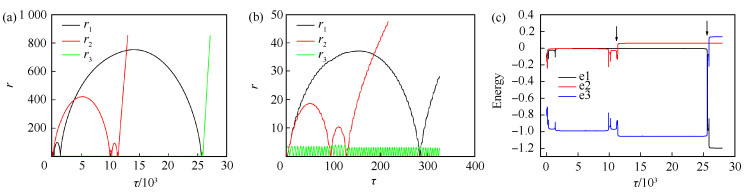 Fig. 4 Trajectory diagram of the triangle configuration(a)A typical long-lived trajectory of the triangle configuration evolves with time; (b)Enlargement of the initial part of the trajectory is shown in(a); (c)The energy of the triple-electron system is a function of time下载:
全尺寸图片
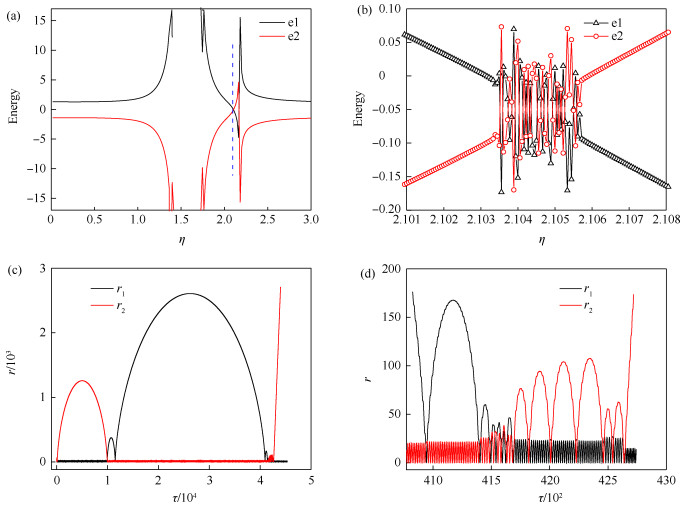 Fig. 5 The fluctuation region and the typical tangling trajectory in the region with the excess energy E =−0.1 au(a)The final energy of double electrons in the collinear configuration after 1 000 au ionization time as a function of different initial conditions given by η; (b)The amplification of the dashed line in(a); (c)A typical long-lived trajectory of the collinear configuration evolves with time; (d)Enlargement of the final part of the trajectory is shown in(c)下载:
全尺寸图片
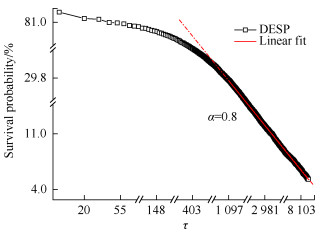 Fig. 6 Survival probability of double electrons in the IS region of the collinear configuration as a function of time shows the decay with algebraic law下载:
全尺寸图片
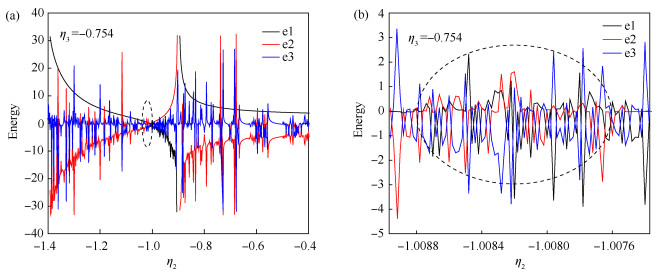 Fig. 7 Irregular scattering of triple electrons in lithium atom of T-shape configuration(As shown in figure 1)(a)The final energy of triple different electrons in the T-shape configuration after 1 000 au ionization time as a function of different initial conditions given by η3=−0.754 and η2 $ \subset$ (− 1.4, − 0.4). The excess energy of system E=−1 au; (b)Enlargement of the region η2 $ \subset$ (− 1.008 7, − 1.007 6) which shown triple electrons Ericson fluctuation like IS marked by the dotted circle in(a)下载:
全尺寸图片
Like the IS of double-electron He system(shown in supporting information in figure 5(a and b)), the three electrons are correlated with each other and the exchange energy electron impact with the nucleus and then transfer the energy to the other electrons. Such interactions among the triple electrons can be viewed via a typical chaotic trajectory of three electrons evolving with time shown in figure 4.
1.4 Algebraic decay of triple electrons
The triple-electron survival probability(TESP, PTE)is defined as the fraction of trajectories that have not led to single electron or double electrons ionization of Li after time τ as compared with the total number of trajectories from a given ensemble of initial conditions. In another word, none of the triple electrons is ionized, all of them survive together in the triple highly excited state of Li atom. However the survival probability of double-electron(DESP, PDE)is defined by the fraction of trajectories that have not led to the double electron ionization of Li after time τ as compared with the total initial number of trajectories. We selected 10 000 initial points in the very narrow region of IS, where η3 =−0.736, η2 $ \subset$(−0.976 3, −0.973 6) as shown in figure 2(b). The TESP and DESP as a function of time were shown in figure 3. It clearly shows that the TESP decays follow an algebraic law as equation(1)for τ > 400 au, the numerical fitting of TESP decay exponent αTE = 2.02. In addition, the DESP decays follow an algebraic law either, the DESP decay exponent αDE = 0.78. It is interesting that the Li atom DESP decay exponent is almost equal to the helium atom decay exponent(see figure 6 for supporting information). Both values are 0.8 approximately. The triple-electron Li system, can be understood by noticing that one electron is ionized, whereas the remaining two electrons interact as they evolve around the helium-like atom. One electron is near the nucleus and the other electron follow a Keplerian orbit of the atomic kernel with effective charge. This phenomenon of surviving triple electrons is just like the case shown in figure 4(a), in which the evolving time τ reaches 11 500 au, whereas e2 is ionized and the energy of e2 becomes positive(by the red line in figure 4(c)).e3 remains inside the atomic kernel, and e1 is in a Keplar orbit also bounded.
For the triple-electrons survival phenomenon, figure 4(a)clearly shows that a typical long-lived trajectory of the triangle configuration evolved with time τ. When the evolving time τ less than 11 500 au, it is clearly shown that two prominent Kepler orbits exist, One is e1 motion; the other is e2 motion. Both electrons follow the Kepler orbits around the e3 atomic kernel of the e3 electron and the nucleus. figure 4(b) shows the beginning of the trajectories enlargement as shown in figure 4(a). These triple electrons survive together for some periodic time, then decay to a double-electron system when one electron ionizes. Due the Coulomb interaction with the parent core, the outer electron oscillates and is recaptured by the parent ion into a Rydberg state. This phenomenon is like the frustrated ionization[16].
These observations of IS in triangle configuration is further confirmed by our analysis of the T-shape configuration that appears in the supporting information. Besides, the decay of TESP and DESP are similar to those found in the triangle configuration, and the TESP decay exponent of T-shape configuration is 2.12 and its DESP decay exponent is 0.83. Hence, we can conclude that a configurations-inde-pendent property of the TESP decay law is crucial for the IS region, in which the three electrons are strongly correlated each other. This configuration memory loss may be related to the resonance of three-electron system. Although the numerical fits of the decay exponent for the two configurations are not exactly the same, this discrepancy may be due to the difference in the screening effect when the outer electron is far from the atomic kernel. However, due to the complexity of the triple-electron motion, the explain of the decay law for the TESP remains a challenging problem.
2. Conclusion
The energy regime for the irregular scattering of the triple-electron Li atom was identified and we found that the triple electrons survival probability followed the algebraic decay law. It was demonstrated that the TESP of the triangle configuration decays follow an algebraic law with a decay exponent αTE = 2.02. In addition, its DESP decays follow an algebraic law with a decay exponent αDE = 0.78 either. The TESP decay exponent is nearly triple times of DESP. This difference may be attribute to the two Kepler motions obtained from the triple-electron system. The interactions between the triple electrons in the IS region are mediated by Coulomb repulsion. By comparing the two main configurations of the Li atom(triangle and T-shape), we found that the TESP algebraic decay law was almost independent of the geometric configuration. These observations hint that the resonance of triple electrons in the IS region play very important role on the algebraic decaying process. This research may provide one effective way for studying the correlations and resonances of multielectrons in the IS region of the multi-electron atom.
-
Fig. 1 Two configurations of the triple-electron Li Hamiltonian
Note: ri is the distances between the triple electrons and the nucleus, i=1, 2, 3.
(a)a triangle configuration; (b)a T-shape configuration下载:
全尺寸图片
Fig. 2 Irregular scattering of triple electrons in lithium atom via the final energy diagram of electron
(a)The final energy of triple different electrons in the triangle configuration after 1 000 au ionization time as a function of different initial conditions given by η3=−0.736 and η2 $ \subset$ (− 1.4, − 0.4), the excess energy of system E=−1 au; (b)Enlargement of the region η2 $ \subset$ (− 0.976 3, − 0.973 6) which shown triple electrons Ericson fluctuation like irregular scattering(IS)marked by the dotted circle in(a)
下载:
全尺寸图片
Fig. 3 Survival probability of triple electrons in the IS region of the equilateral triangle configuration as a function of time
下载:
全尺寸图片
Fig. 4 Trajectory diagram of the triangle configuration
(a)A typical long-lived trajectory of the triangle configuration evolves with time; (b)Enlargement of the initial part of the trajectory is shown in(a); (c)The energy of the triple-electron system is a function of time
下载:
全尺寸图片
Fig. 5 The fluctuation region and the typical tangling trajectory in the region with the excess energy E =−0.1 au
(a)The final energy of double electrons in the collinear configuration after 1 000 au ionization time as a function of different initial conditions given by η; (b)The amplification of the dashed line in(a); (c)A typical long-lived trajectory of the collinear configuration evolves with time; (d)Enlargement of the final part of the trajectory is shown in(c)
下载:
全尺寸图片
Fig. 6 Survival probability of double electrons in the IS region of the collinear configuration as a function of time shows the decay with algebraic law
下载:
全尺寸图片
Fig. 7 Irregular scattering of triple electrons in lithium atom of T-shape configuration(As shown in figure 1)
(a)The final energy of triple different electrons in the T-shape configuration after 1 000 au ionization time as a function of different initial conditions given by η3=−0.754 and η2 $ \subset$ (− 1.4, − 0.4). The excess energy of system E=−1 au; (b)Enlargement of the region η2 $ \subset$ (− 1.008 7, − 1.007 6) which shown triple electrons Ericson fluctuation like IS marked by the dotted circle in(a)
下载:
全尺寸图片
-
[1] BLÜMEL R, SMILANSKY U. Classical irregular scattering and its quantum-mechanical implications[J]. Physical Review Letters, 1988, 60(6): 477. doi: 10.1103/PhysRevLett.60.477 [2] BOHIGAS O, GIANNONI M J, SCHMIT C. Characterization of chaotic quantum spectra and universality of level fluctuation laws[J]. Physical Review Letters, 1984, 52(1): 1. doi: 10.1103/PhysRevLett.52.1 [3] KARNEY C F F. Long-time correlations in the stochastic regime[J]. Physica D, 1983, 8(3): 360-380. doi: 10.1016/0167-2789(83)90232-4 [4] CHANNON S R, LEBOWITZ J L. Numerical experiments in stochasticity and homoclinic oscillation[J]. Annals of the New York Academy of Sciences, 1980, 357 (1): 108. doi: 10.1111/j.1749-6632.1980.tb29680.x [5] VENEGEROLES R. Universality of algebraic laws in Hamiltonian systems[J]. Physical Review Letters, 2009, 102(6): 064101. doi: 10.1103/PhysRevLett.102.064101 [6] KRÜGER T S, GALUZIO P P, PRADO T L, et al. Mechanism for stickiness suppression during extreme events in Hamiltonian systems[J]. Physical Review E, 2015, 91(6): 062903. doi: 10.1103/PhysRevE.91.062903 [7] ROST J M, WINTGEN D. What happens to twoelectron resonances when their energy approaches the break-up threshold?[J]. Europhysics Letters, 1996, 35 (1): 19-24. doi: 10.1209/epl/i1996-00524-7 [8] SCHLAGHECK P, BUCHLEITNER A. Algebraic decay of the survival probability in chaotic helium[J]. Physical Review A, 2001, 63(2): 024701. doi: 10.1103/PhysRevA.63.024701 [9] EMMANOUILIDOU A, WANG P J, ROST J M. Initial state dependence in multielectron threshold ionization of atoms[J]. Physical Review Letters, 2008, 100(6): 063002. doi: 10.1103/PhysRevLett.100.063002 [10] COLGAN J, EMMANOUILIDOU A, PINDZOLA M S. Evidence for a T-shape break-up pattern in the triple photoionization of Li[J]. Physical Review Letters, 2013, 110(6): 063001. doi: 10.1103/PhysRevLett.110.063001 [11] REN X G, DORN A, ULLRICH J. Coulomb four-body problem: electron-impact double ionization of helium in the threshold regime[J]. Physical Review Letters, 2008, 101(9): 093201. doi: 10.1103/PhysRevLett.101.093201 [12] EMMANOUILIDOU A, ROST J M. The Coulomb fourbody problem in a classical framework: triple photoionization of lithium[J]. Journal of Physics B (Atomic, Molecular and Optical Physics), 2006, 39 (20): 4037. doi: 10.1088/0953-4075/39/20/003 [13] SCHNEIDER T, ROST J M. Double photoionization of two-electron atoms based on the explicit separation of dominant ionization mechanisms[J]. Physical Review A, 2003, 67(6): 062704. doi: 10.1103/PhysRevA.67.062704 [14] KABIR P K, SALPETER E E. Radiative corrections to the ground-state energy of the helium atom[J]. Physical Review Journals Archive, 1957, 108(5): 1256. [15] MADDEN R P, CODLING K. New autoionizing atomic energy levels in He, Ne, and Ar[J]. Physical Review Letters, 1963, 10(12): 516. doi: 10.1103/PhysRevLett.10.516 [16] NUBBEMEYER T, GORLING K, SAENZ A, et al. Strong-field tunneling without ionization[J]. Physical Review Letters, 2008, 101(23): 233001. doi: 10.1103/PhysRevLett.101.233001 [17] RICHTER K, TANNER G, WINTGEN D. Classical mechanics of two-electron atoms[J]. Physical Review A, 1993, 48(6): 4182. doi: 10.1103/PhysRevA.48.4182
