

BF-weak ideals and BF-strong ideals in non-involutive residuated lattices
-
摘要: 对非对合剩余格的双极值模糊理想(简称BF-理想)问题进行了研究。引入了非对合剩余格的BF-弱理想和BF-强理想的概念,给出了二者的若干性质和等价刻画。讨论了BF-弱理想、BF-理想和BF-强理想的关系。利用BF-弱理想和BF-强理想的性质给出了强剩余格的特征定理。指明了在强剩余格中,BF-弱理想、BF-理想和BF-强理想三者相互等价。Abstract: This paper studies the problem of bipolar fuzzy ideals(BF-ideals for short) in non-involutive residuated lattices. The notions of BF-weak ideals and BF-strong ideals are introduced in non-involutive residuated lattices. Some their properties and characterizations are given. The relations among BF-weak ideals, BF-ideals and BF-strong ideals are discussed systematically. And the characterization theorems of strong residuated lattices are obtained by using BF-weak ideals and BF-strong ideals. It is showed that in strong residuated lattices the notions of BF-weak ideal, BF-ideal and BF-strong ideal are same.
-
Keywords:
- fuzzy logic /
- non-involutive residuated lattice /
- BF-ideal /
- BF-weak ideal /
- BF-strong ideal
-
0. 引言
模糊逻辑是一门基于数学基础理论和计算机科学应用的全新交叉学科。模糊逻辑代数分析是模糊逻辑的一个重要的研究课题,代数方法的合理运用为模糊逻辑理论的快速发展注入了强大的动力。在各种形式的模糊逻辑代数中,剩余格是一类广受理论界关注的典型代表,关于剩余格结构分析的理论成果更是十分丰富[2-4]。模糊集理论是模糊逻辑概念形成和发展的理论基础,是由控制论专家Zadeh[5]于1965年成功创立,至今,模糊集理论的应用已经遍布在诸如模糊控制、模式识别、模糊决策和优化等人类生产生活的方方面面。然而,随着理论体系的日益完善以及应用领域的不断拓展,学者们日益明确地意识到,模糊集理论虽然深刻改变了人们的传统二值观念,但是却明显忽视了对事物两极性的考量。1994年,Zhang[6]鉴于这一缺陷将不相容的两极性思想引入模糊集理论研究提出了双极值模糊集(bipolar fuzzy sets)概念,简称BF-集,成功对模糊集概念进行了有效的突破和拓展;1975年,Zadeh对这一工作给予了高度赞扬和充分肯定[7]。自此,人们对BF-集理论及其应用的研究日益活跃,涌现出了一批既具理论价值又具推广前景的研究成果[8-16],其中,文献[13-16]充分体现了BF-集思想在半群、$ \mathrm{N}\left(2, \mathrm{ }2, \mathrm{ }0\right) $代数和布尔代数等抽象代数和逻辑代数结构研究的可行性。受其启发,考虑到剩余格在模糊逻辑代数领域的基础性地位,文献[17-20]将BF-集的思想和运算方法应用于非对合剩余格理想问题的研究,提出了BF-理想概念并系统考察了其性质,建立非对合剩余格理想问题的研究框架。本文在非对合剩余格中引入BF-弱理想和BF-强理想概念并考察它们的性质、刻画、关系及应用,获得了一些有意义的结论。
1. 预备知识
定义1.1[1] 设$ \left(L, \le , \wedge , \vee , \odot , \to , \mathrm{0, 1}\right) $是$ \left(\mathrm{2, 2}, \mathrm{2, 2}, \mathrm{0, 0}\right) $型代数,如果下列3个条件成立:
(RL1) $ \left(L, \wedge , \vee , \mathrm{0, 1}\right) $是一个有界格,其中,$ 0 $和$ 1 $分别是其最小元和最大元;
(RL2) $ \left(L, \odot , 1\right) $是一个有单位元$ 1 $的幺半群;
(RL3) $ \left(\odot , \to \right) $是$ L $上的一个伴随对,即($ \forall x, y, z\in L, $ $ x\odot y\le z\iff x\le y\to z $),那么称$ \left(L, \le , \wedge , \vee , \odot , \to , \mathrm{0, 1}\right) $是一个剩余格,简称$ L $是一个剩余格。
定义1.2[3] 设$ L $是一个剩余格,定义$ L $上的一元运算$ \mathrm{*}:L\to L $使$ \forall x\in L $,$ {x}^{\mathrm{*}}=x\to 0 $。若存在$ x\in L $使得$ {x}^{\mathrm{*}\mathrm{*}}\ne x $,则称$ L $是一个非对合剩余格。
定义1.3[2] 设$ L $是一个剩余格,如果对任意的$ x\in L $都有$ {\left({x}^{\mathrm{*}\mathrm{*}}\to x\right)}^{\mathrm{*}\mathrm{*}}=1 $,则称$ L $是一个强剩余格。
引理1.1[2-4] 设$ L $是非对合剩余格,$ \forall x, y, z\in L $,则下列各结论成立:
(RL4) $ x\le y\iff x\to y=1 \text{;} $
(RL5) $ 1\to x=x $且$ x\to 1=1 $且$ x\to x=1 $;
(RL6) $ z\to y\le \left(x\to z\right)\to \left(x\to y\right) $且$ z\to y\le \left(y\to x\right)\to \left(z\to x\right) $;
(RL7) $ x\le y\to x $且$ x\vee y\le \left(x\to y\right)\to y $;
(RL8) $ \left(\left(x\to y\right)\to y\right)\to y=x\to y \text{;} $
(RL9) 如果$ x\le y $,那么$ z\to x\le z\to y $且$ y\to z\le x\to z $;
(RL10) $ x\le y\Rightarrow x\odot z\le y\odot z \text{;} $
(RL11) $ x\to \left(y\to z\right)=y\to \left(x\to z\right)=x\odot y\to z \text{;} $
(RL12) $ x\le y\Rightarrow {y}^{\mathrm{*}}\le {x}^{\mathrm{*}}\Rightarrow {x}^{\mathrm{*}\mathrm{*}}\le {y}^{\mathrm{*}\mathrm{*}} \text{;} $
(RL13) $ (x \rightarrow y) \odot(y \rightarrow z) \leqslant x \rightarrow z \text {; } $
(RL14) $ x\odot \left(x\to y\right)\le y $且$ x\le {x}^{\mathrm{*}}\to y $;
(RL15) $ {x}^{\mathrm{*}\mathrm{*}}\odot {y}^{\mathrm{*}\mathrm{*}}\le {\left(x\odot y\right)}^{\mathrm{*}\mathrm{*}} $且$ {x}^{\mathrm{*}\mathrm{*}}\to {y}^{\mathrm{*}\mathrm{*}}\ge {\left(x\to y\right)}^{\mathrm{*}\mathrm{*}} $;
(RL16) $ x\le {x}^{\mathrm{*}\mathrm{*}} $且$ {x}^{\mathrm{*}\mathrm{*}\mathrm{*}}={x}^{\mathrm{*}} $且$ x\odot {x}^{\mathrm{*}}=0 $;
(RL17) $ {\left(x\to {y}^{\mathrm{*}}\right)}^{\mathrm{*}\mathrm{*}}=x\to {y}^{\mathrm{*}}=y\to {x}^{\mathrm{*}}={\left(x\odot y\right)}^{\mathrm{*}}; $
(RL18) $ {\left(x\to {y}^{\mathrm{*}\mathrm{*}}\right)}^{\mathrm{*}\mathrm{*}}=x\to {y}^{\mathrm{*}\mathrm{*}} 。 $
定义1.4[3] 设$ L $是非对合剩余格,$ \mathrm{\varnothing }\ne I\subseteq L。 $称$ I $是$ L $的一个理想。如果$ I $满足:
(Id1) $ 0\in I \text{;} $
(Id2) 对任意的$ x, y\in L $,$ x\in I $且$ {\left({x}^{\mathrm{*}}\to {y}^{\mathrm{*}}\right)}^{\mathrm{*}}\in I $蕴涵$ y\in I $。
由$ L $的全体理想构成的集合记为$ \mathrm{I}\mathrm{d}\left(L\right) $。
注1.1[3] 设$ L $是非对合剩余格,则
(1) $ \left\{0\right\}\in \mathrm{I}\mathrm{d}\left(L\right) $且$ L\in \mathrm{I}\mathrm{d}\left(L\right) $;
(2) $ {\left\{{I}_{\lambda }\right\}}_{\lambda \in \mathrm{\Lambda }}\subseteq \mathrm{I}\mathrm{d}\left(L\right)\Rightarrow \underset{\lambda \in \mathrm{\Lambda }}{\cap }{I}_{\lambda }\in \mathrm{I}\mathrm{d}\left(L\right) $,即$ \mathrm{I}\mathrm{d}\left(L\right) $对集合的任意交封闭。
对任意的$ a, b\in \left[0, \mathrm{ }1\right] $ $ \left(\mathrm{或}\left[-1, \mathrm{ }0\right]\right) $,分别用$ a\wedge b $和$ a\vee b $表示$ \mathrm{m}\mathrm{i}\mathrm{n}\left(a, b\right) $和$ \mathrm{m}\mathrm{a}\mathrm{x}\left(a, b\right) $。设集合$ X\ne \mathrm{\varnothing } $,记$ {J}_{\left[0, \mathrm{ }1\right]}=\left\{{\mu }^{P}|{\mu }^{P}:X\to \left[0, \mathrm{ }1\right]\right\} $和$ {J}_{\left[-1, \mathrm{ }0\right]}=\left\{{\mu }^{N}|{\mu }^{N}:X\to \left[-1, \mathrm{ }0\right]\right\} $,任取$ f, g\in {J}_{\left[0, \mathrm{ }1\right]} $(或$ {J}_{\left[-1, \mathrm{ }0\right]} $),定义二元关系$ ⋐ $满足:$ f⋐g\iff f\left(x\right)\le g\left(x\right), \mathrm{ }\forall x\in X $。
定义1.5[11] 设$ X $是一个非空集合(论域),对任意的$ {\mu }_{A}^{P}\in {J}_{\left[0, \mathrm{ }1\right]} $和$ {\mu }_{A}^{N}\in {J}_{\left[-1, \mathrm{ }0\right]} $,称
$$ A=\left\{〈x, {\mu }_{A}^{P}\left(x\right), {\mu }_{A}^{N}\left(x\right)〉|x\in X\right\} $$ 是$ X $上的一个双BF-集,简记为$ A=〈{\mu }_{A}^{P}, {\mu }_{A}^{N}〉 $。其中:$ {\mu }_{A}^{P}:X\to \left[0, \mathrm{ }1\right] $称为$ A $的正隶属度函数,$ {\mu }_{A}^{P}\left(x\right) $表示$ X $中元素$ x $关于双极值模糊集$ A $对某种性质的满足度;$ {\mu }_{A}^{N}:X\to \left[-1, \mathrm{ }\mathrm{ }\mathrm{ }\mathrm{ }\mathrm{ }\mathrm{ }0\right] $称为$ A $负隶属函数,$ {\mu }_{A}^{N}\left(x\right) $表示$ X $中元素$ x $关于双极值模糊集$ A $对这种性质的相反性质的满足度。由集合$ X $上的双极值模糊集全体构成的集合记为$ \mathrm{B}\mathrm{F}\mathrm{S}\left(X\right) $。
设$ A=〈{\mu }_{A}^{P}, {\mu }_{A}^{N}〉,B=〈{\mu }_{B}^{P}, {\mu }_{B}^{N}〉\in \mathrm{B}\mathrm{F}\mathrm{S}\left(X\right) $,定义$ \mathrm{B}\mathrm{F}\mathrm{S}\left(X\right) $上的二元关系$ ⊑ $满足
$$ A⊑B\iff {\mu }_{A}^{P}⋐{\mu }_{B}^{P}\mathrm{且}{\mu }_{A}^{N}⋑{\mu }_{B}^{N} \text{,} $$ 显然,$ ⊑ $是$ \mathrm{B}\mathrm{F}\mathrm{S}\left(X\right) $上的一个偏序关系。
设$ Y\subseteq X $,定义$ {\chi }_{Y}=〈{\chi }_{Y}^{P}, {\chi }_{Y}^{N}〉\in \mathrm{B}\mathrm{F}\mathrm{S}\left(X\right) $满足:$ \forall x\in X $,
$ {\chi }_{Y}^{P}\left(x\right)=\left\{\begin{array}{l}1, x\in Y, \\ 0, x\notin Y, \end{array}\right. $且$ {\chi }_{Y}^{N}\left(x\right)=\left\{\begin{array}{l}-1, x\in Y, \\ 0, x\notin Y, \end{array}\right. $
称之为$ Y $的双极值特征函数。
定义1.6[17] 设$ L $是非对合剩余格,$ A=〈{\mu }_{A}^{P}, {\mu }_{A}^{N}〉\in $ $ \mathrm{B}\mathrm{F}\mathrm{S}\left(L\right) $。$ \forall x, y\in L $,如果$ A $满足:
(BFI1) $ {\mu }_{A}^{P}\left(0\right)\ge {\mu }_{A}^{P}\left(x\right) $且$ {\mu }_{A}^{N}\left(0\right)\le {\mu }_{A}^{N}\left(x\right) $,
(BFI2) $ {\mu }_{A}^{P}\left(y\right)\ge {\mu }_{A}^{P}\left(x\right)\wedge {\mu }_{A}^{P}\left({\left({x}^{\mathrm{*}}\to {y}^{\mathrm{*}}\right)}^{\mathrm{*}}\right) $且$ {\mu }_{A}^{N}\left(y\right)\le {\mu }_{A}^{N}\left(x\right)\vee $ $ {\mu }_{A}^{N}\left({\left({x}^{\mathrm{*}}\to {y}^{\mathrm{*}}\right)}^{\mathrm{*}}\right) $,
则称$ A $是$ L $的一个双极值模糊理想,简称BF-理想。由$ L $的BF-理想全体构成的集合记为$ \mathrm{B}\mathrm{F}\mathrm{I}\left(L\right) $。
引理1.2[17] 设$ L $是非对合剩余格,$ A=〈{\mu }_{A}^{P}, {\mu }_{A}^{N}〉\in $ $ \mathrm{B}\mathrm{F}\mathrm{I}\left(L\right) $。则$ A $满足:$ \forall x, y\in L $,
(BFI3) $ x\le y\Rightarrow \left({\mu }_{A}^{P}\left(y\right)\le {\mu }_{A}^{P}\left(x\right)\mathrm{且}{\mu }_{A}^{N}\left(y\right)\ge {\mu }_{A}^{N}\left(x\right)\right) 。 $
2. 非对合剩余格的BF-弱理想和BF-强理想
定义2.1 设$ L $是非对合剩余格,$ A=〈{\mu }_{A}^{P}, {\mu }_{A}^{N}〉\in $ $ \mathrm{B}\mathrm{F}\mathrm{S}\left(L\right) $。若$ A $满足(BFI1)且对任意的$ x, y\in L $,$ {\mu }_{A}^{P}\left(x\right)\ge {\mu }_{A}^{P}\left(y\right)\wedge {\mu }_{A}^{P}\left({\left(x\to y\right)}^{\mathrm{*}}\right) $且$ {\mu }_{A}^{N}\left(x\right)\le {\mu }_{A}^{N}\left(y\right)\vee $ $ {\mu }_{A}^{N}\left({\left(x\to y\right)}^{\mathrm{*}}\right) $,则称$ A $是$ L $的双极值模糊弱理想,简称为BF-弱理想。由$ L $的BF-弱理想全体构成的集合记为$ \mathrm{W}\mathrm{B}\mathrm{F}\mathrm{I}\left(L\right) $。
定理2.1 设$ L $是非对合剩余格,$ A=〈{\mu }_{A}^{P}, {\mu }_{A}^{N}〉\in \mathrm{W}\mathrm{B}\mathrm{F}\mathrm{I}\left(L\right) $,则$ A $满足(BFI3)。
证明 对任意$ x, y\in L $,设$ x\le y $,则由(RL4)得$ {\left(x\to y\right)}^{\mathrm{*}}={1}^{\mathrm{*}}=0 $,故由(WBFI)和(BFI1)得
$$ \begin{gathered} \mu_A^P(x) \geqslant \mu_A^P(y) \wedge \mu_A^P\left((x \rightarrow y)^*\right)=\mu_A^P(y) \wedge \mu_A^P(0)= \\ \mu_A^P(y), \end{gathered} $$ $$ \begin{gathered} \mu_A^N(x) \leqslant \mu_A^N(y) \vee \mu_A^N\left((x \rightarrow y)^*\right)=\mu_A^N(y) \vee \mu_A^N(0)= \\ \mu_A^N(y), \end{gathered} $$ 因此,$ A $满足(BFI3)。
定理2.2 设$ L $是非对合剩余格,$ \mathrm{B}\mathrm{F}\mathrm{I}\left(L\right)\subseteq $ $ \mathrm{W}\mathrm{B}\mathrm{F}\mathrm{I}\left(L\right) $。
证明 设$ A=〈{\mu }_{A}^{P}, {\mu }_{A}^{N}〉\in \mathrm{B}\mathrm{F}\mathrm{I}\left(L\right) $,则由定义1.6和引理1.2得$ A $满足(BFI1)~(BFI3)。对任意的$ x, y\in L $,因为$ x\to y\le {y}^{\mathrm{*}}\to {x}^{\mathrm{*}} $,所以$ {\left({y}^{\mathrm{*}}\to {x}^{\mathrm{*}}\right)}^{\mathrm{*}}\le {\left(x\to y\right)}^{\mathrm{*}} $,从而由(BFI3)得$ {\mu }_{A}^{P}\left({\left({y}^{\mathrm{*}}\to {x}^{\mathrm{*}}\right)}^{\mathrm{*}}\right)\ge {\mu }_{A}^{P}\left({\left(x\to y\right)}^{\mathrm{*}}\right) $且$ {\mu }_{A}^{N}\left({\left({y}^{\mathrm{*}}\to {x}^{\mathrm{*}}\right)}^{\mathrm{*}}\right)\le {\mu }_{A}^{N}\left({\left(x\to y\right)}^{\mathrm{*}}\right) $,再由(BFI2)便得
$$ {\mu }_{A}^{P}\left(x\right)\ge {\mu }_{A}^{P}\left(y\right)\wedge {\mu }_{A}^{P}\left({\left({y}^{\mathrm{*}}\to {x}^{\mathrm{*}}\right)}^{\mathrm{*}}\right)\ge {\mu }_{A}^{P}\left(y\right)\wedge {\mu }_{A}^{P}\left({\left(x\to y\right)}^{\mathrm{*}}\right) \text{,} $$ $$ {\mu }_{A}^{N}\left(x\right)\le {\mu }_{A}^{N}\left(y\right)\vee {\mu }_{A}^{N}\left({\left({y}^{\mathrm{*}}\to {x}^{\mathrm{*}}\right)}^{\mathrm{*}}\right)\le {\mu }_{A}^{N}\left(y\right)\vee {\mu }_{A}^{N}\left({\left(x\to y\right)}^{\mathrm{*}}\right) 。 $$ 因此$ A=〈{\mu }_{A}^{P}, {\mu }_{A}^{N}〉\in \mathrm{W}\mathrm{B}\mathrm{F}\mathrm{I}\left(L\right) $。
注2.1 下面的例子表明定理2.2的逆命题不真,即非对合剩余格的BF-弱理想不必是BF-理想。
例2.1 设格$ L=\left\{0, a, b, c, \mathrm{ }1\right\} $且$ 0 < a < b < c < 1 $,定义$ L $上二元运算“$ \to $”和“$ \odot $”如表 1所示,
表 1 L上二元运算“→”和“⊙”的定义→ 0 a b c 1 ⊙ 0 a b c 1 0 1 1 1 1 1 0 0 0 0 0 0 a c 1 1 1 1 a 0 0 0 0 a b c c 1 1 1 b 0 0 0 0 b c b b b 1 1 c 0 0 0 c c 1 0 a b c 1 1 0 a b c 1 且$ \forall x\in L $,$ {x}^{\mathrm{*}}=x\to 0 $。则$ \left(L, \le , \wedge , \vee , \odot , \to , \mathrm{0, 1}\right) $是非对合剩余格。定义$ A=〈{\mu }_{A}^{P}, {\mu }_{A}^{N}〉\in \mathrm{B}\mathrm{F}\mathrm{S}\left(L\right) $满足:
$$ {\mu }_{A}^{P}\left(x\right)=\left\{\begin{array}{l}0.8, x=0, a, \\ 0.3, x=b, c, 1, \end{array}\right.\mathrm{且}{\mu }_{A}^{N}\left(x\right)=\left\{\begin{array}{l}-0.7, x=0, a, \\ -0.4, x=b, c, \mathrm{ }1, \end{array}\right. $$ 可验证$ A\in \mathrm{W}\mathrm{B}\mathrm{F}\mathrm{I}\left(L\right) $,但$ A\notin \mathrm{B}\mathrm{F}\mathrm{I}\left(L\right) $。这是因为
$$ \begin{gathered} \mu_A^P(b)=0.3<0.8=\mu_A^P(a) \wedge \mu_A^P\left(\left(a^* \rightarrow b^*\right)^*\right)= \\ \mu_A^P(a) \wedge \mu_A^P\left((c \rightarrow c)^*\right)=\mu_A^P(a) \wedge \mu_A^P(0), \end{gathered} $$ $$ \begin{gathered} \mu_A^N(b)=-0.4>-0.7=\mu_A^N(a) \vee \mu_A^N\left(\left(a^* \rightarrow b^*\right)^*\right)= \\ \mu_A^N(a) \vee \mu_A^N\left((c \rightarrow c)^*\right)=\mu_A^N(a) \vee \mu_A^N(0)_{\circ} \end{gathered} $$ 定义2.2 设$ L $是非对合剩余格,$ A=〈{\mu }_{A}^{P}, {\mu }_{A}^{N}〉\in $ $ \mathrm{B}\mathrm{F}\mathrm{I}\left(L\right) $。若$ A $满足:$ \forall x, y\in L $,
(SBFI1) $ {\mu }_{A}^{P}\left({\left({x}^{\mathrm{*}\mathrm{*}}\to x\right)}^{\mathrm{*}}\right)={\mu }_{A}^{P}\left(0\right) $且$ {\mu }_{A}^{N}\left({\left({x}^{\mathrm{*}\mathrm{*}}\to x\right)}^{\mathrm{*}}\right)={\mu }_{A}^{N}\left(0\right) $,
则称$ A $是$ L $的双极值模糊强理想,简称为BF-强理想。由$ L $的BF-强理想全体构成的集合记为$ \mathrm{S}\mathrm{B}\mathrm{F}\mathrm{I}\left(L\right) $。
例2.2 设格$ L=\left\{0, a, b, c, \mathrm{ }1\right\} $且其Hasse图如图 1所示,定义$ L $上二元运算“$ \to $”和“$ \odot $”如表 2所示,
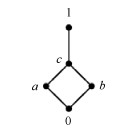 图 1 格L的 Hasse 图
 下载:
全尺寸图片
表 2 L上二元运算“→”和“⊙”的定义
→ 0 a b c 1 ⊙ 0 a b c 1 0 1 1 1 1 1 0 0 0 0 0 0 a b 1 b 1 1 a 0 a 0 a a b a a 1 1 1 b 0 0 b b b c 0 a b 1 1 c 0 a b c c 1 0 a b c 1 1 0 a b c 1 且$ \forall x\in L $,$ {x}^{\mathrm{*}}=x\to 0 $。则$ \left(L, \le , \wedge , \vee , \odot , \to , \mathrm{0, 1}\right) $是非对合剩余格。定义$ A=〈{\mu }_{A}^{P}, {\mu }_{A}^{N}〉\in \mathrm{B}\mathrm{F}\mathrm{S}\left(L\right) $满足
$$ {\mu }_{A}^{P}\left(x\right)=\left\{\begin{array}{l}0.8, x=0, \\ 0.6, x=a, \\ 0.3, x=b, c, 1, \end{array}\right.\mathrm{且}{\mu }_{A}^{N}\left(x\right)=\left\{\begin{array}{l}-0.9, x=0, \\ -0.7, x=a, \\ -0.4, x=b, c, \mathrm{ }1, \end{array}\right. $$ 可以验证$ A\in \mathrm{S}\mathrm{B}\mathrm{F}\mathrm{I}\left(L\right) $。
定理2.3 设$ L $是非对合剩余格,$ \forall x, y\in L $,$ A=〈{\mu }_{A}^{P}, {\mu }_{A}^{N}〉\in $ $ \mathrm{B}\mathrm{F}\mathrm{I}\left(L\right) $。则$ A\in \mathrm{S}\mathrm{B}\mathrm{F}\mathrm{I}\left(L\right) $当且仅当$ A $满足如下的(SBFI2)~(SBFI4)3个条件之一:
(SBFI2) $ {\mu }_{A}^{P}\left({\left(\left(y\to {x}^{\mathrm{*}\mathrm{*}}\right)\to {\left(y\to x\right)}^{\mathrm{*}\mathrm{*}}\right)}^{\mathrm{*}}\right)={\mu }_{A}^{P}\left(0\right) $且$ {\mu }_{A}^{N}\left({\left(\left(y\to {x}^{\mathrm{*}\mathrm{*}}\right)\to {\left(y\to x\right)}^{\mathrm{*}\mathrm{*}}\right)}^{\mathrm{*}}\right)={\mu }_{A}^{N}\left(0\right) $;
(SBFI3) $ {\mu }_{A}^{P}\left({\left(\left(x\to y\right)\to {\left({x}^{\mathrm{*}\mathrm{*}}\to y\right)}^{\mathrm{*}\mathrm{*}}\right)}^{\mathrm{*}}\right)={\mu }_{A}^{P}\left(0\right) $且$ {\mu }_{A}^{N}\left({\left(\left(x\to y\right)\to {\left({x}^{\mathrm{*}\mathrm{*}}\to y\right)}^{\mathrm{*}\mathrm{*}}\right)}^{\mathrm{*}}\right)={\mu }_{A}^{N}\left(0\right) $;
(SBFI4) $ {\mu }_{A}^{P}\left({\left(\left({x}^{\mathrm{*}}\to y\right)\to {\left({y}^{\mathrm{*}}\to x\right)}^{\mathrm{*}\mathrm{*}}\right)}^{\mathrm{*}}\right)={\mu }_{A}^{P}\left(0\right) $且$ {\mu }_{A}^{N}\left({\left(\left({x}^{\mathrm{*}}\to y\right)\to {\left({y}^{\mathrm{*}}\to x\right)}^{\mathrm{*}\mathrm{*}}\right)}^{\mathrm{*}}\right)={\mu }_{A}^{N}\left(0\right) $。
证明 (1)$ A\in \mathrm{S}\mathrm{B}\mathrm{F}\mathrm{I}\left(L\right)\iff A $满足(SBFI2):设$ A\in \mathrm{S}\mathrm{B}\mathrm{F}\mathrm{I}\left(L\right) $,对任意的$ x, y\in L $,因为由(RL16)得$ y\to x\le {\left(y\to x\right)}^{**} $,所以由(RL6)和(RL9)得
$$ \begin{gathered} x^{* *} \rightarrow x \leqslant\left(y \rightarrow x^{* *}\right) \rightarrow(y \rightarrow x) \leqslant \\ \left(y \rightarrow x^{* *}\right) \rightarrow(y \rightarrow x)^{* *}, \end{gathered} $$ 从而再由(RL12)得$ {\left(\left(y\to {x}^{\mathrm{*}\mathrm{*}}\right)\to {\left(y\to x\right)}^{\mathrm{*}\mathrm{*}}\right)}^{\mathrm{*}}\le {\left({x}^{\mathrm{*}\mathrm{*}}\to x\right)}^{\mathrm{*}} $,由(BFI3)和(SBFI1)得
$$ {\mu }_{A}^{P}\left({\left(\left(y\to {x}^{\mathrm{*}\mathrm{*}}\right)\to {\left(y\to x\right)}^{\mathrm{*}\mathrm{*}}\right)}^{\mathrm{*}}\right)\ge {\mu }_{A}^{P}\left({\left({x}^{\mathrm{*}\mathrm{*}}\to x\right)}^{\mathrm{*}}\right)={\mu }_{A}^{P}\left(0\right) \text{,} $$ $$ {\mu }_{A}^{N}\left({\left(\left(y\to {x}^{\mathrm{*}\mathrm{*}}\right)\to {\left(y\to x\right)}^{\mathrm{*}\mathrm{*}}\right)}^{\mathrm{*}}\right)\le {\mu }_{A}^{N}\left({\left({x}^{\mathrm{*}\mathrm{*}}\to x\right)}^{\mathrm{*}}\right)={\mu }_{A}^{N}\left(0\right) \text{,} $$ 于是再由(BFI1)便得
$$ \begin{aligned} & \mu_A^P\left(\left(\left(y \rightarrow x^{* *}\right) \rightarrow(y \rightarrow x)^{* *}\right)^*\right)=\mu_A^P(0), \\ & \mu_A^N\left(\left(\left(y \rightarrow x^{* *}\right) \rightarrow(y \rightarrow x)^{* *}\right)^*\right)=\mu_A^N(0)。 \end{aligned} $$ 因此,$ A $满足(SBFI2)。
反之,设$ A $满足(SBFI2)。对任意$ x\in L $,在(SBFI2)中令$ y={x}^{\mathrm{*}\mathrm{*}} $,则由(RL5)和(RL16)得
$$ \begin{gathered} \mu_A^P(0)=\mu_A^P\left(\left(\left(x^{* *} \rightarrow x^{* *}\right) \rightarrow\left(x^{* *} \rightarrow x\right)^{* *}\right)^*\right)= \\ \mu_A^P\left(\left(1 \longrightarrow\left(x^{* *} \longrightarrow x\right)^{* *}\right)^*\right)=\mu_A^P\left(\left(x^{* *} \longrightarrow x\right)^{* * *}\right)= \\ \mu_A^P\left(\left(x^{* *} \longrightarrow x\right)^*\right), \end{gathered} $$ $$ \begin{gathered} \mu_A^N(0)=\mu_A^N\left(\left(\left(x^{* *} \rightarrow x^{* *}\right) \rightarrow\left(x^{* *} \rightarrow x\right)^{* *}\right)\right)= \\ \mu_A^N\left(\left(1 \rightarrow\left(x^{* *} \rightarrow x\right)^{* *}\right)^*\right)=\mu_A^N\left(\left(x^{* *} \rightarrow x\right)^{* * *}\right)= \\ \mu_A^N\left(\left(x^{* *} \longrightarrow x\right)^*\right), \end{gathered} $$ 即,$ A $满足(SBFI1),因此,由定理2.2得$ A\in \mathrm{S}\mathrm{B}\mathrm{F}\mathrm{I}\left(L\right) $。
(2) $ A\in \mathrm{S}\mathrm{B}\mathrm{F}\mathrm{I}\left(L\right)\iff A $满足(SBFI3):设$ A\in \mathrm{S}\mathrm{B}\mathrm{F}\mathrm{I}\left(L\right) $,对任意的$ x, y\in L $,因为由(RL16)得$ {x}^{\mathrm{*}\mathrm{*}}\to y\le {\left({x}^{\mathrm{*}\mathrm{*}}\to y\right)}^{\mathrm{*}\mathrm{*}} $,所以由(RL6)和(RL9)得
$$ \begin{gathered} x^{* *} \rightarrow x \leqslant(x \rightarrow y) \rightarrow\left(x^{* *} \rightarrow y\right) \leqslant \\ (x \rightarrow y) \rightarrow\left(x^{* *} \rightarrow y\right)^{* *}, \end{gathered} $$ 从而再由(RL12)得$ {\left(\left(x\to y\right)\to {\left({x}^{\mathrm{*}\mathrm{*}}\to y\right)}^{\mathrm{*}\mathrm{*}}\right)}^{\mathrm{*}}\le {\left({x}^{\mathrm{*}\mathrm{*}}\to x\right)}^{\mathrm{*}} $,故由(BFI3)和(SBFI1)得
$$ {\mu }_{A}^{P}\left({\left(\left(x\to y\right)\to {\left({x}^{\mathrm{*}\mathrm{*}}\to y\right)}^{\mathrm{*}\mathrm{*}}\right)}^{\mathrm{*}}\right)\ge {\mu }_{A}^{P}\left({\left({x}^{\mathrm{*}\mathrm{*}}\to x\right)}^{\mathrm{*}}\right)={\mu }_{A}^{P}\left(0\right) \text{,} $$ $$ {\mu }_{A}^{N}\left({\left(\left(x\to y\right)\to {\left({x}^{\mathrm{*}\mathrm{*}}\to y\right)}^{\mathrm{*}\mathrm{*}}\right)}^{\mathrm{*}}\right)\le {\mu }_{A}^{N}\left({\left({x}^{\mathrm{*}\mathrm{*}}\to x\right)}^{\mathrm{*}}\right)={\mu }_{A}^{N}\left(0\right) \text{,} $$ 于是再由(BFI1)便得
$ {\mu }_{A}^{P}\left({\left(\left(x\to y\right)\to {\left({x}^{\mathrm{*}\mathrm{*}}\to y\right)}^{\mathrm{*}\mathrm{*}}\right)}^{\mathrm{*}}\right)={\mu }_{A}^{P}\left(0\right) $且
$ {\mu }_{A}^{N}\left({\left(\left(x\to y\right)\to {\left({x}^{\mathrm{*}\mathrm{*}}\to y\right)}^{\mathrm{*}\mathrm{*}}\right)}^{\mathrm{*}}\right)={\mu }_{A}^{N}\left(0\right) $。
因此,$ A $满足(SBFI3)。
反之,设$ A $满足(SBFI3)。对任意$ x\in L $,在(SBFI3)中令$ y=x $,则由(RL5)和(RL16)得
$$ \begin{array}{c} {\mu }_{A}^{P}\left(0\right)={\mu }_{A}^{P}\left({\left(\left(x\to x\right)\to {\left({x}^{\mathrm{*}\mathrm{*}}\to x\right)}^{\mathrm{*}\mathrm{*}}\right)}^{\mathrm{*}}\right)= \\ {\mu }_{A}^{P}\left({\left(1\to {\left({x}^{\mathrm{*}\mathrm{*}}\to x\right)}^{\mathrm{*}\mathrm{*}}\right)}^{\mathrm{*}}\right)={\mu }_{A}^{P}\left({\left({x}^{\mathrm{*}\mathrm{*}}\to x\right)}^{\mathrm{*}\mathrm{*}\mathrm{*}}\right)= \\ {\mu }_{A}^{P}\left({\left({x}^{\mathrm{*}\mathrm{*}}\to x\right)}^{\mathrm{*}}\right) \text{,} \end{array}$$ $$ \begin{array}{c}{\mu }_{A}^{N}\left(0\right)={\mu }_{A}^{N}\left({\left(\left(x\to x\right)\to {\left({x}^{\mathrm{*}\mathrm{*}}\to x\right)}^{\mathrm{*}\mathrm{*}}\right)}^{\mathrm{*}}\right)= \\ {\mu }_{A}^{N}\left({\left(1\to {\left({x}^{\mathrm{*}\mathrm{*}}\to x\right)}^{\mathrm{*}\mathrm{*}}\right)}^{\mathrm{*}}\right)={\mu }_{A}^{N}\left({\left({x}^{\mathrm{*}\mathrm{*}}\to x\right)}^{\mathrm{*}\mathrm{*}\mathrm{*}}\right)= \\ {\mu }_{A}^{N}\left({\left({x}^{\mathrm{*}\mathrm{*}}\to x\right)}^{\mathrm{*}}\right) \text{,}\end{array}$$ 即,$ A $满足(SBFI1),因此,由定义2.2得$ A\in \mathrm{S}\mathrm{B}\mathrm{F}\mathrm{I}\left(L\right) $。
(3) $ A\in \mathrm{S}\mathrm{B}\mathrm{F}\mathrm{I}\left(L\right)\iff A $满足(SBFI4):设$ A\in \mathrm{S}\mathrm{B}\mathrm{F}\mathrm{I}\left(L\right) $,对任意的$ x, y\in L $,因为由(RL13)得$ {x}^{\mathrm{*}\mathrm{*}}={x}^{\mathrm{*}}\to 0\ge \left({x}^{\mathrm{*}}\to y\right)\odot \left(y\to 0\right)=\left({x}^{\mathrm{*}}\to y\right)\odot {y}^{\mathrm{*}} $且由(RL6)得$ {y}^{\mathrm{*}}\to x\le {\left({y}^{\mathrm{*}}\to x\right)}^{\mathrm{*}\mathrm{*}} $,所以由(RL6)和(RL11)得
$$ \begin{gathered} x^{* *} \rightarrow x \leqslant\left(x^* \rightarrow y\right) \odot y^* \rightarrow x \leqslant \\ \left(x^* \rightarrow y\right) \rightarrow\left(y^* \rightarrow x\right) \leqslant\left(x^* \rightarrow y\right) \rightarrow\left(y^* \rightarrow x\right)^{* *}, \end{gathered} $$ 从而再由(RL12)得$ {\left(\left({x}^{\mathrm{*}}\to y\right)\to {\left({y}^{\mathrm{*}}\to x\right)}^{\mathrm{*}\mathrm{*}}\right)}^{\mathrm{*}}\le {\left({x}^{\mathrm{*}\mathrm{*}}\to x\right)}^{\mathrm{*}} $,故由(BFI3)和(SBFI1)得
$$ {\mu }_{A}^{P}\left({\left(\left({x}^{\mathrm{*}}\to y\right)\to {\left({y}^{\mathrm{*}}\to x\right)}^{\mathrm{*}\mathrm{*}}\right)}^{\mathrm{*}}\right)\ge {\mu }_{A}^{P}\left({\left({x}^{\mathrm{*}\mathrm{*}}\to x\right)}^{\mathrm{*}}\right)={\mu }_{A}^{P}\left(0\right) \text{,} $$ $$ {\mu }_{A}^{N}\left({\left(\left({x}^{\mathrm{*}}\to y\right)\to {\left({y}^{\mathrm{*}}\to x\right)}^{\mathrm{*}\mathrm{*}}\right)}^{\mathrm{*}}\right)\le {\mu }_{A}^{N}\left({\left({x}^{\mathrm{*}\mathrm{*}}\to x\right)}^{\mathrm{*}}\right)={\mu }_{A}^{N}\left(0\right) \text{,} $$ 于是再由(BFI1)便得
$$ \begin{aligned} & \mu_A^P\left(\left(\left(x^* \rightarrow y\right) \rightarrow\left(y^* \rightarrow x\right)^{* *}\right)^*\right)=\mu_A^P(0), \\ & \mu_A^N\left(\left(\left(x^* \rightarrow y\right) \rightarrow\left(y^* \rightarrow x\right)^{* *}\right)^*\right)=\mu_A^N(0)。 \end{aligned} $$ 因此,$ A $满足(SBFI4)。
反之,设$ A $满足(SBFI2)。对任意$ x\in L $,在(SBFI2)中令$ y={x}^{\mathrm{*}} $,则由(RL5)和(RL16)得
$$ \begin{gathered} \mu_A^P(0)=\mu_A^P\left(\left(\left(x^* \rightarrow x^*\right) \rightarrow\left(x^{* *} \rightarrow x\right)^{* *}\right)^*\right)= \\ \mu_A^P\left(\left(1 \rightarrow\left(x^{* *} \rightarrow x\right)^{* *}\right)^*\right)=\mu_A^P\left(\left(x^{* *} \rightarrow x\right)^{* * *}\right)= \\ \mu_A^P\left(\left(x^{* *} \rightarrow x\right)^*\right), \end{gathered} $$ $$ \begin{gathered} \mu_A^N(0)=\mu_A^N\left(\left(\left(x^* \rightarrow x^*\right) \rightarrow\left(x^{* *} \rightarrow x\right)^{* *}\right)\right)= \\ \mu_A^N\left(\left(1 \rightarrow\left(x^{* *} \rightarrow x\right)^{* *}\right)^*\right)=\mu_A^N\left(\left(x^{* *} \rightarrow x\right)^{* * *}\right)= \\ \mu_A^N\left(\left(x^{* *} \rightarrow x\right)^*\right), \end{gathered} $$ 即,$ A $满足(SBFI1),因此,由定理2.2得$ A\in \mathrm{S}\mathrm{B}\mathrm{F}\mathrm{I}\left(L\right) $。
定理2.4 设$ L $是一个非对合剩余格,$ A=〈{\mu }_{A}^{P}, {\mu }_{A}^{N}〉,B=〈{\mu }_{B}^{P}, {\mu }_{B}^{N}〉\in \mathrm{B}\mathrm{F}\mathrm{I}\left(L\right) $。如果$ A⊑B $,$ {\mu }_{A}^{P}\left(0\right)={\mu }_{B}^{P}\left(0\right) $,$ {\mu }_{A}^{N}\left(0\right)={\mu }_{B}^{N}\left(0\right) $且$ A\in \mathrm{S}\mathrm{B}\mathrm{F}\mathrm{I}\left(L\right) $,则$ B\in \mathrm{S}\mathrm{B}\mathrm{F}\mathrm{I}\left(L\right) $。
证明 对任意的$ x\in L $,由$ A⊑B $,$ {\mu }_{A}^{P}\left(0\right)={\mu }_{B}^{P}\left(0\right) $,$ {\mu }_{A}^{N}\left(0\right)={\mu }_{B}^{N}\left(0\right) $且$ A\in \mathrm{S}\mathrm{B}\mathrm{F}\mathrm{I}\left(L\right) $得
$$ {\mu }_{B}^{P}\left(0\right)={\mu }_{A}^{P}\left(0\right)={\mu }_{A}^{P}\left({\left({x}^{\mathrm{*}\mathrm{*}}\to x\right)}^{\mathrm{*}}\right)\le {\mu }_{B}^{P}\left({\left({x}^{\mathrm{*}\mathrm{*}}\to x\right)}^{\mathrm{*}}\right) \text{,} $$ $$ {\mu }_{B}^{N}\left(0\right)={\mu }_{A}^{N}\left(0\right)={\mu }_{A}^{N}\left({\left({x}^{\mathrm{*}\mathrm{*}}\to x\right)}^{\mathrm{*}}\right)\ge {\mu }_{B}^{N}\left({\left({x}^{\mathrm{*}\mathrm{*}}\to x\right)}^{\mathrm{*}}\right) 。 $$ 又因为$ B\in \mathrm{B}\mathrm{F}\mathrm{I}\left(L\right) $,所以由(BFI1)又得$ {\mu }_{B}^{P}\left(0\right)\ge {\mu }_{B}^{P}\left({\left({x}^{\mathrm{*}\mathrm{*}}\to x\right)}^{\mathrm{*}}\right) $且$ {\mu }_{B}^{N}\left(0\right)\le {\mu }_{B}^{N}\left({\left({x}^{\mathrm{*}\mathrm{*}}\to x\right)}^{\mathrm{*}}\right) $,从而便得$ {\mu }_{A}^{P}\left({\left({x}^{\mathrm{*}\mathrm{*}}\to x\right)}^{\mathrm{*}}\right)={\mu }_{A}^{P}\left(0\right) $且$ {\mu }_{A}^{N}\left({\left({x}^{\mathrm{*}\mathrm{*}}\to x\right)}^{\mathrm{*}}\right)={\mu }_{A}^{N}\left(0\right) $。因此,由定义2.2便得$ B\in \mathrm{S}\mathrm{B}\mathrm{F}\mathrm{I}\left(L\right) $。
注2.2 设$ L $是非对合剩余格,则由定义2.2知$ \mathrm{S}\mathrm{B}\mathrm{F}\mathrm{I}\left(L\right)\subseteq \mathrm{B}\mathrm{F}\mathrm{I}\left(L\right) $。但是$ \mathrm{B}\mathrm{F}\mathrm{I}\left(L\right)⊈\mathrm{S}\mathrm{B}\mathrm{F}\mathrm{I}\left(L\right) $,即BF-理想不必是BF-强理想。
例如,设$ L $是例2.1中所给非对合剩余格,定义$ A=〈{\mu }_{A}^{P}, {\mu }_{A}^{N}〉\in \mathrm{B}\mathrm{F}\mathrm{S}\left(L\right) $满足
$$ {\mu }_{A}^{P}\left(x\right)=\left\{\begin{array}{l}0.7, x=0, \\ 0.4, x=a, b, c, 1, \end{array}\right.\mathrm{且}{\mu }_{A}^{N}\left(x\right)=\left\{\begin{array}{l}-0.8, x=0, \\ -0.3, x=a, b, c, \mathrm{ }1, \end{array}\right. $$ 可以验证$ A\in \mathrm{B}\mathrm{F}\mathrm{I}\left(L\right) $。但是$ A\notin \mathrm{S}\mathrm{B}\mathrm{F}\mathrm{I}\left(L\right) $,这是因为
$$ {\mu }_{A}^{P}\left({\left({a}^{\mathrm{*}\mathrm{*}}\to a\right)}^{\mathrm{*}}\right)={\mu }_{A}^{P}\left(b\right)=0.4\ne 0.7={\mu }_{A}^{P}\left(0\right) \text{,} $$ $$ {\mu }_{A}^{N}\left({\left({a}^{\mathrm{*}\mathrm{*}}\to a\right)}^{\mathrm{*}}\right)={\mu }_{A}^{N}\left(b\right)=0.4\ne 0.7={\mu }_{A}^{N}\left(0\right) 。 $$ 定理2.5(强剩余格的特征定理Ⅰ) 设$ L $是非对合剩余格,则下列各陈述等价:
(1) $ L $是强剩余格;
(2) $ L $的任一BF-理想都是BF-强理想;
(3) $ {\chi }_{\left\{0\right\}}=〈{\chi }_{\left\{0\right\}}^{P}, {\chi }_{\left\{0\right\}}^{N}〉\in \mathrm{S}\mathrm{B}\mathrm{F}\mathrm{I}\left(L\right) 。 $
证明 (1)$ \Rightarrow $(2):设$ L $是强剩余格且$ A=〈{\mu }_{A}^{P}, {\mu }_{A}^{N}〉\in \mathrm{B}\mathrm{F}\mathrm{I}\left(L\right) $,则对任意的$ x\in L $,由定义1.3得$ {\left({x}^{\mathrm{*}\mathrm{*}}\to x\right)}^{\mathrm{*}\mathrm{*}}=1 $,从而由(RL16)得$ {\left({x}^{\mathrm{*}\mathrm{*}}\to x\right)}^{\mathrm{*}}={\left({x}^{\mathrm{*}\mathrm{*}}\to x\right)}^{\mathrm{*}\mathrm{*}\mathrm{*}}={1}^{\mathrm{*}}=0 $。故
$ {\mu }_{A}^{P}\left({\left({x}^{\mathrm{*}\mathrm{*}}\to x\right)}^{\mathrm{*}}\right)={\mu }_{A}^{P}\left(0\right) $且$ {\mu }_{A}^{N}\left({\left({x}^{\mathrm{*}\mathrm{*}}\to x\right)}^{\mathrm{*}}\right)={\mu }_{A}^{N}\left(0\right) $,
故$ A $满足(SBFI1)。因此,由定义2.2便得$ A\in \mathrm{S}\mathrm{B}\mathrm{F}\mathrm{I}\left(L\right) $。
(2) $ \Rightarrow $(3):因为由文献[16]中定理2.5得$ {\chi }_{\left\{0\right\}}\in \mathrm{B}\mathrm{F}\mathrm{I}\left(L\right) $,所以由(2)得$ {\chi }_{\left\{0\right\}}\in \mathrm{S}\mathrm{B}\mathrm{F}\mathrm{I}\left(L\right) $。
(3) $ \Rightarrow $(1):设$ {\chi }_{\left\{0\right\}}=〈{\chi }_{\left\{0\right\}}^{P}, {\chi }_{\left\{0\right\}}^{N}〉\in \mathrm{S}\mathrm{B}\mathrm{F}\mathrm{I}\left(L\right) $,则由定义2.2得
$ {\mu }_{{\chi }_{\left\{0\right\}}}^{P}\left({\left({x}^{\mathrm{*}\mathrm{*}}\to x\right)}^{\mathrm{*}}\right)={\mu }_{{\chi }_{\left\{0\right\}}}^{P}\left(0\right)=1 $且
$ {\mu }_{{\chi }_{\left\{0\right\}}}^{N}\left({\left({x}^{\mathrm{*}\mathrm{*}}\to x\right)}^{\mathrm{*}}\right)={\mu }_{{\chi }_{\left\{0\right\}}}^{N}\left(0\right)= $-1,
从而$ {\left({x}^{\mathrm{*}\mathrm{*}}\to x\right)}^{\mathrm{*}}=0 $,故$ {\left({x}^{\mathrm{*}\mathrm{*}}\to x\right)}^{\mathrm{*}\mathrm{*}}={1}^{\mathrm{*}}=0 $。因此,由定义1.3知$ L $是强剩余格。
定理2.6 设$ L $是强剩余格,则$ \mathrm{B}\mathrm{F}\mathrm{I}\left(L\right)=\mathrm{W}\mathrm{B}\mathrm{F}\mathrm{I}\left(L\right) $。
证明 设$ L $是强剩余格,则对任意$ x\in L $,$ {\left({x}^{\mathrm{*}\mathrm{*}}\to x\right)}^{\mathrm{*}\mathrm{*}}=1 $。因为由定理2.1知$ \mathrm{B}\mathrm{F}\mathrm{I}\left(L\right)\subseteq $ $ \mathrm{W}\mathrm{B}\mathrm{F}\mathrm{I}\left(L\right) $,所以只需证$ \mathrm{W}\mathrm{B}\mathrm{F}\mathrm{I}\left(L\right)\subseteq \mathrm{B}\mathrm{F}\mathrm{I}\left(L\right) $。设$ A=〈{\mu }_{A}^{P}, {\mu }_{A}^{N}〉\in \mathrm{W}\mathrm{B}\mathrm{F}\mathrm{I}\left(L\right) $,对任意$ x, y\in L $,因为
$$ \begin{gathered} (y \rightarrow x)^* \rightarrow\left(x^* \rightarrow y^*\right)^*=\left((y \rightarrow x)^* \rightarrow\left(x^* \rightarrow y^*\right)^{* *}=\right. \\ \left(\left(x^* \rightarrow y^*\right) \rightarrow(y \rightarrow x)^{* *}\right)^{* *}= \\ \left(\left(y \rightarrow x^{* *}\right) \rightarrow(y \rightarrow x)^{* *}\right)^{* *} \geqslant \\ \left(\left(y \rightarrow x^{* *}\right) \rightarrow(y \rightarrow x)\right)^{* *} \geqslant \\ \left(x^{* *} \rightarrow x\right)^{* *}=1, \end{gathered} $$ 所以$ {\left({\left(y\to x\right)}^{\mathrm{*}}\to {\left({x}^{\mathrm{*}}\to {y}^{\mathrm{*}}\right)}^{\mathrm{*}}\right)}^{\mathrm{*}}={1}^{\mathrm{*}}=0 $,故由(WBFI)和(BFI1)得
$$ \begin{gathered} \mu_A^P(y) \geqslant \mu_A^P(x) \wedge \mu_A^P\left((y \rightarrow x)^*\right) \geqslant \\ \mu_A^P(x) \wedge\left[\mu_A^P\left(\left(x^* \rightarrow y^*\right)\right) \wedge \mu_A^P\left(\left((y \rightarrow x)^* \rightarrow\left(x^* \rightarrow y^*\right)^*\right)\right)\right]= \\ \mu_A^P(x) \wedge \mu_A^P\left(\left(x^* \rightarrow y^*\right)\right) \wedge \mu_A^P(0)= \\ \mu_A^P(x) \wedge \mu_A^P\left(\left(x^* \rightarrow y^*\right)\right), \end{gathered} $$ $$ \begin{gathered} \mu_A^N(y) \leqslant \mu_A^N(x) \vee \mu_A^N\left((y \rightarrow x)^*\right) \leqslant \\ \mu_A^N(x) \vee\left[\mu_A^N\left(\left(x^* \rightarrow y^*\right)\right) \vee \mu_A^N\left(\left((y \rightarrow x)^* \rightarrow\left(x^* \rightarrow y^*\right)^*\right)^*\right)\right]= \\ \mu_A^N(x) \vee \mu_A^N\left(\left(x^* \rightarrow y^*\right)\right) \vee \mu_A^N(0)= \\ \mu_A^N(x) \vee \mu_A^N\left(\left(x^* \rightarrow y^*\right)\right), \end{gathered} $$ 即$ A $是(BFI2)。由定义1.4便得$ A\in \mathrm{B}\mathrm{F}\mathrm{I}\left(L\right) $。
定理2.7(强剩余格的特征定理Ⅱ) 设$ L $是非对合剩余格,则下列各陈述等价:
(1) $ L $是强剩余格;
(2) $ L $的任一BF-弱理想都是BF-强理想;
(3) $ {\chi }_{\left\{0\right\}}=〈{\chi }_{\left\{0\right\}}^{P}, {\chi }_{\left\{0\right\}}^{N}〉\in \mathrm{S}\mathrm{B}\mathrm{F}\mathrm{I}\left(L\right) 。 $
证明 由定理2.5和定理2.6立即可得。
注2.3 设格$ L $是强剩余格,则由定理2.2、定义2.2、定理2.5、定理2.6和定理2.7可知,BF-弱理想、BF-理想和BF-强理想三者是等同的概念,即$ \mathrm{W}\mathrm{B}\mathrm{F}\mathrm{I}\left(L\right)=\mathrm{B}\mathrm{F}\mathrm{I}\left(L\right)=\mathrm{S}\mathrm{B}\mathrm{F}\mathrm{I}\left(L\right) $。
例2.3 设格$ L=\left\{0, a, b, c, \mathrm{ }1\right\} $且$ 0 < a < b < c < 1 $,定义$ L $上二元运算“$ \to $”和“$ \odot $”如表 3:
表 3 L上二元运算“→”和“⊙”的定义→ 0 a b c 1 ⊙ 0 a b c 1 0 1 1 1 1 1 0 0 0 0 0 0 a b 1 1 1 1 a 0 0 0 a a b a a 1 1 1 b 0 0 b b b c 0 a b 1 1 c 0 a b c c 1 0 a b c 1 1 0 a b c 1 且$ \forall x\in L $,$ {x}^{\mathrm{*}}=x\to 0 $。则$ \left(L, \le , \wedge , \vee , \odot , \to , \mathrm{0, 1}\right) $是一个强剩余格。可验证$ \mathrm{W}\mathrm{B}\mathrm{F}\mathrm{I}\left(L\right)=\mathrm{B}\mathrm{F}\mathrm{I}\left(L\right)=\mathrm{S}\mathrm{B}\mathrm{F}\mathrm{I}\left(L\right) $。
3. 结束语
本文引入了非对合剩余格的BF-弱理想和BF-强理想的概念,获得了若干性质和等价刻画。系统讨论了BF-弱理想、BF-理想和BF-强理想三者间的关系,指明在强剩余格中BF-理想与BF-强理想是相互等价的。同时,利用BF-弱理想和BF-强理想的性质给出了强剩余格的特征定理。这些工作不但使非对合剩余格的BF-理想理论之研究内容得到进一步充实和丰富,而且也为利用理想概念研究其他多种逻辑代数的结构提供了方法和技术上的支持。后续还将持续关注非对合剩余格上的诸如BF-布尔理想、BF-关联理想、BF-交换理想和BF-素理想等多种特殊类型BF-理想概念的引入和性质特征的揭示,以期为推动非对合剩余格的双极值模糊理想理论研究及应用推广做出贡献。
-
图 1 格L的 Hasse 图
下载:
全尺寸图片
表 1 L上二元运算“→”和“⊙”的定义
→ 0 a b c 1 ⊙ 0 a b c 1 0 1 1 1 1 1 0 0 0 0 0 0 a c 1 1 1 1 a 0 0 0 0 a b c c 1 1 1 b 0 0 0 0 b c b b b 1 1 c 0 0 0 c c 1 0 a b c 1 1 0 a b c 1 表 2 L上二元运算“→”和“⊙”的定义
→ 0 a b c 1 ⊙ 0 a b c 1 0 1 1 1 1 1 0 0 0 0 0 0 a b 1 b 1 1 a 0 a 0 a a b a a 1 1 1 b 0 0 b b b c 0 a b 1 1 c 0 a b c c 1 0 a b c 1 1 0 a b c 1 表 3 L上二元运算“→”和“⊙”的定义
→ 0 a b c 1 ⊙ 0 a b c 1 0 1 1 1 1 1 0 0 0 0 0 0 a b 1 1 1 1 a 0 0 0 a a b a a 1 1 1 b 0 0 b b b c 0 a b 1 1 c 0 a b c c 1 0 a b c 1 1 0 a b c 1 -
[1] WARD M, DILWORTH R P. Residuated lattices[J]. Transactions of the American Mathematical Society, 1939, 45: 335-354. doi: 10.1090/S0002-9947-1939-1501995-3 [2] HAJEK P. Metamathematics of fuzzy logic[M]. Dordrecht: Kluwer Academic Publishers, 1998. [3] 刘春辉. 否定非对合剩余格的LI-理想理论[J]. 高校应用数学学报(A辑), 2015, 30(4): 445-456. https://www.cnki.com.cn/Article/CJFDTOTAL-GXYZ201504008.htm [4] LIU Y, QIN Y, QIN X Y, et al. Ideals and fuzzy ideals on residuated lattices[J]. International Journal of Machine Learning and Cybernetics, 2017, 8(1): 239-253. doi: 10.1007/s13042-014-0317-2 [5] ZADEH L A. Fuzzy sets[J]. Information and Control, 1965, 8(3): 338-353. doi: 10.1016/S0019-9958(65)90241-X [6] ZHANG W R. Bipolar fuzzy sets and relations: a computational framework for cognitive modeling and multiagent decision analysis[C]//Anon. Nafips/ifis/nasa 94 First International Joint Conference of the North American Fuzzy Information Processing Society Bi Conference the Industrial Fuzzy Control & Intellige. Hawaii: IEEE, 2002. [7] ZHANG W R. Yin Yang bipolar relativity: a unifying theory of nature, agents and causality wihth applications in quantum computing, cogintive informatics and lift sciences[M]. Hershey: International Academic Publisher, 2011. [8] LEE K M. Bipolar-valued fuzzy sets and their operations[C]//Anon. International Conference on Intelligent Technologies. Bangkok Thailand: Springer, 2000. [9] AKRAM M. Bipolar fuzzy graphs[J]. Information Sciences, 2011, 181(24): 5548-5564. doi: 10.1016/j.ins.2011.07.037 [10] MAHMOOD K, HAYAT K. Characterizations of Hemirings by their bipolar-valued fuzzy h-ideals[J]. Information Sciences Letters, 2015, 4(2): 51-59. http://pdfs.semanticscholar.org/62bc/6b1df5c2da4f71321d50f6a3fff5e4f90797.pdf [11] 索南仁欠, 华毛加. 双极值模糊集的距离与相似性测度[J]. 青海师范大学学报(自然科学版), 2020, 36(3): 1-5. doi: 10.3969/j.issn.1001-7542.2020.03.001 [12] 王金英, 王艳平. 双极值犹豫模糊软集及其在决策中的应用[J]. 模糊系统与数学, 2020, 34(4): 145-155. https://www.cnki.com.cn/Article/CJFDTOTAL-MUTE202004016.htm [13] 王丰效. 半群的(λ, μ)-双极值模糊子半群[J]. 宁夏大学学报(自然科学版), 2020, 41(1): 23-26+32. doi: 10.3969/j.issn.0253-2328.2020.01.005 [14] 王丰效. N(2, 2, 0)代数的双极值模糊理想[J]. 山西师范大学学报(自然科学版), 2017, 31(3): 26-29. https://www.cnki.com.cn/Article/CJFDTOTAL-SFDX201703025.htm [15] 姜曼, 彭家寅. 布尔代数的I-V犹豫模糊子代数[J]. 黑龙江大学自然科学学报, 2021, 38(2): 157-163. https://www.cnki.com.cn/Article/CJFDTOTAL-HLDZ202102005.htm [16] 姜曼. 布尔代数的乘积型双极值模糊点理想[J]. 首都师范大学学报(自然科学版), 2022, 43(4): 15-18. https://www.cnki.com.cn/Article/CJFDTOTAL-SDSX202204003.htm [17] 刘春辉, 李玉毛, 张海燕. 否定非对合剩余格的双极值模糊理想[J]. 山东大学学报(理学版), 2019, 54(9): 88-98. https://www.cnki.com.cn/Article/CJFDTOTAL-SDDX201909005.htm [18] 刘春辉. 否定非对合剩余格的双极值模糊素理想[J]. 山东大学学报(理学版), 2019, 54(11): 71-80. https://www.cnki.com.cn/Article/CJFDTOTAL-SDDX201911007.htm [19] LIU C H. Uniform topological spaces based on BFideals in negative non-inwolutive residuated lattice[J]. Electronic Notes in Theoretical Computer Science, 2019, 345: 113-124. [20] LIU C H. Normal bipolar fuzzy ideals in non-involutive residuated lattices[J]. Journal of Mathematical Research with Applications, 2020, 40(5): 441-452.